Type your hotel's name into Google and look at the right-hand side of the results, or the top of them on a phone. If a box appears with your name, a map, your photos, your rating, your address, and a tidy summary of what you are, then Google understands your property as a thing in the world. If nothing appears, or if what appears is thin, wrong, or belongs to a business with a similar name three states away, then to Google your hotel is not really a thing at all. It is just a string of characters that happens to appear on some web pages. And in 2026, the difference between being a thing and being a string is close to the difference between being findable and being invisible.
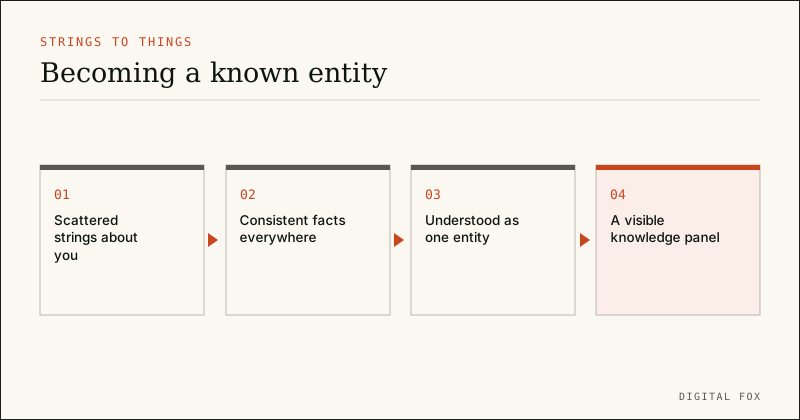
This is the part of SEO that hotel marketing has almost entirely skipped, because it does not look like SEO. There are no keywords in it, no meta descriptions to tweak, no blog posts to publish. It is about whether the systems that now mediate search, both Google and the AI assistants, hold a clear, correct, connected understanding of your property as a distinct entity: what it is, where it is, what it contains, what it relates to, and why it can be trusted. Search stopped being about matching words years ago. It became about understanding things. Most hotels are still optimizing for the old game.
So this guide is about the new one. What an entity actually is and why the shift from strings to things changed everything. How search engines and AI models build their understanding of your hotel, and where that understanding comes from. How to earn and shape a knowledge panel. How entity clarity has quietly become one of the strongest drivers of whether an AI assistant will confidently recommend you. And the specific, unglamorous work of making your property legible as a thing, which turns out to be some of the highest-leverage SEO available to an independent hotel precisely because so few of them do it.
From strings to things.
For most of its history, a search engine was fundamentally a string-matching machine. You typed words, it found pages containing those words or close variants, and it ranked them. SEO, accordingly, was largely about words: putting the right ones on the right pages in the right density and earning links with the right anchor text. That world is gone, and it has been gone longer than most hotel marketing has noticed.
The shift was deliberate and public. Google moved toward understanding search in terms of entities: distinct, identifiable things, people, places, organizations, concepts, and the relationships between them. Rather than merely matching the letters in "boutique hotel near the harbor," the system tries to understand that you are asking about a type of lodging entity, in a particular place, near a particular geographic feature, and to reason about which specific hotel entities satisfy that. The knowledge that powers this reasoning is held in a vast structured store, a graph of entities and their attributes and connections, and being a recognized, well-described node in that graph is what it now means to genuinely exist in search.
An entity, in this sense, is not a web page and not a keyword. It is a thing the system knows about, with a stable identity, a set of attributes, and a web of relationships. Your hotel, ideally, is an entity: a lodging business, with a name, a location, a star level, a set of amenities, a parent brand or independent status, a neighborhood, a set of nearby landmarks, a restaurant it contains, reviews attached to it, and connections to its city and region. When the system has that model of you, it can reason about you, recommend you, disambiguate you from other businesses, and present you confidently. When it does not, you are back to being a string, competing on words in a game the system has largely moved beyond.
This is why entity SEO sits slightly outside the familiar categories. It is not on-page optimization, though on-page work supports it. It is not link building, though links contribute. It is the work of establishing your property as a clearly defined, correctly described, well-connected thing in the systems' model of the world, so that all the other optimization has a solid entity to attach to.
Why this matters more now, not less.
It would be reasonable to ask why entity clarity, a fairly technical concern, should suddenly be a priority for an independent hotel. The answer is that the rise of AI search has raised the stakes enormously, because AI systems are even more entity-dependent than traditional search.
When an assistant answers a question about hotels, it is reasoning over its model of the relevant entities. It needs to know that your property exists, what it is, where it is, and what distinguishes it, and it assembles that understanding from the same kind of entity information that powers the knowledge graph. A property that is a clear, well-defined, richly attributed entity is something an assistant can reason about and recommend with confidence. A property that is fuzzy, thinly described, or easily confused with another business is something the assistant will handle tentatively or skip, because recommending the wrong thing is the failure it most wants to avoid. The mechanics of how these systems assemble their picture of you are examined in where AI actually gets its hotel information, and entity clarity is the substrate underneath all of it.
There is also a disambiguation dimension that hits independents especially hard. Hotel names are often generic, geographic, or shared: the number of properties called some variant of "The Grand," "The Harborview," or "The [Neighborhood] Inn" is enormous. If the systems cannot cleanly distinguish your entity from the others that share your name or your descriptors, they blend you together, attribute your reviews to someone else, or surface the wrong property entirely. A strong, well-defined entity is what stops that blurring, and for a property with a common name it is not a nicety but a survival requirement.
And entity understanding increasingly feeds the practical surfaces that drive bookings: the knowledge panel that appears for your name, the local and map results, the hotel-specific modules, and the AI answers. All of these draw on the systems' entity model of you. Strengthen the entity, and you strengthen every one of those surfaces at once, which is what makes this work unusually efficient compared with optimizing each surface separately.
How the systems learn what your hotel is.
If you are going to shape the systems' understanding of your property, you first have to know where that understanding comes from, because you influence an entity by influencing its inputs rather than by editing it directly. There is no single dial. There is a set of sources that, together, teach the systems what you are.
The systems do not build their model of your property from a single source. They assemble it, corroborate it, and continually revise it from many inputs, and understanding those inputs is what makes entity work actionable rather than mysterious.
The foundation is your own website, correctly structured and marked up so the systems can reliably extract who and what you are. This is where your canonical facts should originate, and where structured data does its most important work by stating, in machine-readable form, that this is a lodging business with this name, this address, this location, these amenities, and these relationships.
Then your authoritative business listings, above all your Google Business Profile, which is close to a direct line into Google's understanding of local entities. The completeness and accuracy of that profile shapes the entity more directly than almost anything else, which is why the detailed work in Google Business Profile optimization is really entity work in disguise.
Then the wider web of corroboration: your listings across directories, tourism boards, review platforms, and industry associations; the editorial and local coverage that mentions you; the structured references that describe you; and, importantly, the encyclopedic and reference sources that the systems trust heavily for entity information. The systems cross-check the picture across all of these, and consistency across them is what turns a claim into a confident attribute.
Then the relationships: the connections that place your entity in context. Your hotel relates to its city, its neighborhood, nearby landmarks and attractions, its parent brand if any, the restaurant and spa it contains, the events it hosts, the organizations it belongs to. These relationships are part of the entity, and they are what let the system reason that you are relevant to "hotels near the convention center" or "hotels with a spa in this city." An entity with rich, accurate relationships is far more useful to the system than an isolated one.
The through-line across all of it is corroboration and consistency. The systems build confidence in an attribute when many independent sources agree on it, and they lose confidence, or blend you with someone else, when the sources disagree. Which means the single most damaging thing you can do to your own entity is to let your information contradict itself across the web, and the single most valuable thing you can do is make it agree everywhere.
What it costs to stay a string.
It helps to make the stakes concrete, because entity work is abstract enough that it is easy to defer indefinitely in favor of tasks that feel more tangible. The cost of remaining a poorly-understood string rather than a well-understood thing is paid continuously, quietly, and in exactly the places a hotel can least afford it.
A property the systems do not understand cleanly is passed over in AI recommendations in favor of ones they can reason about confidently, and it never sees the impression it did not get. It surfaces weakly or wrongly in the local and hotel-specific modules that increasingly mediate discovery, because those modules are built on entity understanding. It presents a thin or absent knowledge panel on its own branded results, ceding that prime space and inviting confusion with namesakes and interception by intermediaries. Its reviews and its reputation may be partly attributed to the wrong entity, diluting the very signals it worked to build. And it is more vulnerable to being confused, blended, or mischaracterized, with all the misdirected bookings and disappointed guests that follow.
None of these costs shows up as a line item. There is no report that reads "revenue lost to entity confusion." The property simply underperforms in ways its team struggles to explain, concluding that the market is tough or the competition is better resourced, when the actual problem is that the systems mediating its discovery do not have a clear enough model of what it is to recommend it with confidence. That invisibility of the cost is exactly why the work gets deferred, and exactly why the properties that do it quietly pull ahead.
Structured data: telling the system directly.
Most of entity work is influence at a distance, shaping inputs and waiting for the model to update. Structured data is the exception, the one channel where you address the systems in their own language and state plainly what you are.
Structured data is where entity work becomes concrete, because it is the one place you get to state your entity's attributes to the systems in language they parse without ambiguity. On a normal page, the system has to infer what you are from prose. With structured data, you tell it directly.
For a hotel, the relevant markup describes your property as a lodging business and states its name, its address and geographic coordinates, its contact details, its star rating, its amenities, its check-in and check-out times, its price range, its images, and its aggregate rating. Done properly, this hands the systems a clean, unambiguous statement of your core entity attributes, rather than leaving them to guess from the text. The broader discipline of hotel structured data is covered in the hotel schema markup cheatsheet, and entity clarity is the reason it matters beyond the occasional rich result.
Two principles separate structured data that helps your entity from structured data that does nothing or backfires. First, it must be accurate and it must match your visible content and your other listings, because contradictory markup is worse than none, undermining the very consistency that entity confidence depends on. Second, it should express relationships, not just isolated facts: connecting your property to its restaurant, its location, its parent organization, and the other entities it relates to, so the system can place you in context rather than treating you as a floating set of attributes.
A specific and underused move is to make your key entities explicit and connected across your site: your hotel, the restaurant inside it, the spa, the neighborhood you sit in. When these are each described clearly and linked to each other, you are handing the system a small, coherent local graph rather than a pile of pages, and coherent graphs are exactly what entity-based systems are built to understand.
The knowledge panel: your entity made visible.
Everything so far has been about the invisible model the systems hold of you. The knowledge panel is where that model surfaces, which makes it both the clearest evidence of your entity's health and a valuable piece of real estate in its own right.
The knowledge panel, the box that appears for a well-understood entity, is the most visible manifestation of entity understanding, and earning a strong one is both a goal in itself and a signal that the underlying entity work has landed.
First, the important correction: you do not create a knowledge panel by filling in a form, and anyone selling you a guaranteed knowledge panel for a fee is selling something they cannot reliably deliver. A knowledge panel is generated by Google when its confidence in an entity crosses a threshold, assembled from its entity understanding rather than submitted by you. You do not build the panel directly. You build the entity, and the panel follows.
That said, there is a great deal you can do to earn and then improve it. Earning it is the entity work itself: a complete and authoritative Google Business Profile, accurate and consistent information across the web, strong corroboration from independent sources, structured data that states your attributes clearly, and enough presence in the reference sources the system trusts that it becomes confident you are a distinct, real, well-defined thing. For an established property with a complete profile and consistent presence, a panel of some kind usually already exists; the work is often less about summoning one and more about correcting and enriching one that is thin or partly wrong.
Once a panel exists, you can influence its accuracy. Google allows the recognized representative of an entity to claim and to suggest edits to its knowledge panel, and the information it displays is drawn from sources you can improve: your profile, your website, your listings, and the corroborating web. If the panel shows a wrong attribute, the fix is rarely to argue with the panel; it is to correct the underlying sources it is drawing from and let the panel update. This mirrors the AI-correction logic exactly: you do not edit the answer, you edit the evidence.
The practical value of a strong panel is considerable. It occupies prominent space on your own branded results, presents your property authoritatively, displays your best information and photos, and, crucially, is drawn from your entity rather than from an OTA. For the branded-search battle, where you are fighting to own the results for your own name against intermediaries bidding on it, a rich knowledge panel is a major asset, and it connects directly to the work in owning your branded search results.
Entities within your entity.
A hotel is unusual among local businesses in that it is really a container of other entities, and treating it as a single flat thing leaves a great deal of visibility on the table. Your property contains, potentially, a restaurant, a bar, a spa, meeting and event spaces, a wedding venue, a rooftop, a cafe. Each of those is itself an entity that can be understood, searched for, and recommended, and each relates to your hotel and to its place.
The systems can only reason about these contained entities if you make them legible as entities, which most hotels never do. The restaurant gets a sentence on the dining page. The spa is a photo and a phone number. The event space is a downloadable brochure. To the systems, these are barely-there mentions rather than defined things, so the property forfeits all the searches and recommendations that would attach to them: the diner searching for a restaurant, the local looking for a spa day, the couple seeking a wedding venue, none of whom are searching for a hotel at all.
Handled as entities, each contained venue gets a genuine canonical home, a substantive description, its own structured data as the appropriate business type, its own reviews where it has them, and an explicit, marked-up relationship to the parent hotel. Done well, this builds a small connected graph, the hotel and its contained venues, each defined and all linked, which is exactly the structure entity-based systems are built to understand and reason over. It also lets each venue compete in its own search market, a strategy developed for dining in hotel restaurant and bar SEO and for the spa in hotel spa and wellness SEO.
The relationship direction matters too. You want the systems to understand not just that these venues exist, but that they belong to and sit within your hotel, so that the hotel benefits from the venues' visibility and the venues benefit from the hotel's, and so that a guest discovering the restaurant can be led to the rooms above it. Expressing that containment clearly, in content and in markup, is what turns a set of disconnected mentions into a coherent, mutually reinforcing local graph.
Disambiguation: being unmistakably you.
If there is one entity problem that costs independent hotels more than any other, it is this one, and it is worth understanding precisely because the fix is specific and achievable rather than vague.
For hotels, one entity problem outranks all others in frequency and damage: being confused with something else. It deserves its own treatment because the fix is specific.
The confusion comes in several forms. There are other businesses with your name or a close variant, sometimes in your own city. There are unrelated entities that share your name, a person, a product, a place. There is your own restaurant or spa, which may be mistaken for a separate independent business or, conversely, may fail to be recognized as yours. And there is the generic descriptor problem, where a name like "Harbor View Hotel" is so close to a category description that the system struggles to treat it as a specific entity at all.
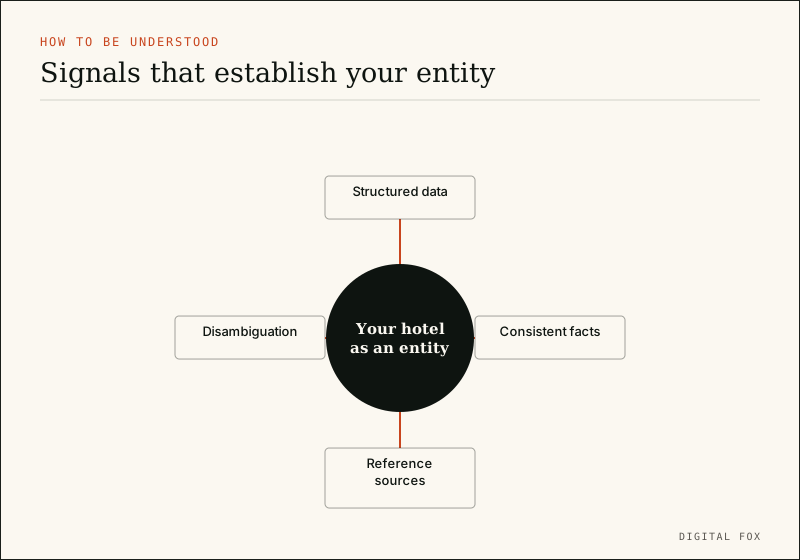
The systems resolve this confusion using distinguishing attributes and relationships, so the fix is to supply them abundantly and consistently. Your precise location and coordinates, stated identically everywhere, are the strongest disambiguating signal, because place is the attribute least likely to be shared. Your specific, consistent attributes, the exact address, the star level, the amenities, the room count, drawn identically across every source, build a fingerprint that distinguishes you. Your relationships, the neighborhood, the landmarks, the parent brand, the entities you contain, place you in a context no other business shares. And your presence in authoritative reference and tourism sources, describing you specifically, gives the system trusted anchors for your identity.
The enemy of disambiguation is inconsistency, because every contradiction is an opportunity for the system to either pick wrong or to blend you with the entity you are being confused for. A property serious about its entity treats absolute consistency of its identifying attributes as non-negotiable, precisely because that consistency is what makes it unmistakable.
The reference-source layer hotels overlook.
There is a category of entity input that hotels almost universally neglect, partly because it is not obviously marketing and partly because it feels beneath a nice property: the structured, authoritative, and reference sources that the systems lean on heavily for establishing that an entity is real and for learning its basic attributes.
These are the sources a system treats as trustworthy anchors for identity rather than as promotional material. Tourism board and destination marketing organization listings, which carry unusual weight because they are seen as authoritative about the places and businesses in their region. Official local government and chamber of commerce records. Industry association memberships and their directories. Well-maintained structured directories specific to hospitality. And the encyclopedic and reference sources that the systems consult heavily for entity facts, where inclusion depends on genuine notability and cannot be bought or faked.
The reason these matter more than their traffic would suggest is that they function as identity anchors. When several authoritative, independent sources agree that a business with your name, at your location, with your attributes, exists and is a hotel, the system gains confidence that you are a real, distinct entity, and it uses those trusted sources to anchor its understanding against the noisier commercial web. A property present and consistent across this authoritative layer is far easier for the system to treat as a confident entity than one visible only on its own site and the OTAs.
The practical work is to inventory this layer for your specific location and category, and to ensure you are present, claimed where possible, and consistent everywhere. Your regional tourism board listing, your local official records, your relevant association directories, your presence in the reference sources that describe businesses like yours. It is unglamorous, it delivers little direct traffic, and it is one of the strongest and least contested entity signals available, precisely because most of your competitors have never thought of it as SEO at all.
A word of caution on the encyclopedic sources specifically: inclusion there is governed by genuine notability and independent significance, not by marketing, and attempting to force an entry that does not meet those standards is both futile and reputationally risky. The right posture is to become genuinely notable through real coverage and significance, and to let inclusion follow, rather than to manufacture it. For most independent hotels the achievable and valuable work is in the tourism, government, association, and directory layer, which rewards diligence rather than notability.
Your website as the entity home.
Amid all the off-site corroboration, it is easy to lose sight of the fact that your own website should be the definitive home of your entity, the place the systems return to as the authoritative statement of what you are. When it plays that role well, everything else corroborates it. When it is thin or unclear, the systems are left to assemble your identity entirely from third parties, which is both riskier and less within your control.
A website that anchors an entity well does several specific things. It states your identity unambiguously and consistently, with your name, location, and nature clear on every relevant page rather than buried. It carries accurate, relationship-rich structured data as discussed. It has a clear, canonical page for each of your key entities, the hotel itself, the restaurant, the spa, the meeting and event spaces, each described substantively rather than as a thin stub. And it connects those entities to each other and to their place through genuine internal linking and content, so that a system crawling your site receives a coherent model of a hotel and the things it contains and relates to.
This is where entity work rejoins familiar territory, because a site structured to express a clear entity is also a site structured well for users and for conventional SEO. The canonical page for your spa serves the guest researching your spa, ranks for spa queries, and anchors the spa entity, all at once. The internal linking that expresses your local graph also helps users navigate and distributes authority, as covered in internal linking for hotel websites. The entity frame does not replace good site architecture; it gives you a sharper reason to get it right.
The failure mode to avoid is a website that describes the hotel adequately but treats its contained venues and its relationships as afterthoughts, a single thin mention of the restaurant, no real page for the spa, no clear expression of the neighborhood. That leaves your local graph impoverished and forces the systems to guess at relationships you could have stated plainly. A property serious about its entity gives each of its meaningful parts a genuine home on its own site and connects them deliberately.
Building your entity, in practice.
Set aside the theory and here is the actual work, in the order that delivers the most entity clarity for the least effort.
Establish a single source of truth.
One canonical record of your entity's core attributes: exact legal and trading name, address in a single consistent format, coordinates, phone, category, star level, room count and types, every amenity, check-in and check-out, restaurant and spa details, and the relationships that matter. Everything else reconciles to this. Building it usually surfaces two or three internal disagreements about what is actually true, which is itself valuable.
Perfect your Google Business Profile.
The most direct input into Google's local entity understanding. Complete every field, choose categories precisely, keep hours and attributes current, and make the description specific and accurate. Detail here is disproportionately rewarded because it feeds the entity model almost directly.
Mark up your site with accurate structured data.
State your entity's attributes and relationships in machine-readable form, matching your visible content and your other listings exactly. Express the connections between your hotel and its restaurant, spa, and location, so the system receives a coherent local graph rather than isolated facts.
Reconcile every listing you hold.
Directories, tourism boards, review platforms, OTA property pages, associations. Make every identifying attribute match your source of truth exactly. This consistency is what turns your claims into confident entity attributes and stops the blending that destroys disambiguation.
Earn authoritative references.
Presence in the tourism, editorial, and reference sources the systems trust for entity information, describing you specifically and accurately. This is where entity work overlaps with digital PR, covered in digital PR and link building for hotels, and its entity value is a reason to pursue it beyond the links.
Build and connect your relationships.
Explicitly associate your property with its city, neighborhood, landmarks, contained venues, and any parent brand, both in your content and your markup. Rich, accurate relationships are what let the system reason about your relevance to the queries that matter.
Monitor and correct the resulting picture.
Check your knowledge panel and the systems' descriptions of you regularly, and when something is wrong, fix the underlying source rather than arguing with the surface. Entity information drifts, and quarterly maintenance keeps it accurate.
None of this involves keywords, and all of it makes your property genuinely easier for both machines and people to understand correctly. That is the signature of durable work: the thing that clarifies your entity for the systems is the same thing that gives a real traveler an accurate picture of what you are.
A worked example: two hotels, one name.
Consider a mid-sized independent hotel with a common, geographic name, shared with at least two other businesses in its wider region and close to a generic category description. It has a decent website and an average traffic level, and its team cannot understand why it underperforms in local and AI results despite being a genuinely good property.
The entity audit reveals the problem immediately. The systems are blending it with the similarly named businesses. Its reviews are partly attributed elsewhere. Its knowledge panel is thin and shows one wrong attribute. Its address is formatted four different ways across its listings, its star level is stated inconsistently, and its restaurant appears as an unconnected separate business in some sources and not at all in others. To the systems, this is not one clear entity; it is a smear across several half-defined ones.
The fix is pure entity work, and none of it is glamorous. The property builds its single source of truth and discovers, in the process, that even its own staff disagreed on the room count. It perfects its Google Business Profile. It marks up its site with accurate, relationship-rich structured data that explicitly ties the hotel to its restaurant and its precise location. It reconciles every listing to identical identifying attributes, killing the address-format chaos. It earns two authoritative local references that describe it specifically and by its distinguishing features. And it connects its entity firmly to its neighborhood and nearby landmarks everywhere it appears.
Over the following months the smear resolves into a thing. The knowledge panel fills out and corrects itself as the underlying sources it draws from become consistent. The reviews attach to the right entity. The property begins appearing cleanly in local and AI results for its distinguishing attributes, because the system can now tell it apart from its namesakes and reason about it confidently. Its traffic and bookings improve, and the team is slightly deflated to learn that the transformation came not from any clever content but from making the property, at long last, unmistakably itself.
Auditing your entity strength.
Before and during the work, you want a read on how strong and clean your entity currently is. There is no single score for this, but a handful of checks together give an honest picture, and all of them are free.
Search your own name and read the panel. Look at what appears for your exact name across devices. Is there a knowledge panel, is it yours, is it complete, and is every attribute correct? A missing, thin, or wrong panel is the most visible symptom of a weak or confused entity.
Search your name and your namesakes. Add your city, then try the bare name, then try close variants. Watch for blending: your reviews on someone else, another business surfacing for your name, your restaurant appearing as an unrelated entity. This reveals disambiguation problems directly.
Ask the AI assistants about you specifically. Ask several of them what your hotel is, where it is, and what it offers, and check whether they can answer confidently and correctly. Hesitation, vagueness, confusion with another property, or wrong attributes all indicate a weak entity, since a well-defined entity is exactly what lets an assistant answer cleanly. This overlaps with the prompt-audit approach in where AI actually gets its hotel information.
Check your attribute consistency across sources. Pull your name, address, category, star level, and key attributes from your website, your Google Business Profile, your major listings, and a couple of directories, and lay them side by side. Every contradiction you find is an entity weakness a system may be tripping over.
Audit your relationships. Check whether your contained venues, your neighborhood, and your parent brand if any are clearly and consistently expressed. Missing or contradictory relationships impoverish the model the system builds of you.
Run this at the start to find the problems, and re-run it quarterly to catch drift, because entity information decays and namesakes appear over time. The audit is manual and unscalable, which is precisely why it is honest: you are looking at what the systems actually understand about you, not at a vendor dashboard estimating it.
Why this favors independents willing to be specific.
There is a reason to find the entity shift encouraging rather than intimidating, and it is the same reason that runs through most of what has changed in hotel search: the systems now reward properties that are genuinely, specifically something, and independents that lean into their specificity have a real structural advantage.
An entity is defined by its distinguishing attributes and relationships, and a property with genuine character has more of them to offer. The independent hotel in a specific neighborhood, with a specific history, a named restaurant, a particular kind of guest, and real ties to its place, is rich in exactly the distinguishing signals that make an entity clear and recommendable. A generic property with nothing particular to say about itself is, almost by definition, harder for the systems to define as a distinct thing, because there is less that distinguishes it.
This inverts an old disadvantage. For years, scale and brand recognition were the dominant advantages in hotel search, and independents competed uphill against chains with enormous authority. Entity understanding does not erase that, but it shifts the ground: being a well-defined, specifically-attributed, richly-connected thing is available to any property willing to describe itself honestly and consistently, and it does not require scale. A small, distinctive, well-described independent can be a cleaner and more confidently recommendable entity than a large but generic competitor, because it gives the systems more to understand and less to confuse.
The catch is that it requires the property to actually be specific and to say so plainly, everywhere, consistently. The generic instinct in hospitality marketing, to describe every property as a luxurious oasis of comfort and service, is the enemy of entity clarity, because it provides no distinguishing attributes at all. The properties that win are the ones willing to be concretely what they are, and to state it the same way in every place a system might look.
Entity work and the AI future.
It is worth being explicit about why this discipline is likely to grow more important rather than less, because that shapes how much to invest in it.
Every trend in search points toward deeper reliance on entity understanding. AI assistants reason over entities by their nature. Google's systems have moved steadily from strings toward things for over a decade and continue to. The surfaces that increasingly mediate discovery, knowledge panels, AI answers, local and hotel modules, all draw on entity models. As search becomes more conversational and more mediated by AI, the question shifts from "does this page contain the right words" to "does the system understand this thing well enough to reason about it and recommend it." That is an entity question, and it will only become more central.
The properties that will be visible in whatever search looks like in a few years are the ones the systems understand clearly as distinct, well-attributed, richly connected, trustworthy things. That understanding is built now, through the unglamorous consistency and corroboration work described here, and it compounds: an entity, once well-established, is durable across algorithm updates in a way that keyword rankings are not, because it is built on the systems' fundamental model of reality rather than on the shifting weights of a ranking function. The strategic case for building on this kind of durable foundation runs through generative engine optimization for hotels, and entity clarity is the layer beneath all of it.
What not to do.
- Do not pay for a guaranteed knowledge panel. Panels are generated by Google from its entity confidence, not sold. Anyone promising one for a fee is promising something they cannot reliably deliver. Build the entity and the panel follows.
- Do not let your identifying attributes contradict each other. Inconsistent addresses, names, star levels, and room counts across the web are the single biggest cause of entity blending and misattribution. Consistency is the foundation everything else sits on.
- Do not add structured data that contradicts your visible content or other listings. Inaccurate markup is worse than none, because it undermines the consistency that entity confidence depends on.
- Do not try to argue with a wrong knowledge panel or AI answer directly. The fix is to correct the underlying sources the surface draws from, then wait for it to update. You edit the evidence, not the answer.
- Do not treat your restaurant and spa as afterthoughts. They are entities too, and connecting them clearly to your hotel enriches your local graph and helps the systems reason about your full offering.
- Do not assume entity work is a one-time task. Entity information drifts, sources change, and namesakes appear. Quarterly maintenance keeps your entity clear.
- Do not expect keywords to fix an entity problem. If the system does not understand what you are, more keyword optimization will not help. The entity has to be clear first.
Frequently asked questions.
What is entity SEO, and how is it different from normal SEO?
Entity SEO is the work of making your hotel a clearly defined, correctly described, well-connected thing in the systems' model of the world, rather than optimizing pages for keywords. Search engines and AI no longer just match words; they reason about entities, distinct identifiable things with attributes and relationships, and they draw on a structured knowledge store to do it. Normal SEO optimizes the words on your pages. Entity SEO establishes what your property fundamentally is, so that all the other optimization has a solid, well-understood entity to attach to.
How do I get a knowledge panel for my hotel?
You do not create one directly, and you cannot buy a guaranteed one. Google generates a knowledge panel when its confidence in your entity crosses a threshold, assembled from its entity understanding. You earn it by doing the entity work: a complete and authoritative Google Business Profile, accurate and consistent information across the web, strong corroboration from independent sources, clear structured data, and presence in the reference sources the system trusts. For an established property with a complete profile, a panel usually already exists, and the work is often correcting and enriching a thin or partly wrong one rather than summoning a new one.
My knowledge panel shows wrong information. How do I fix it?
Do not try to argue with the panel directly. It is generated from underlying sources, so the fix is to correct those sources and let the panel update. Trace the wrong attribute to where it lives, your website, your Google Business Profile, your listings, or old references, and correct it everywhere it appears, because a single remaining stale source can keep reintroducing the error. If you are the recognized representative of the entity, you can also claim the panel and suggest edits, but the durable fix is always in the sources the panel draws from.
Why does entity SEO matter so much for AI search specifically?
Because AI systems are even more entity-dependent than traditional search. When an assistant answers a question about hotels, it reasons over its model of the relevant entities, so it needs to know that your property exists, what it is, where it is, and what distinguishes it. A clear, richly attributed entity is something an assistant can reason about and recommend confidently. A fuzzy or easily confused one gets handled tentatively or skipped, because recommending the wrong thing is the failure these systems most want to avoid. Entity clarity is the substrate underneath AI visibility.
My hotel keeps getting confused with another business. What do I do?
This is the most common entity problem for hotels, and the fix is to supply distinguishing attributes and relationships abundantly and consistently. Your exact location and coordinates are the strongest disambiguating signal, because place is rarely shared. State your specific attributes, address, star level, room count, amenities, identically everywhere to build a distinguishing fingerprint. Connect your entity firmly to your neighborhood, landmarks, and any parent brand. And earn presence in authoritative sources that describe you specifically. The enemy is inconsistency, because every contradiction is a chance for the system to blend you with your namesake.
Is structured data the same as entity SEO?
Structured data is a major tool for entity SEO, but not the whole of it. It is the one place you get to state your entity's attributes and relationships to the systems in language they parse without ambiguity, which makes it important. But entity clarity also depends on your business profile, the consistency of your information across the web, corroboration from trusted sources, and your web of relationships. Structured data that is accurate and matches everything else strengthens your entity; structured data that contradicts your other sources actively harms it. It is necessary but not sufficient.
How long does entity work take to show results?
Some inputs register relatively quickly, since business profile and structured data are directly consulted, but the full picture, especially knowledge panel enrichment and clean disambiguation, resolves over months as the systems re-consult and reconcile your now-consistent sources. Think in quarters. The upside is that a well-established entity is unusually durable, because it is built on the systems' fundamental model of reality rather than on shifting ranking weights, so it tends to hold up across algorithm updates far better than keyword rankings do.
If you want to know how clearly Google and the AI assistants currently understand your property, whether your entity is clean or blended, what your knowledge panel is missing, and where your information contradicts itself, that entity audit is part of every Digital Fox engagement. You can see the approach on the services page, or reach us at inquiries@digitalfoxllc.com. Search stopped rewarding the hotels with the right words and started rewarding the ones it genuinely understands. The work is making sure it understands you.