Walk through the average hotel website to the spa page and you will usually find the same thing: a soft-focus photograph of a candle and a folded towel, a paragraph of adjectives about tranquility and rejuvenation, a list of treatments with no prices, and a phone number. It is treated as a brochure, a nice-to-have that reassures a guest who already booked a room. And it is quietly one of the most expensive missed opportunities on the entire site, because your spa is frequently your highest-margin square footage, it serves two completely different audiences through two completely different searches, and that candle-and-towel page answers neither of them.
This is the guide to fixing that. Hotel spa and wellness SEO is a genuinely distinct discipline from hotel SEO, not a subset of it, because the spa competes in a different market, against different competitors, for different searchers, on different queries. The traveler booking a room and the local resident booking a massage are not the same person, are not searching the same way, and cannot be served by the same page. A hotel that understands this treats its spa as what it actually is, a revenue business with its own search demand, and captures a stream of high-margin bookings that its room-focused SEO never touches. A hotel that does not leaves that money folded up next to the towel.
So we will work through it properly. Why the spa is a separate search business with two distinct audiences. The local-search dimension that most hotels ignore entirely. How to structure treatment and service content so it actually ranks and converts. The pricing question that quietly kills spa conversion. The gift and voucher demand that is pure high-intent revenue. How wellness intent is changing what travelers search for. And how to turn spa visibility into hotel bookings and back again, so the two businesses feed each other rather than sitting on the same site ignoring one another.
Your spa is a separate search business.
Everything in this guide follows from one shift in how you see the spa, so it is worth stating plainly before anything else and letting it reframe the rest.
The foundational insight, from which everything else follows, is that your spa competes in a different search market than your hotel does. When someone searches for a spa, they are usually not searching for a hotel at all. They are searching for a spa, and the results they see are dominated by day spas, wellness centers, and independent operators, not by hotels. Your hotel spa is competing against those local businesses, on those local queries, in a market your room-focused SEO does not even enter.
This means the spa needs its own search strategy, aimed at its own market, rather than a paragraph on the hotel site hoping to be found by hotel guests. The competitors are local spas and wellness businesses. The queries are spa and treatment queries, heavily local, often mobile, frequently high-intent. The searcher is often not a hotel guest and may have no interest in staying the night. And the booking, if you win it, is high-margin revenue that has nothing to do with your room business.
Treating the spa this way, as a business with its own search presence, changes what you build. It gets its own well-developed content rather than a brochure page. It gets its own local search presence, which we will come to, because local is where spa demand largely lives. It gets treatment and service pages that answer real queries. And it gets an entity of its own, connected to the hotel but distinct, so the systems understand it as a spa that can be searched for and recommended in its own right, a structure grounded in entity SEO for hotels. Most hotels never do any of this, which is precisely why the opportunity is so open.
Two audiences, two completely different searches.
Once you accept that the spa is its own search business, the next thing to understand is that it is really serving two businesses at once, and the single biggest content mistake hotels make is trying to serve both with one page written for neither.
The reason a single spa page cannot work is that the spa serves two fundamentally different audiences whose searches have almost nothing in common, and a page written for one actively fails the other.
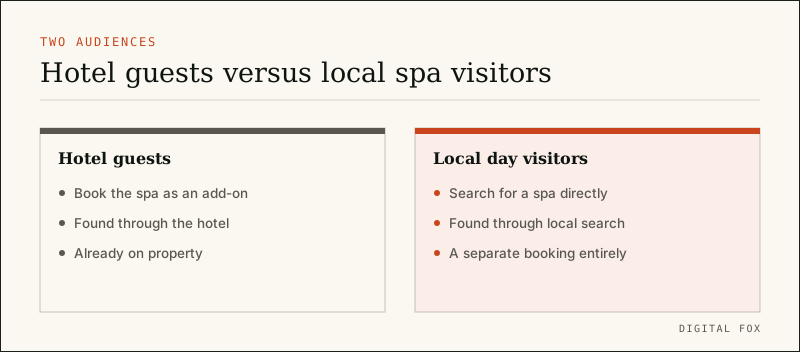
The first audience is the hotel guest, or the prospective hotel guest, for whom the spa is an amenity that influences the decision to book the room. This person searches for hotels with a spa, or researches your property and wants to know what the spa offers, or is already booked and planning to use it. Their search is tied to the stay. For them, the spa content needs to sell the amenity as part of the hotel experience, answer practical questions about access and hours and booking, and reinforce the reason to choose your property over one without a spa. This audience is reached largely through your hotel SEO, with the spa as a supporting selling point.
The second audience is the local or day guest, who wants a spa experience and has no interest in staying the night. This person searches for a spa near them, a massage in their city, a specific treatment, a day of wellness, a spa for an occasion. They are not looking at hotels; they are looking at spas, and your hotel spa is one option among the local field. For them, the content needs to compete as a spa, on local spa queries, answering the questions a spa-goer asks, with none of the assumption that they care about the hotel at all. This audience is reached only through dedicated spa SEO aimed at the local spa market, and it is the audience hotels almost universally ignore.
These two searches barely overlap. The hotel guest searches within the context of a trip; the day guest searches within the context of their own city and their own wellness. The hotel guest cares about the stay; the day guest does not. A page that leads with the hotel experience loses the day guest, who does not care and cannot tell whether they can even come without booking a room. A page that leads with local spa services can confuse the hotel guest looking for amenity information. The resolution is not one clever page but a considered structure that serves both, usually a strong spa presence aimed at the local market plus clear amenity information integrated into the hotel journey, each doing its own job.
The day-guest audience is the larger untapped opportunity for most properties, precisely because it is the one hotels neglect. Selling the spa as a hotel amenity is at least attempted, however weakly. Competing for local spa demand as a genuine spa business is something most hotels never try, which leaves the entire local spa market open to them if they choose to enter it.
The local search dimension hotels ignore.
If the day-guest is the neglected audience, local search is the neglected channel, and the two facts are really the same fact seen from different angles, because that audience lives almost entirely in local results.
Because so much spa demand is local, the spa lives or dies in local search, and this is the single most neglected dimension of hotel spa marketing. A great deal of spa searching is explicitly local, spa near me, treatment in this city, wellness in this neighborhood, and much of it is mobile and high-intent, someone looking to book soon. Winning it requires the same local SEO discipline that a standalone day spa would use, applied to your hotel spa.
The centerpiece is a properly developed local presence for the spa. This raises a genuine strategic question that deserves a clear answer: should the spa have its own Google Business Profile, separate from the hotel's? In many cases yes, because the spa is a distinct business that local searchers look for on its own terms, and a separate profile lets it compete directly in local spa results, carry its own reviews, its own photos, its own categories, and its own hours. The general discipline of the profile is in Google Business Profile optimization, and the spa-specific move is to give the spa its own local identity where it operates as a genuinely separate, publicly-accessible business rather than a rooms-only amenity.
There are conditions and nuances to that decision, and it should be made deliberately rather than by default, respecting the platforms' rules about what qualifies as a distinct business location. But the underlying point stands regardless of how the profile question is resolved: the spa needs a real local search presence, optimized for local spa queries, with the reviews, information, and content that local spa searchers respond to. A hotel that treats the spa purely as an on-site amenity, invisible in local spa search, has conceded the entire local market to the day spas down the road, many of which are worse than its own.
The broader local SEO fundamentals apply with full force here, and are covered in local SEO for hotels: consistent information, strong local content, reviews, and local relevance. The spa-specific twist is that all of it is aimed at the local spa and wellness market rather than the hotel market, which is a different competitive field with different incumbents and different queries, and one that a good hotel spa is often well-placed to win precisely because it brings resources and quality that independent day spas may lack.
Treatment and service pages that actually work.
If local search is the channel and the day-guest is the audience, treatment content is the substance that wins them, and it is where the gap between a real spa business and a brochure is most visible.
The content core of spa SEO is the treatment and service pages, and this is where the candle-and-towel approach fails most concretely. A single page listing treatment names is not content that ranks or converts. Genuine spa SEO gives real treatments and services the substantial, specific pages that match how people actually search for them.
People search for treatments specifically: a particular kind of massage, a specific facial, a body treatment, a wellness experience, and often with modifiers, for a couple, for an occasion, for a concern. Each of these is a query, and a spa that has genuine, useful content about each treatment can capture demand that a bare list never will. The content should describe the treatment substantively and honestly: what it is, what it involves, what it is good for, how long it takes, what to expect, who it suits. This is genuinely useful to someone deciding, it answers their real questions, and it is exactly the specific, expert content that ranks and that AI systems draw on, rather than the generic filler that recent quality reassessments discount.
Structure matters. Rather than one page trying to cover everything, meaningful treatments and categories get their own developed pages, connected sensibly, forming a coherent set that covers the spa's actual offering in the depth that both searchers and search systems reward. This mirrors the topic-cluster approach used elsewhere on a good hotel site, applied to the spa's services, and it lets the spa rank for the specific treatment and experience queries that carry real intent.
The writing has to serve the searcher, not the search engine. Someone researching a treatment has genuine questions and some anxiety, about whether it will suit them, what it will be like, whether it is worth it, and content that honestly and warmly answers those questions both ranks well and converts well, because it is doing the real job of helping a person decide. Content stuffed with keywords or padded to a word count does neither, and it is exactly what a spa page should not be.
The pricing question that kills conversion.
Of all the small omissions on hotel spa pages, one does more quiet damage than any other, and it is so common that fixing it alone can move the numbers.
There is a specific, near-universal failure on hotel spa pages that quietly destroys conversion, and it is worth isolating because the fix is simple and the impact is large: the absence of prices.
Hotel spas frequently omit treatment prices, listing services with no indication of cost, often out of a vague sense that discussing price cheapens a luxury experience or out of a desire to have the conversation on the phone. Whatever the reasoning, the effect on a searching, comparing customer is corrosive. A day-guest choosing a spa is very often comparing options and expects to see prices, exactly as they would for any local service, and a spa that hides its prices reads as either expensive-and-cagey or as untrustworthy, and it loses the comparison to the spa that is transparent. The customer does not call to find out; they book the option that told them what it cost.
Prices also matter for search itself. Price is information searchers want and that the systems increasingly surface, and a spa that provides clear pricing gives both the searcher and the systems what they are looking for. Structured information about services and their prices helps the systems understand and present the spa, and it aligns with the entity and structured-data work that helps the spa be understood as a real, well-defined business.
The fix is to be transparent. Show prices, or at least clear price ranges, for treatments and services, the way any local service business does. This does not cheapen the experience; it respects the customer's ability to make an informed decision, which is exactly what a comparing day-guest is trying to do. The luxury hotels that worry most about this are often the ones losing the most local spa business to transparent competitors, because the modern customer treats price-hiding as a red flag rather than as a mark of exclusivity.
Gift vouchers: pure high-intent demand.
Beyond the treatments and the local searches sits a pocket of demand so ready to convert that ignoring it is close to leaving cash on the counter.
If there is one specific pocket of spa demand that hotels fail most completely and lose most needlessly, it is this one, and it is worth isolating because the searcher could hardly be more ready to buy.
One category of spa demand is so high-intent and so under-served on hotel sites that it deserves its own treatment: gift vouchers and spa gifts. This is some of the most valuable, most ready-to-buy demand a spa can capture, and hotel spas routinely make it almost impossible.
Think about the searcher. Someone looking for a spa gift, a spa voucher, a spa day as a present, a wellness gift for an occasion, is a person ready to spend money now, on behalf of someone else, often against a deadline like a birthday or an anniversary. Their intent is extraordinarily high, their price sensitivity is often low because it is a gift, and their need is immediate. This is close to the ideal customer, and they are searching explicitly for exactly what a spa can sell them.
Hotel spas frequently fail this searcher completely. There is no gift or voucher content, no clear way to buy a gift online, no page that ranks for gift queries, and the would-be buyer, unable to easily purchase, goes to a spa that made it simple. The revenue was there, ready, searching, and the property had no way to receive it.
Capturing this demand requires genuine gift and voucher content, pages that speak to the gift-giver and their occasions, a straightforward way to actually purchase a gift or voucher online, and visibility for the gift and voucher queries that carry this intent. It rewards seasonal awareness too, since gift demand spikes around occasions and holidays, a pattern that connects to the broader approach in seasonal demand content strategy. A spa that serves the gift-giver well captures a stream of high-margin, high-intent, low-sensitivity revenue that most hotel spas leave entirely on the table.
Reviews, but for the spa.
If the spa is its own business competing for its own customers, then it needs its own proof, and this is one more place where folding the spa into the hotel quietly costs it the very reassurance its customers are looking for.
Reviews drive spa decisions at least as powerfully as they drive hotel decisions, and often more directly, because a spa treatment is a personal, somewhat vulnerable experience and prospective customers lean heavily on the reassurance of others who have been. Yet hotel spas frequently have no review presence of their own, their guest feedback folded entirely into the hotel's reviews where a spa-seeker will never find it.
The distinction matters. A local person choosing a spa is reading spa reviews, looking for reassurance about the therapists, the treatments, the atmosphere, the value. If your spa's reviews exist only as scattered mentions inside hotel reviews about rooms and breakfast, that reassurance is invisible to the person seeking it, and they choose the day spa with a hundred dedicated spa reviews instead. A spa that is serious about local business needs its own review presence, gathering feedback specifically about the spa experience, visible to people searching for a spa.
Building it follows the same principles as hotel review acquisition, covered in hotel reviews and reputation management, applied to the spa: ask every spa guest, promptly and frictionlessly, and prompt for genuine specifics about the treatment and experience rather than generic praise. Those specifics are exactly what a prospective spa-goer wants and what the systems draw on: reviews that mention the particular treatment, the skill of the therapist, the suitability for an occasion, the value. A spa with a growing body of specific, recent, dedicated reviews is both more attractive to the searching customer and more confidently recommendable by the systems, and it compounds over time into a genuine competitive advantage over spas that never gathered any.
There is a reputation dimension too. A spa experience that goes wrong, a rushed treatment, a booking mishandled, a therapist mismatch, generates the same kind of damage as any service failure, and a spa serious about its business handles its reviews and its service recovery with the same care a hotel gives its own reputation. The spa's reputation is its own asset, distinct from the hotel's, and it deserves deliberate attention rather than being left to accumulate unmanaged.
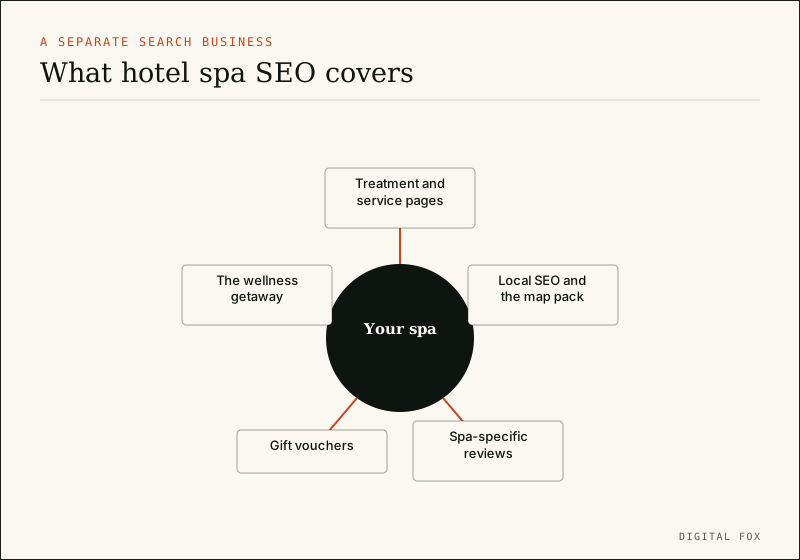
The wellness getaway: where spa meets travel.
So far the spa's audiences have pulled in opposite directions, the local day-guest who wants no room and the hotel guest who wants the room. There is a third audience where the two finally align, and for many properties it is the most valuable of all.
Between the local day-guest and the amenity-seeking hotel guest sits a third and growing audience worth its own attention: the traveler seeking a wellness experience as the purpose of the trip, not a byproduct of it. This is the wellness getaway, the spa break, the retreat, the wellness weekend, and it represents demand where the spa is the reason for the booking rather than a nice extra.
This searcher is distinct from both others. Unlike the local day-guest, they will stay the night, so this is genuinely hotel demand. Unlike the ordinary hotel guest, the spa and wellness offering is the primary motivation, so the room is chosen because of the spa rather than the spa used because of the room. They search for wellness getaways, spa breaks, retreat weekends, wellness experiences in a destination, and they are choosing among properties on the strength and specificity of their wellness offering.
Capturing this demand requires content that presents the wellness experience as a genuine reason to travel: substantive, specific descriptions of what a wellness stay at your property actually is, the experiences, the treatments, the setting, the rhythm of it, rather than a generic promise of relaxation. It rewards packaging the spa and the stay together in ways this searcher is looking for, and it rewards the destination and experience-led content that positions your property as a genuine wellness destination rather than a hotel that happens to have a spa. This is where spa SEO and hotel SEO genuinely converge, because the booking is a room booking driven by spa demand, and content that serves it strengthens both businesses at once.
The wellness-getaway audience is growing as wellness-motivated travel grows, and it favors properties with a genuine, specific, well-articulated wellness identity over those with a generic spa and vague adjectives. A hotel with a real wellness story, told specifically and honestly across its content and understood clearly as an entity, is positioned to capture demand that a property treating its spa as an afterthought never sees.
The booking path the spa never got.
Everything up to here has been about being found. This section is about what happens in the seconds after, because a spa can win the search and still lose the sale at the last step.
Visibility that leads to a dead end converts nobody, and hotel spas are notorious for winning a searcher's interest and then making it genuinely difficult to book. The day-guest who found your spa, liked the look of a treatment, and decided to book is frequently met with no online booking option at all, only a phone number and a set of hours, and a meaningful share of them simply book the competitor who let them reserve in three taps.
The modern spa customer, especially the local day-guest and the gift-buyer, expects to book online, immediately, at the moment of intent, which is often outside business hours when no phone will be answered. A spa that requires a call is losing the customer whose intent was highest at eleven at night, on a phone, ready to commit, and who will not still be ready tomorrow when the spa opens. The friction between wanting to book and being able to book is where spa revenue quietly leaks, exactly as it does with hotel rooms, and the principles are the same ones covered in hotel website conversion optimization applied to the spa.
The fix is a genuine, low-friction booking path for spa services and gifts: online booking for treatments where feasible, straightforward gift and voucher purchase, clear availability, and as few steps as possible between deciding and confirming. Every step removed captures customers who would otherwise have leaked away, and every barrier, the forced phone call, the account creation, the vague availability, sends the highest-intent customers to a competitor who made it easy. A spa serious about capturing the demand its visibility creates treats its booking path with the same seriousness the hotel gives its own.
The booking path is also where visibility becomes measurable revenue, closing the loop on everything else. All the local presence, treatment content, and gift visibility in the world produces nothing if the interested customer cannot easily complete the booking, and conversely, a smooth path converts the demand into the high-margin revenue that justifies the whole effort. It is the least glamorous part of spa SEO and one of the most decisive.
The seasonal rhythm of spa demand.
The spa does not just have its own audience and its own booking path; it has its own calendar, and a property that plans around the hotel's season alone keeps missing the spa's.
Spa demand has its own seasonality, distinct from the hotel's and worth planning around, because the spa's peaks and the hotel's do not always coincide and its content needs to be ready before demand arrives rather than after.
Some spa demand tracks occasions and holidays, particularly the gift and voucher business, which spikes hard around the giving occasions of the year and around personal occasions like anniversaries and celebrations. Some tracks the wellness calendar, the resolutions and resets of certain times of year, the desire for relief at busy or stressful periods. And some tracks the local rhythm rather than the travel rhythm, since much of the day-guest business is local residents whose spa-going follows their own year rather than the tourist season.
The practical consequence, following the logic of seasonal demand content strategy, is that spa content and offers should anticipate these rhythms, published and visible before the demand arrives, since content needs time to rank and buyers plan gifts and getaways ahead. A gift-voucher page that goes live the week of a giving holiday has missed the searchers who were planning for weeks. A wellness-reset offer published after the reset season has passed is content for next year. A spa that maps its own demand calendar and prepares ahead of each peak captures demand that a reactive spa watches go to competitors who were ready.
This is also where the spa's seasonality can complement the hotel's. Where the spa's local and gift demand peaks in periods that are soft for rooms, the spa can generate revenue exactly when the hotel needs it most, and a property that understands both calendars can use the spa to smooth the troughs in the room business. Treated as a business with its own demand pattern, the spa becomes not just an additional revenue stream but a counter-cyclical one, which is worth a great deal to a seasonal property.
Turning spa visibility into hotel bookings.
A hotelier reading all this might reasonably worry that chasing local day-guests and gift-buyers pulls focus from the real job of filling rooms. It is the natural objection, and it is backwards, because a well-run spa is one of the best room-selling tools a property has.
The objection a hotelier might raise is that all this local, day-guest, gift-focused spa business is a distraction from the core job of selling rooms. The opposite is true: a strong spa search presence feeds the hotel, and a strong hotel feeds the spa, when the two are connected deliberately rather than left to ignore each other.
The connections run both ways. A local resident who discovers and enjoys your spa becomes a warm audience for the hotel, someone who now knows and trusts the property, and who may book a staycation, recommend the hotel, book a room for visiting family, or hold an event there. The spa is a low-commitment entry point into the property for local people who would never have booked a room cold, and every satisfied day-guest is a potential future hotel guest and advocate. This is the same audience-building logic that runs through building a first-party audience, with the spa as an unusually effective front door.
In the other direction, a well-marketed spa strengthens the hotel's own appeal, because the spa is a genuine reason to choose your property over one without one, and spa-related searches, hotels with a spa, wellness getaways, spa breaks, are hotel demand the spa content helps you capture. The spa is both its own business and a selling point for the room business, and the content can serve both.
The practical work is to connect the two deliberately: to lead spa day-guests gently toward the hotel where it is natural, to present the spa prominently in the hotel journey as a reason to book, to capture and nurture the local spa audience as a hotel audience over time, and to let the spa and the rooms cross-sell honestly. Done well, the spa is not a distraction from the hotel; it is one of the most effective ways to bring new people into contact with the property and to give existing guests a reason to choose it. The two businesses share a building, and with a little deliberate connection, they can share an audience.
The spa in AI and voice search.
Everything described so far becomes more important, not less, as search moves toward AI and conversation, because the brochure page that fails a human searcher fails an assistant even more completely.
The shift toward AI-mediated and conversational search touches the spa in specific ways that reward the work described here and punish the brochure approach, and it is worth understanding because it is only becoming more consequential.
Spa and wellness questions are exactly the kind of thing people now ask assistants conversationally: where to get a particular treatment in a city, whether a spa is good for a specific concern, what a wellness getaway in a region involves, a good spa for an occasion. When an assistant answers, it assembles its recommendation from what it can understand about the local spas, and a hotel spa that is a clear, well-described, well-reviewed entity with substantive treatment content is something it can recommend confidently, while a spa that exists only as a candle photo on a hotel page is something it cannot really see. The mechanics of how these systems source their recommendations are in where AI actually gets its hotel information, and the spa is subject to exactly the same dynamics as the hotel.
The practical implication reinforces everything above. A spa that has real, specific content about its treatments and experiences, a clear entity of its own, a genuine local presence, transparent information including prices, and a body of specific reviews, is exactly what an AI system can understand and recommend. A spa that is a thin brochure gives the systems nothing to work with and is passed over in favor of the day spas that described themselves properly. The AI shift does not introduce a new discipline for the spa; it raises the stakes on the discipline the spa already needed.
There is a wellness-specific angle worth noting. Because wellness searches are often exploratory and question-led, is this good for that, what should I try, where should I go, they are unusually well-suited to conversational AI, which means a meaningful share of wellness discovery may flow through assistants. A spa with genuine, specific, question-answering content about its treatments and experiences is positioned to be the answer, while a generic one is invisible to a mode of search that is only growing.
Measuring the spa as a business.
You cannot manage what you do not measure, and the reason so many hotel spas drift along underperforming is that nobody ever measured them as anything other than a line inside the hotel's numbers.
If the spa is a distinct business, it deserves to be measured as one rather than buried in the hotel's numbers, and measuring it properly is what keeps the work honest and reveals whether it is paying off.
The meaningful measures are the spa's own. Its visibility for spa, treatment, local, and gift queries, tracked separately from the hotel's rankings, since they are a different market. Its local presence and how it performs in local spa search. Its own traffic and the queries bringing it, which reveal what people actually search to find the spa. Its bookings and revenue, split where possible between hotel-guest and day-guest business, so you can see the local market you are winning or losing. Its gift and voucher revenue, previously invisible and often substantial once captured. And its review profile as a spa, growing and specific.
The trap to avoid is the same one that afflicts hotel measurement generally, examined in why your SEO tools give the wrong answers: trusting third-party estimates over your own data, and watching proxy metrics rather than business outcomes. The spa's own booking and revenue data, and its own search console data, are the trustworthy instruments. The point of measuring the spa separately is to see it clearly as the business it is, to know whether the local and gift and wellness demand is actually being captured, and to justify the investment by showing the high-margin revenue it produces, revenue that was previously invisible because nobody measured the spa as anything other than a room amenity.
Measured this way, a spa that was quietly underperforming becomes a business with visible, improvable numbers, and the case for treating it seriously makes itself. A spa that generates real, growing, high-margin day-guest and gift revenue, and that feeds warm local prospects to the hotel, is not an amenity to be described with adjectives. It is a business, and the numbers, once you actually keep them, say so plainly.
A worked example: the ignored spa.
It helps to see all of this land on a single property, because the transformation is less about any one fix than about the shift from treating the spa as decoration to treating it as a business.
Consider a hotel with a genuinely excellent spa that performs far below its potential. The spa is beautiful, the therapists are skilled, and the facilities are better than most of the independent day spas in the area. And yet it is quiet, running mostly on hotel guests, with almost no local business, and its contribution to the property is a fraction of what it could be.
The audit finds the familiar pattern. The spa has a single page on the hotel website, a candle photo, adjectives, a treatment list with no prices, and a phone number. It has no local search presence of its own, no separate profile, no reviews as a spa. It has no treatment content, no gift or voucher offering, and no way to book anything online. In local spa search, it is invisible, ceding the entire local market to inferior day spas. To the systems, it is barely a spa at all, just a mention on a hotel page.
The work is to treat the spa as the business it is. It gets a proper local presence aimed at the local spa market, with reviews and complete, accurate information. It gets real treatment pages, substantive and honest, that answer how people actually search for treatments and that show prices transparently. It gets genuine gift and voucher content with a real way to purchase, aimed at the high-intent gift searcher. It gets its own clear entity, connected to the hotel but distinct, so the systems understand it as a spa. And the hotel and spa are connected deliberately, so day-guests become hotel prospects and the spa becomes a genuine selling point for the rooms.
Over the following months the spa stops being invisible in local search and starts appearing for the treatment, local, and gift queries that carry real intent. Local and day-guest business grows, high-margin and independent of the room business. Gift-voucher revenue, previously zero, becomes a genuine stream. And a portion of the new local audience begins converting into hotel bookings and advocacy, so the spa starts feeding the property it belongs to. Nothing about the spa itself changed. It was always excellent. What changed is that it stopped being a brochure and started being a business that people could find.
What not to do.
Much of spa SEO is a matter of avoiding a handful of specific, common mistakes, most of which come from treating the spa as decoration rather than as a business. The list below is those mistakes in one place.
- Do not treat the spa as a single brochure page. A candle photo, adjectives, and a treatment list is not content that ranks or converts. The spa is a business with its own search demand and needs its own developed presence.
- Do not write only for the hotel guest. The larger untapped audience is the local day guest searching for a spa, not a hotel, and content that assumes everyone cares about the stay loses them entirely.
- Do not hide your prices. A comparing day-guest expects to see prices and reads their absence as a red flag, booking the transparent competitor instead. Price-hiding costs conversions; it does not signal luxury.
- Do not ignore local search. Most spa demand is local, and a spa invisible in local spa search has ceded the entire local market to the day spas nearby, often ones inferior to your own.
- Do not neglect gift and voucher demand. It is some of the highest-intent, lowest-sensitivity, most ready-to-buy demand a spa can capture, and most hotel spas make it impossible to actually purchase a gift.
- Do not leave the spa and hotel disconnected. Connected deliberately, the spa brings new local people into the property and the hotel strengthens the spa. Left disconnected, they share a building and ignore each other.
- Do not publish thin, generic wellness filler. Recent quality reassessments discount exactly that. Spa content that works is specific, honest, and genuinely useful to someone deciding on a treatment.
Frequently asked questions.
Why does my hotel spa need its own SEO separate from the hotel's?
Because the spa competes in a different search market. When people search for a spa, they are usually not searching for a hotel, and the results are dominated by day spas and wellness centers rather than hotels. Your spa competes against those local businesses, on local spa and treatment queries, for searchers who often have no interest in staying the night. Your hotel SEO does not enter that market at all, so the spa needs its own strategy, content, local presence, and entity to capture the substantial high-margin demand that room-focused SEO never touches.
Should my spa have its own Google Business Profile?
In many cases yes, because the spa is a distinct business that local searchers look for on its own terms, and a separate profile lets it compete directly in local spa results with its own reviews, photos, categories, and hours. This should be a deliberate decision that respects the platforms' rules about what qualifies as a distinct, publicly-accessible business location, rather than a default. But however the profile question is resolved, the underlying need is the same: the spa requires a real local search presence optimized for local spa queries, or it concedes the entire local market to nearby day spas.
Should I show spa treatment prices on my website?
Yes. A day-guest choosing a spa is comparing options and expects to see prices exactly as they would for any local service, and a spa that hides them reads as cagey or untrustworthy and loses the comparison to a transparent competitor. The customer does not call to find out; they book the option that told them the cost. Prices are also information the searcher wants and the systems increasingly surface. Show prices or clear ranges. It respects the customer's ability to decide, which is precisely what a comparing day-guest is doing, and it does not cheapen the experience.
What content should a hotel spa page actually have?
Far more than a treatment list. Meaningful treatments and services deserve their own substantive, honest pages that describe what each is, what it involves, what it is good for, how long it takes, and what to expect, because that is how people actually search and it answers their real questions. Add transparent pricing, genuine gift and voucher content with a real way to purchase, and clear practical information. The writing should serve the person deciding, warmly and honestly, rather than being stuffed for search engines, which is both what ranks and what converts.
How do I capture spa gift and voucher demand?
Recognize that it is some of the highest-intent demand you can get: someone searching for a spa gift or voucher is ready to buy now, for someone else, often against a deadline, and frequently with low price sensitivity because it is a gift. Serve them with genuine gift content that speaks to occasions, a straightforward way to actually purchase a gift or voucher online, and visibility for the gift and voucher queries. Be aware that this demand spikes around occasions and holidays, so seasonal readiness matters. Most hotel spas make gift-buying nearly impossible and lose this revenue entirely.
Will focusing on local day-guests distract from selling rooms?
No, the opposite, when the two are connected deliberately. A local resident who discovers and enjoys your spa becomes a warm audience for the hotel: someone who now knows and trusts the property and may book a staycation, recommend it, book rooms for visiting family, or hold an event there. The spa is a low-commitment front door into the property for people who would never have booked a room cold. Meanwhile the spa strengthens the hotel's own appeal for guests choosing between properties. Connected well, the spa brings new people to the hotel rather than distracting from it.
How is wellness search intent changing?
Travelers and local searchers are increasingly seeking wellness experiences specifically, not just treatments, which broadens the relevant demand toward wellness getaways, spa breaks, and experience-led searches alongside individual treatments. This favors spas that present genuine, specific wellness experiences and that have real, expert content about them, over spas offering a generic treatment list. It also rewards clear entity understanding, so the systems and AI assistants can recognize and recommend your spa for the wellness intent behind the search. The practical response is substantive, honest, experience-led content rather than adjective-laden filler.
If your spa is quieter than it should be, running on hotel guests while the local spa market goes to inferior competitors, an honest look at why, and a plan to make it findable as the business it actually is, is part of every Digital Fox engagement. You can see the approach on the services page, or reach us at inquiries@digitalfoxllc.com. Your spa is probably your highest-margin square footage. It should not have your worst-performing page.