There is a particular kind of SEO advice that is quietly poisonous to a luxury hotel. Compete on price. Shout the deal. Chase the high-volume searches. Optimize for the discount-seeker. Fill the funnel with anyone. It is standard advice, and for many businesses it is fine, but for a property whose entire value rests on prestige, exclusivity, and rate integrity, following it is not just ineffective; it is corrosive, because it wins the wrong guests at the cost of the very brand equity the property depends on. A luxury hotel cannot compete on price and must not try, which means its SEO has to do something more difficult and more interesting: win genuine visibility while protecting the prestige, the discretion, and the rate integrity that make it luxury in the first place. That is a different game, and it needs to be played differently.
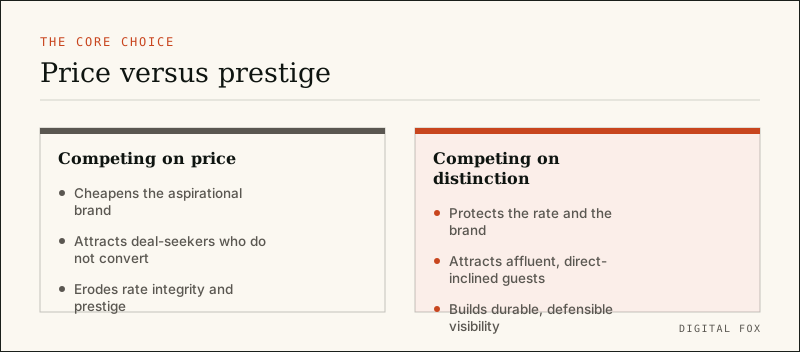
This is the guide to playing it. Luxury hotel SEO is not ordinary hotel SEO turned up in budget; it is a distinct discipline with a distinct goal, visibility without discounting, reach without cheapening, competing for the affluent, intent-rich guest without ever entering the price competition that would damage the brand. The affluent traveler searches differently, values different things, and is reached through different content and positioning than the deal-seeker, and a luxury property that lets generic, volume-and-price SEO be applied to it risks winning traffic that does not convert, guests who are wrong for the property, and, worst of all, erosion of the prestige and rate integrity that are its actual assets. Getting luxury SEO right means understanding what the property is really selling and building visibility that protects rather than dilutes it.
So we will work through it properly. Why price competition is specifically dangerous for a luxury property. Who the affluent guest is and how they actually search. How to build visibility on prestige, experience, and distinction rather than price. How to protect rate integrity and discretion through SEO choices. How luxury positioning works in AI search. And how the whole thing fits a property whose goal is the right guests at the right rate, not the most guests at any rate.
Why price competition is dangerous here.
The whole discipline turns on one danger that generic advice not only misses but actively courts, so it has to be understood before anything else.
Start with the central danger, because it shapes everything else: for a luxury property, competing on price is not merely ineffective but actively harmful, damaging the very brand equity that the whole business depends on. This is the thing generic SEO advice gets most dangerously wrong for luxury.
Price competition is dangerous because prestige depends on not competing on price. A luxury property's value rests substantially on exclusivity, aspiration, and the sense that it is above the price-driven scramble, and the moment it competes on price, shouts discounts, chases deal-seekers, positions on affordability, it undermines exactly that perception, cheapening the brand in the eyes of the affluent guest who was drawn by its prestige. For luxury, being seen to compete on price is itself a loss, regardless of whether it wins any bookings, because it damages the aspirational positioning that is the property's core asset.
It is dangerous, too, because it attracts the wrong guests. SEO optimized for price and volume brings in deal-seekers, guests drawn by price rather than by the property's genuine luxury value, and these are frequently the wrong guests for a luxury property: less likely to convert at the property's real rates, less aligned with what it offers, and less valuable than the affluent guests who choose it for its distinction. Winning volume by competing on price fills the funnel with poorly-matched prospects while missing the smaller, higher-value segment that is actually right, which is a bad trade for a luxury property whose economics depend on the right guests at the right rate.
The wrong-guest problem compounds beyond the individual booking, too. Deal-seeking guests drawn to a luxury property by price tend to be harder to satisfy at the property's real standard, more likely to leave reviews complaining about value rather than praising the experience, and less likely to become the loyal, returning, referring guests a luxury property depends on, so winning them is not merely low-value but can actively work against the property's reputation and relationships. Volume-and-price SEO thus imports a guest mismatch whose costs ripple through reviews, loyalty, and brand perception, which is a far worse outcome than the empty funnel it was meant to fill.
And it is dangerous because it erodes rate integrity, which luxury depends on. A luxury property's rate is part of its positioning, and visible discounting, price-driven promotion, and deal-seeking guests all pressure the rate downward and signal that the rate is negotiable, undermining the rate integrity that both protects margin and signals quality. Once a luxury property is seen to discount, it teaches the market to wait for discounts and cheapens the perception of its rate, a dynamic that is hard to reverse, which is why protecting rate integrity, rather than chasing price-driven volume, is central to luxury SEO in a way it is not for ordinary properties.
The harm here is unusually durable, which is what makes it so dangerous. A discount is a moment, but the perception it creates lingers: once affluent guests and the wider market have seen a luxury property discount, they carry forward the belief that its rate is soft and its exclusivity conditional, and that belief depresses both the rate and the prestige long after the promotion has ended. Brand equity of this kind is slow to build and quick to damage, so a luxury property that lets price-driven SEO chase short-term volume can spend years repairing a positioning that a season of discounting undid, which is exactly why the discipline of never competing on price matters so much more for luxury than the immediate booking math would suggest.
The affluent guest and how they search.
If price is the wrong axis, the way forward begins with a clear picture of the guest luxury SEO is actually for, because that guest bears little resemblance to the deal-seeker most SEO is built around.
Luxury SEO is built around a specific guest who searches in specific ways, and understanding the affluent traveler is the foundation, because everything about luxury positioning follows from what this guest actually wants and how they actually look for it. They are not simply richer deal-seekers; they search on different terms entirely.
The affluent guest searches on experience and distinction, not price. Where the deal-seeker searches on price and value, the affluent traveler searches for the specific experience, the particular property, the distinctive qualities they want, a certain kind of stay, a certain level of service, a certain character, and price is often secondary to finding the genuinely right property. This means luxury SEO is not about being cheap or even about value in the ordinary sense; it is about being the distinctive, genuinely excellent answer to a search driven by the desire for a particular experience, which is a completely different optimization than price-and-volume SEO.
This does not mean the affluent guest is indifferent to price; it means price enters their decision differently, as a signal and a filter rather than the objective. A rate that is too low can actually deter this guest, reading as evidence that the property is not what they are looking for, since for a certain kind of stay the price is part of how quality and exclusivity are signaled. So luxury SEO is not merely price-neutral but must understand that, for this guest, an appropriately high rate confidently presented is itself part of the appeal, which is the opposite of the discount logic that ordinary SEO would apply.
The affluent guest is also discerning and researches deeply, which shapes what content works. This is a sophisticated traveler who researches thoroughly, cares about genuine quality and specific detail, and can readily tell real luxury from marketing gloss, so the content that reaches them has to be genuinely excellent, specific, and substantive, conveying real distinction rather than empty superlatives. Generic luxury language, the reflexive stunning and world-class and unparalleled, does nothing for a discerning guest; specific, genuine, confident conveyance of what actually makes the property distinctive does everything, which places a premium on real quality in the content that most SEO never reaches for.
And the affluent guest is high-value and often direct-inclined, which raises the stakes on reaching them well. The affluent traveler who chooses a property for its genuine distinction is a high-value guest, often willing to book direct with a property they trust and value, and inclined to a real relationship with a property that matches their expectations, which makes them exactly the guests a luxury property's direct strategy is built around. Reaching this guest is not about volume but about connecting with the right high-value travelers in a way that draws them to book direct, which connects luxury SEO to the broader direct-booking goal in direct booking SEO while pursuing it through distinction rather than deals.
Building visibility on prestige, not price.
Knowing who the guest is and what not to do leaves the constructive question: how a luxury property actually earns visibility on foundations that strengthen the brand rather than cheapen it.
The heart of luxury SEO is building genuine visibility on the foundations of prestige, experience, and distinction rather than price and volume, which is a specific discipline of positioning and content. This is how a luxury property wins search without ever entering the price competition that would damage it.
It starts with content that conveys genuine distinction. A luxury property wins the affluent guest through content that genuinely conveys what makes it exceptional, the specific experience, the real quality, the distinctive character, the authentic story, rendered with the specificity and confidence that a discerning guest responds to and generic superlatives never achieve. This is the opposite of thin, generic content; it is genuinely excellent content that matches the property's genuine excellence, which is both what reaches the affluent guest and what the quality systems reward, in the spirit of the experience and expertise that drive E-E-A-T for hotels. The content has to be as distinctive as the property.
This is one of the places where luxury has a genuine, and often unused, advantage. A real luxury property has abundant genuine distinction to convey, the specific design, the particular service culture, the authentic character, the real experiences, so it is unusually well equipped to produce the specific, substantive, distinctive content that both the discerning guest and the quality systems reward, if only it commits to conveying its genuine excellence specifically rather than reaching for the generic superlatives that waste it. The property that has the most real distinction to draw on is precisely the one for whom generic content is the greatest waste, and specific content the greatest opportunity.
It relies on authority and entity, which signal prestige to the systems. A luxury property benefits from building genuine authority and a strong, recognized entity, the property understood as the distinctive, prestigious, recognized place it is, because this feeds the entity and authority signals that increasingly drive visibility and that align naturally with luxury positioning, the substance of entity SEO for hotels. Prestige and recognized authority are, in a sense, what luxury already has and what the systems increasingly reward, so building the property's entity and authority is both good SEO and good luxury positioning, the two reinforcing each other rather than pulling apart. This is a rare and fortunate alignment: for many businesses, SEO and brand-building are separate efforts that occasionally conflict, but for luxury they converge, since the recognized authority that lifts search visibility is the same prestige the brand is built on, so the property does not have to choose between doing SEO and protecting its positioning, because done properly the SEO is the positioning, expressed in a form the systems can recognize.
And it targets the right searches, not the highest-volume ones. Luxury SEO deliberately targets the searches that reach the affluent guest, the experience-driven, distinction-seeking, specific queries that the right guest actually makes, rather than the high-volume, price-driven searches that bring the wrong traffic. This is a quality-over-volume approach to targeting, pursuing the smaller set of searches that reach genuinely valuable guests rather than the larger set that brings poorly-matched traffic, which requires understanding the affluent guest's actual search behavior rather than defaulting to volume, and connects to the long-tail, intent-rich targeting in the long-tail keywords competitors miss. For luxury, the right hundred guests are worth more than the wrong ten thousand.
Protecting rate integrity and discretion.
Luxury SEO is defined as much by what it declines to do as by what it pursues, and nowhere is that restraint more important than around rate and discretion.
A distinctive concern of luxury SEO, largely absent from ordinary hotel SEO, is actively protecting rate integrity and discretion through the SEO choices themselves, because for luxury these are assets that careless SEO can damage. This is where luxury SEO has to exercise a restraint that volume-driven SEO never considers.
Protecting rate integrity means not letting SEO pressure the rate downward. The luxury property's SEO should avoid the price-driven promotion, visible discounting, and deal-seeking positioning that erode rate integrity, instead building visibility on value and distinction that justify the rate rather than apologize for it. This connects to the broader rate discipline of a hotel's distribution and pricing, examined in rate parity and rankings, but for luxury it carries the additional weight that the rate is part of the brand, so SEO that pressures it downward damages the positioning, not just the margin. Luxury SEO protects the rate by never competing on it.
In practice this shows up in small, deliberate choices throughout the SEO: how offers are framed, whether promotions are foregrounded, what language surrounds the rate, whether the content argues the property is worth its price or hints that the price might bend. Each of these choices either reinforces the rate as a settled expression of the property's value or quietly signals that it is negotiable, and luxury SEO consistently chooses the former, building every piece of visibility around why the property is worth what it charges rather than around any suggestion of a deal. The cumulative effect of those small choices is a search presence that holds the rate up as part of the brand rather than eroding it, which is exactly the discipline generic promotion-led SEO lacks.
Protecting discretion means respecting the privacy and exclusivity that luxury guests value. Many affluent guests value discretion, privacy, and a sense of exclusivity, and luxury SEO has to respect this, building visibility and reaching guests without cheapening the property through the loud, mass-market tactics that would violate the discreet, exclusive character the guest values. This is a genuine tension that ordinary SEO never faces: being visible enough to be found by the right guests while preserving the discretion and exclusivity that are part of the appeal, which requires a lighter, more careful touch than mass-market SEO. Luxury SEO reaches the right guests without shouting.
The discretion principle also governs the choices a luxury property declines to make, which is what makes it a genuine discipline rather than a preference. It means passing on the aggressive tactics that would trade dignity for reach, resisting the pull toward louder, broader, more promotional visibility even when that visibility is available, and accepting a quieter, more selective presence as the price of preserving the exclusivity the guest values. That restraint is uncomfortable for an SEO mindset trained to seize every available bit of visibility, which is exactly why it has to be a deliberate, understood commitment for a luxury property rather than an afterthought.
And protecting both means being willing to forgo volume for the sake of the brand. The luxury property has to be willing, in its SEO, to leave volume on the table, to not chase the price-driven searches, to not pursue the mass-market traffic, to not do the things that would bring more guests at the cost of the brand, because for luxury the brand is the asset and volume that damages it is a bad trade. This willingness to prioritize the brand over volume is the defining discipline of luxury SEO, and it is exactly what generic, volume-maximizing SEO cannot do, which is why luxury SEO has to be approached on its own terms rather than as ordinary SEO scaled to a fancy property.
Luxury positioning in AI search.
The affluent guest is among the earliest and most fluent adopters of AI-assisted research, so luxury positioning has to hold up on that surface, and encouragingly it holds up well.
As affluent travelers increasingly use AI systems to research and choose, luxury positioning has to work in AI search, and the good news is that the foundations of luxury SEO, genuine distinction, authority, specific excellence, are exactly what AI systems favor, so luxury and AI visibility align naturally when done well. This is a surface where genuine luxury can do particularly well.
AI systems favor genuine distinction and authority, which luxury properties can genuinely possess. When an affluent traveler asks an AI system for a distinctive luxury property with particular qualities in a destination, the system is looking for genuinely distinguished, recognized, specifically excellent properties, exactly what a real luxury hotel is, and a property that has built genuine authority and clearly conveyed its real distinction is precisely what the system wants to surface, the substance of generative engine optimization for hotels. Genuine luxury, clearly and specifically conveyed, is strong material for AI citation, because the systems are trying to identify the genuinely distinguished properties and a real luxury hotel is one.
This alignment is worth appreciating, because it means the AI shift, which unsettles so much of hotel marketing, actually favors genuine luxury done well. The systems are not looking for the cheapest option or the loudest marketing; on a distinction-seeking query they are looking for the properties that genuinely are what the traveler is asking for, which rewards exactly the specific, substantive, authoritative conveyance of real distinction that luxury SEO is built on. A property that has done the genuine work of conveying its excellence specifically is well placed to be surfaced by assistants precisely because it has given them something real and distinctive to recognize, while properties leaning on generic superlatives give the systems nothing to distinguish them by.
The affluent, experience-driven query is also exactly the kind of specific, high-intent request AI systems handle well and luxury properties can win. A traveler asking an assistant for a property with specific distinctive qualities, a certain character, experience, or level of service, is making a nuanced, filterable request, and a genuinely distinctive property that has conveyed its specific excellence clearly is well positioned to be the answer, in a way generic properties competing on price are not, connecting to the discovery dynamics in how independent hotels show up in AI search. The nuanced, experience-driven queries that reach affluent guests play to the strengths of both genuine luxury and AI-mediated discovery.
The discretion and rate-integrity concerns carry into AI search too, requiring the same careful touch. Luxury positioning in AI search should convey genuine distinction and excellence without cheapening the property, respecting the discretion the affluent guest values and never letting AI-oriented optimization pull the property toward the price-driven, mass-market positioning that would damage it. The principle is consistent across surfaces: build genuine, specific, authoritative distinction, convey it clearly, and let the systems and the affluent guests reward the real luxury, while protecting the prestige, rate integrity, and discretion that are the property's assets, in AI search exactly as in traditional search. The through-line across every surface is that genuine luxury, specifically conveyed and confidently held, is the strategy, and the systems, traditional and AI alike, increasingly reward exactly that, which means a property that commits to conveying its real distinction well is building visibility that works everywhere and cheapens nowhere.
The generic-superlative trap.
Within that content work sits one mistake so pervasive in luxury marketing that it is worth isolating, because avoiding it is half the battle.
One failure is so common and so specific to luxury that it deserves its own treatment: the reflexive reliance on generic luxury language, the superlatives that every property uses and that a discerning guest has learned to ignore entirely. Understanding why the superlatives fail, and what replaces them, is central to luxury content.
The superlatives fail because they convey nothing and everyone uses them. Stunning, world-class, unparalleled, luxurious, exquisite, these words appear on every property that aspires to luxury, which means they distinguish nothing, carry no information, and signal marketing rather than substance to a guest sophisticated enough to see through them. A discerning affluent traveler reads a page of superlatives and learns nothing about the property except that it, like every other, claims to be exceptional, which is precisely the opposite of the specific distinction they are searching for. The generic superlative is not just weak; it actively signals the absence of real, specific substance.
What replaces them is specific, concrete, confident detail. Instead of asserting that a property is stunning, luxury content shows the specific thing that makes it so, the particular view, the actual design, the real experience, rendered concretely enough that the guest can see it and discerning enough that it rings true. Instead of claiming world-class service, it conveys the specific character of the service through real detail. This specificity is what a sophisticated guest responds to, because it demonstrates rather than asserts distinction, and it is also what the quality and AI systems reward, since specific, substantive content is exactly what they favor over generic assertion. The move from superlative to specific is the single most important content shift in luxury SEO.
A practical way to enforce the shift is to test every luxury claim against a simple question: could a competitor put the exact same sentence on their own page? If the sentence is a generic superlative, world-class service, stunning views, unparalleled luxury, the answer is yes, any property could claim it, so it distinguishes nothing and should be replaced. If the sentence is specific to the property, describing the actual thing in real detail, no competitor could honestly copy it, which is precisely what makes it distinctive and citable. Running luxury content through that test, and rewriting everything that fails it into specific, property-true detail, is a concrete discipline that reliably lifts luxury content from generic assertion to genuine distinction.
There is a confidence dimension too, which luxury content particularly needs. Genuine luxury conveys distinction with quiet confidence rather than straining superlatives, since the straining itself signals insecurity about the claim, while calm, specific, confident conveyance signals the real thing. The tone that works for luxury is assured and specific, letting the genuine distinction speak through concrete detail rather than shouting it through adjectives, which both reaches the discerning guest and matches the prestige the property is trying to convey. Confident specificity is the register of genuine luxury, and generic superlatives are the register of properties reaching for a luxury they cannot specifically demonstrate, which is exactly the difference the affluent guest is reading for.
Quality of guest over quantity of traffic.
All of these choices rest on a single reorientation of the goal, which is worth stating plainly because so much standard advice assumes the opposite.
Underlying all of luxury SEO is a reorientation of the basic goal, from quantity of traffic to quality of guest, and making this shift explicit clarifies why so much ordinary SEO advice is wrong for luxury and what the right measure of success actually is. Luxury SEO succeeds by reaching the right guests, not the most visitors.
The reorientation matters because volume and value diverge sharply for luxury. For many businesses, more traffic is straightforwardly better, but for a luxury property, traffic composed of the wrong guests, deal-seekers, poorly-matched prospects, price-driven visitors, is not merely useless but potentially harmful, since serving and converting the wrong guests dilutes the property and pressures the rate. The right measure for luxury is not how much traffic the SEO brings but how well it reaches the specific, high-value, well-matched guests the property wants, which is a fundamentally different target than volume and requires a fundamentally different approach, the outcome-focused thinking developed in how SEO impacts hotel revenue.
This reorientation changes how luxury SEO is judged, away from vanity metrics especially. Traffic, rankings on high-volume terms, and raw impressions are particularly misleading for luxury, because they can rise while the property attracts the wrong guests and erodes its brand, so luxury SEO has to be judged by whether it reached and converted the right high-value guests at the right rates, protecting the brand, rather than by volume metrics that may be actively misleading. The discipline of judging by the right outcomes rather than vanity metrics matters everywhere, but it matters especially for luxury, where volume can directly conflict with the actual goal.
And the reorientation is ultimately about matching the SEO to the economics of luxury. A luxury property's economics rest on high-value guests at strong rates, not on volume, so its SEO should rest on the same foundation, reaching the right guests at the right rates rather than maximizing traffic, which aligns the SEO with the business rather than pulling against it. This is the deepest reason luxury SEO is a distinct discipline: the business it serves is built on quality and rate rather than volume and price, so the SEO must be too, and any SEO that maximizes volume and chases price is optimizing for a business the luxury property is not and does not want to be. Matching the SEO to luxury's real economics, the right guests at the right rate, is the whole point.
This is also why importing SEO expertise from volume-and-price industries so often misfires for luxury hospitality. A practitioner whose instincts were formed maximizing traffic and conversions for businesses that genuinely want volume will, by default, pull a luxury property toward more traffic, broader targeting, and price-competitive positioning, because that is what worked everywhere else, and every one of those defaults is wrong for luxury. Getting luxury SEO right therefore depends less on raw SEO skill than on understanding that the goal itself is different, the right guests at the right rate rather than the most guests at any rate, and building the whole program around that difference from the start.
Where luxury visibility comes from.
The principle of building on prestige rather than price becomes actionable once you name the specific places that visibility actually comes from.
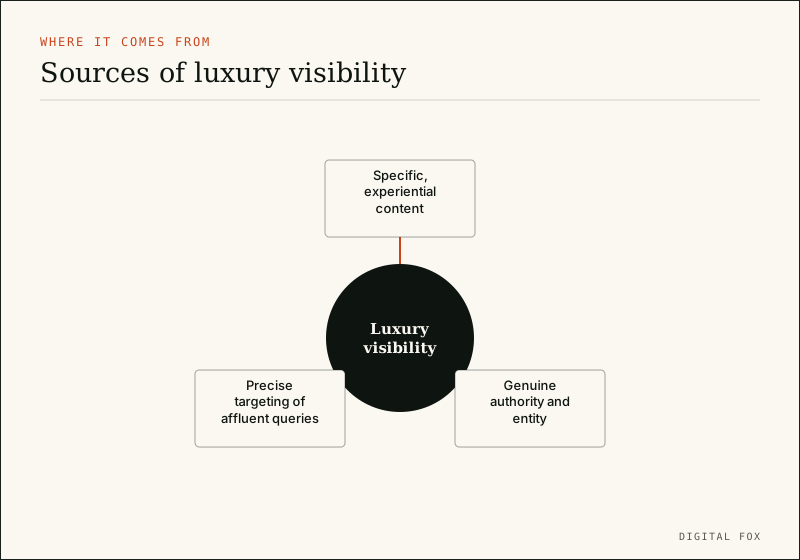
It helps to be concrete about the actual sources of luxury visibility, because building on prestige rather than price is not abstract; it means investing in specific things that reach the affluent guest and signal genuine distinction, and knowing what those are turns the philosophy into a program.
The first source is deep, specific content about the genuine experience. A luxury property earns visibility by producing content that conveys, in real and specific detail, what a stay actually offers, the particular experiences, the design and character, the service culture, the authentic sense of place, rendered with the specificity a discerning guest responds to and the substance the systems reward. This is content only the property can authentically produce about its own genuine distinction, which makes it both distinctive and defensible, and it is the foundation on which luxury visibility is built, in the spirit of the destination and experience content in area and destination content but pitched to the affluent guest's search for a specific kind of stay.
The second source is genuine authority and recognition. A luxury property builds visibility through the authority signals that align naturally with prestige, genuine recognition, a strong entity, the standing of a property understood as the distinguished place it is, which feed both traditional and AI visibility and reinforce the luxury positioning at the same time. This authority is earned rather than bought, through genuine quality and recognition rather than manipulation, and it is exactly the kind of durable signal that both reflects and reinforces luxury, connecting to the earned-authority thinking in digital PR and authority for hotels. For luxury, building genuine authority is both good SEO and good brand-building, the two moving together.
The third source is precise targeting of the right searches. A luxury property earns the right visibility by understanding and targeting the specific, experience-driven, distinction-seeking searches the affluent guest actually makes, rather than the high-volume, price-driven ones, which means researching how the right guest searches and building visibility for exactly those queries. This precise, quality-focused targeting is what reaches the valuable guest efficiently, and it is a very different exercise from the volume-maximizing keyword strategy of ordinary SEO, requiring genuine understanding of the affluent guest's intent rather than a chase for search volume. Together, specific experiential content, genuine authority, and precise targeting are the concrete sources of luxury visibility, all of them building the brand rather than trading it away.
A worked example: the property that stopped discounting.
The cost of getting this wrong, and the shape of getting it right, are clearest in a property that had been marketed as though prestige were just another word for popularity.
Consider a luxury property whose SEO had been handled like any other hotel's. It was optimized for volume and value, its content leaned on generic luxury superlatives, it chased high-volume searches, and its promotion drifted toward deals and price-driven positioning in an effort to fill rooms. The property was getting traffic, but the wrong kind: deal-seekers who did not convert at its real rates, poorly-matched prospects drawn by price, and a slow erosion of the prestige and rate integrity that were supposed to be its assets. The volume-and-price SEO was quietly cheapening a property whose whole value was that it was not cheap.
The diagnosis was that ordinary hotel SEO had been applied to a property that needed luxury SEO, and the mismatch was damaging it. The optimization for volume and price attracted the wrong guests and pressured the rate; the generic superlatives failed to convey any genuine distinction to the discerning affluent guest; the pursuit of high-volume searches brought traffic that did not match the property; and the drift toward deals undermined the rate integrity and prestige that were the property's real foundation. The SEO was not just failing to reach the right guests; it was actively eroding the brand equity the property depended on, by treating a luxury property as a volume-and-price business.
The correction was to rebuild the SEO around luxury's actual goal. The content was remade to convey genuine, specific distinction, the real experience, the authentic quality, the particular character, rendered with the specificity and confidence a discerning guest responds to, rather than empty superlatives. The targeting shifted from high-volume, price-driven searches to the experience-driven, distinction-seeking queries that reach the affluent guest. The authority and entity of the property were built up to signal genuine prestige. And the price-driven promotion and discounting were stopped, with visibility built instead on the value and distinction that justify the rate, protecting rate integrity and discretion rather than eroding them.
The result was fewer but far better guests, and a strengthened rather than eroded brand. The property attracted the affluent, high-value, direct-inclined guests who were right for it, converting at its real rates because they were drawn by genuine distinction rather than price, while the deal-seeking traffic that never converted well fell away. The rate integrity was protected, the prestige was reinforced rather than cheapened, and the property was reaching exactly the guests its economics depended on, at the rates its positioning required. It had learned that for a luxury property, the goal of SEO is not the most guests but the right guests at the right rate, and that reaching them requires protecting, not sacrificing, the brand equity that makes the property what it is.
The instructive part is that the property ended up with fewer visitors and a stronger business, which is the exact inversion of what volume-focused SEO promises and precisely what luxury requires. Had it judged its SEO by traffic, the correction would have looked like a step backward; judged by the right guests at the right rate and by the health of the brand, it was a clear step forward. That inversion, less traffic and a better business, is the signature of luxury SEO done right, and a property or practitioner who cannot accept it, who insists on reading success in volume, will keep pulling a luxury property back toward the price-and-volume approach that quietly damages it.
What not to do.
The cautions below all follow from one principle: for a luxury property, the brand is the asset, and any SEO that trades it for volume or price is a bad trade.
- Do not compete on price. For a luxury property, price competition is not merely ineffective but corrosive, cheapening the aspirational positioning that is its core asset. Being seen to compete on price is itself a loss.
- Do not optimize for volume. Volume-and-price SEO brings deal-seekers who do not convert at the property's real rates and are wrong for it, while missing the smaller, higher-value affluent segment. The right hundred guests beat the wrong ten thousand.
- Do not rely on generic luxury superlatives. The discerning affluent guest sees straight through stunning and world-class and unparalleled. Convey genuine, specific distinction with confidence, not empty adjectives.
- Do not let SEO pressure the rate downward. The rate is part of the luxury brand, so visible discounting and deal-seeking positioning damage the positioning, not just the margin. Build visibility on value and distinction that justify the rate.
- Do not violate discretion with mass-market tactics. Affluent guests value discretion, privacy, and exclusivity, and loud, cheapening tactics undermine the very appeal. Reach the right guests without shouting.
- Do not chase the highest-volume searches. Target the experience-driven, distinction-seeking queries that reach affluent guests, not the high-volume, price-driven ones that bring poorly-matched traffic. Quality of guest over quantity of traffic.
- Do not apply ordinary hotel SEO to a luxury property. Volume-and-price SEO actively erodes the prestige and rate integrity a luxury property depends on. Luxury SEO is a distinct discipline that protects the brand while building visibility.
Frequently asked questions.
These are the questions that come up when a luxury operator starts to sense that ordinary SEO is quietly working against the very things that make the property valuable.
Why is competing on price so dangerous for a luxury hotel specifically?
Because a luxury property's value rests substantially on prestige, exclusivity, and the sense of being above the price-driven scramble, and competing on price undermines exactly that. The moment a luxury property shouts discounts or positions on affordability, it cheapens the aspirational perception that drew the affluent guest, so being seen to compete on price is itself a loss regardless of any bookings won. Price competition also attracts the wrong guests, deal-seekers who do not convert at the property's real rates and are poorly matched to it, while missing the higher-value affluent segment. And it erodes rate integrity, teaching the market that the rate is negotiable and pressuring it downward, which is hard to reverse. For a property whose economics and brand depend on the right guests at the right rate, price competition damages the very assets it relies on.
How does the affluent guest search differently from a deal-seeker?
The affluent guest searches on experience and distinction rather than price. Where a deal-seeker searches on price and value, the affluent traveler searches for a specific experience, a particular property, a certain level of service or character, with price often secondary to finding the genuinely right place. They are also discerning and research deeply, caring about real quality and specific detail and readily telling genuine luxury from marketing gloss, so they respond to specific, substantive, confident content and ignore generic superlatives. And they are high-value and often direct-inclined, willing to book direct with a property they trust and inclined to a real relationship with one that matches their expectations. So reaching them is not about volume or price but about being the distinctive, genuinely excellent answer to an experience-driven search, conveyed with the specificity a sophisticated traveler responds to.
How do I build visibility without discounting?
By building it on prestige, experience, and distinction rather than price and volume. Create content that conveys genuine distinction, the specific experience, real quality, and authentic character, rendered with the specificity and confidence a discerning guest responds to rather than empty superlatives. Build genuine authority and a strong, recognized entity, since prestige and recognized authority both signal luxury and feed the signals that increasingly drive visibility. And target the experience-driven, distinction-seeking searches that reach affluent guests rather than the high-volume, price-driven ones that bring the wrong traffic. This quality-over-volume approach wins the affluent guest through genuine distinction, never entering the price competition that would damage the brand, so visibility grows without any discounting, built instead on the real excellence that justifies the rate.
What does protecting rate integrity through SEO actually mean?
It means making SEO choices that never pressure the rate downward or signal that it is negotiable. Concretely, it means avoiding price-driven promotion, visible discounting, and deal-seeking positioning in favor of building visibility on the value and distinction that justify the rate rather than apologize for it. For luxury this matters more than for ordinary properties because the rate is part of the brand, so SEO that pushes it down damages the positioning, not just the margin, and once a luxury property is seen to discount it teaches the market to wait for discounts, which is hard to reverse. Protecting rate integrity also means being willing to forgo the volume that price-driven SEO would bring, prioritizing the brand and the right guests at the right rate over maximizing traffic, which is a discipline generic volume-maximizing SEO does not exercise.
How do I stay discreet and exclusive while still being findable?
By reaching the right guests without resorting to the loud, mass-market tactics that would cheapen the property. The tension is real: a luxury property has to be visible enough to be found by the affluent guests searching for it while preserving the discretion, privacy, and exclusivity that are part of its appeal. The resolution is a lighter, more careful touch, building genuine visibility through distinction, authority, and specific excellence that reaches the right guests, rather than through the volume-and-shout tactics that violate the discreet character the guest values. The affluent guest is searching for genuine distinction, so conveying that distinction clearly and authoritatively reaches them without the mass-market noise, since the specific, substantive content that signals real luxury is itself discreet in tone, speaking to those who understand it rather than shouting to everyone, which is how luxury SEO stays findable to the right people while preserving the exclusivity that makes the property desirable in the first place.
Does luxury positioning work in AI search too?
Yes, and it aligns naturally, because the foundations of luxury SEO are exactly what AI systems favor. When an affluent traveler asks an assistant for a distinctive luxury property with particular qualities, the system looks for genuinely distinguished, recognized, specifically excellent properties, which is what a real luxury hotel is, so a property that has built genuine authority and clearly conveyed its real distinction is precisely what the system wants to surface. The nuanced, experience-driven queries that reach affluent guests are also the kind of specific request AI systems handle well, and a genuinely distinctive property that has conveyed its excellence clearly is well positioned to be the answer where generic price-competing properties are not. The discretion and rate-integrity concerns carry over too, so the approach is consistent: build genuine, specific, authoritative distinction, convey it clearly, and protect the brand, in AI search as in traditional search.
Our luxury hotel is being treated like any other hotel by our SEO. Is that a problem?
Very likely yes, because ordinary volume-and-price hotel SEO does not just fail to reach luxury's right guests, it can actively erode the brand equity a luxury property depends on. Optimizing for volume and price attracts deal-seekers who do not convert at your real rates and are wrong for the property; generic superlatives fail to convey genuine distinction to a discerning guest; chasing high-volume searches brings poorly-matched traffic; and drift toward deals and discounting undermines the rate integrity and prestige that are your actual assets. The result is a property being quietly cheapened by SEO that treats it as a volume-and-price business when its whole value is that it is not one. Luxury SEO is a distinct discipline that builds visibility while protecting the brand, and applying ordinary hotel SEO to a luxury property is a genuine problem worth correcting.
If your luxury property is being handled with ordinary volume-and-price SEO, and you can see it attracting the wrong guests or pressuring the rate and prestige you depend on, the correction is SEO built around luxury's real goal: the right guests at the right rate, reached through genuine distinction while the brand is protected. Doing that well, with the restraint and specificity luxury requires, is the kind of work a hotel SEO agency for luxury properties should understand from the start. You can see the approach on the services page, or reach us at inquiries@digitalfoxllc.com. Luxury is never won on price. It should never be marketed as though it were.