A new hotel opens, the ribbon is cut, the first guests arrive, and about a week later someone in marketing sits down to start the SEO. They register the analytics, they think about a blog, they claim the Google listing, and they begin the long climb from zero. It is diligent, it is sensible, and it is roughly a year too late. Because the properties that open into a stream of direct bookings rather than into silence did not start their search presence on opening day. They started it in the months before the building was finished, back when the hotel did not yet exist and there was nothing to sell, which turns out to be exactly the right time to become findable.
This is the guide to that head start. Pre-opening SEO is the least discussed and most valuable window in a hotel's entire search lifetime, because it is the one time you have the two things that are scarcest later: runway and a clean slate. Search results take months to develop. Authority takes months to accrue. An entity takes months for the systems to understand and trust. Reviews start at zero and grow slowly. Every one of those clocks can be started before you open, so that on opening day the property arrives into existing demand rather than beginning a cold, expensive climb while it is also trying to run a new hotel.
Most owners and operators never do this, for an understandable reason: before opening, everything is construction, financing, hiring, and a hundred urgent physical problems, and search feels like something that can wait until there are rooms to sell. That instinct is precisely the expensive mistake. The pre-opening months are not too early for SEO. They are the single best time for it, and the properties that use them open with a running start that the properties who wait spend a year trying to catch.
Why opening day is already too late.
The phrase sounds like hyperbole, and it is not. It is a statement about clocks, and once you see which clocks are running and how slowly, the timing stops being a matter of preference and becomes a matter of arithmetic.
To see why the pre-opening window matters so much, you have to understand what does not happen quickly in search, because those slow-moving things are exactly what you can start early.
Search visibility develops over months, not weeks. A brand-new domain with new content does not rank immediately even when the content is excellent; the systems need time to crawl it, assess it, trust it, and position it, and that maturation simply takes calendar time that cannot be compressed by effort. A hotel that publishes its content the week it opens is starting that clock on the worst possible day, so that its first busy season arrives while it is still invisible. The realistic timelines are laid out in how long hotel SEO actually takes, and the headline is that the clock is long and it does not care how urgently you need it to be short.
Authority accrues slowly. The links, mentions, and coverage that establish a site as credible are earned over time, and there is no way to buy a year of accumulated authority on opening day. A property that spent its pre-opening months earning genuine coverage and relationships opens with a foundation; one that starts from nothing opens with nothing.
Entity understanding takes time to build and settle. As covered in entity SEO for hotels, the systems need time to learn what your property is, corroborate it across sources, and trust it as a distinct thing. A hotel that established its entity, its listings, its structured data, and its corroborating references before opening is understood on day one; one that starts the process at opening is a fuzzy, unrecognized string for months while it tries to sell rooms.
And reviews begin at zero and grow only as guests stay. There is no legitimate way to arrive on opening day with a mature review profile, and reviews are among the strongest signals for both ranking and recommendation. The cold-start reality is unavoidable, but its impact can be shaped by having the acquisition system ready to run from the very first guest rather than being built weeks after they have already left.
Put those four slow clocks together and the conclusion is inescapable. The things that take longest in search are the things you can start before you open, and starting them early is the difference between opening into demand and opening into a year of climbing.
The pre-opening advantages you will never have again.
Starting early is not just about beating the clock. The pre-opening period confers a set of advantages that are genuinely unavailable at any other point in a property's life, and recognizing them changes how seriously the window gets taken.
Beyond simply starting the clocks early, the pre-opening period hands you specific advantages that vanish the moment you open, and it is worth naming them because they change what is possible.
You have time without pressure. Once open, every SEO decision competes with the daily emergency of running a hotel, and the temptation is always to defer the important for the urgent. Before opening, search work can be done deliberately, in the right order, without a front desk on fire. That calm is a genuine resource, and it never returns.
You have a clean slate. No accumulated technical debt, no legacy content to prune, no messy migration to untangle, no contradictory listings to reconcile. You get to build the site, the structure, the entity, and the listings correctly the first time, which is enormously cheaper than fixing them later. Most established hotels spend real effort undoing early mistakes that a pre-opening property can simply avoid.
You have a genuine story. A new hotel opening is inherently newsworthy in a way an established one is not. Local press, tourism boards, and industry publications are interested in a new property, its design, its restaurant, its arrival in the neighborhood, and that interest is a one-time window for earning coverage and relationships that would be far harder to obtain later. The opening is a PR asset with an expiry date.
And you have the ability to shape the entity from birth. Rather than correcting a confused or blended entity later, you can establish a clean, clear, well-defined one from the start, consistent everywhere, disambiguated from any namesakes before the confusion ever sets in. Establishing an entity correctly is far easier than repairing one.
These advantages are real and they are temporary. The pre-opening window is the one moment a hotel has calm, a clean slate, a story, and a blank entity all at once, and using it is worth more than any amount of catch-up effort afterward.
What you build before you exist.
The objection is intuitive and worth taking seriously, because answering it properly is what unlocks the entire strategy: how can you possibly do SEO for a hotel that does not yet exist?
The natural objection is that you cannot do SEO for a hotel that has no rooms to sell, no guests to review it, and nothing yet to say. This is wrong, and seeing why is the heart of pre-opening strategy. A great deal of the most valuable search work has nothing to do with selling rooms you do not yet have.
You can build the foundation: the domain, the site architecture, the technical setup, the analytics, the structured data, all done correctly and early so they are mature and clean by opening. You can establish the entity: the listings, the profiles, the consistent information, the corroborating references, so the systems understand what you are before you open. You can build destination authority: content about your location, your neighborhood, and the experience of visiting your area, which requires no rooms and which is exactly what a new property needs to become a recognized voice about its place. You can earn relationships and coverage, using the opening as the story. You can prepare the booking and conversion path so it works from the first reservation. And you can build the review acquisition system so it runs from the first guest.
Notice that none of this requires the hotel to be open. All of it can be substantially complete before the doors open, so that opening day is the moment the property arrives into a search presence that is already warm rather than the moment it starts building one from cold. That reframing, from "SEO begins when we open" to "SEO is substantially built before we open," is the whole of the strategy.
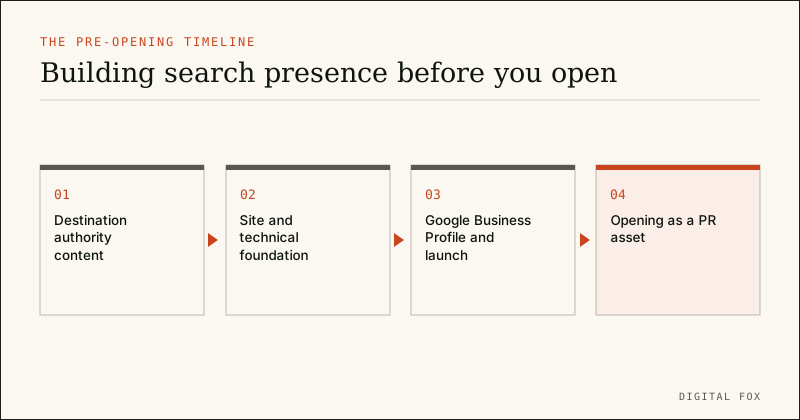
The pre-opening timeline.
Knowing that the work should start early is not the same as knowing what to do when. The sequence below places each task where it needs to be so that the slow clocks all finish by opening rather than starting there.
Working backward from opening day, here is the sequence that gives each slow clock the time it needs. The exact spacing depends on your runway, but the order matters more than the precise months.
Earliest: secure the domain and foundation.
As soon as the name is decided, secure the domain and stand up at least a basic, indexable site, even if it is only a holding presence with real information. This starts the domain's maturation clock at the earliest possible moment, and every week it exists and is crawled is a week of aging you will be glad of later. Establish analytics and search console from the start so you are measuring from day zero.
Early: build the real site and its architecture correctly.
Build the actual website with a clean structure, correct technical foundation, accurate structured data, and a sound information architecture, getting right the things that are painful to fix later. This is the clean-slate advantage in action, and the fundamentals are in what technical SEO for hotels actually means.
Early and ongoing: establish the entity.
Set up the listings, profiles, and references, all consistent, all accurate, all disambiguated from any namesakes from the very beginning. Give the systems the months they need to understand and trust your property as a distinct entity before you open.
Ongoing: build destination authority through content.
Begin publishing genuinely useful content about your location, neighborhood, and destination, the content that needs no rooms and that positions you as a real voice about your place well before opening. This is the longest-lead item, so start it as early as you can.
Mid: earn coverage and relationships using the opening story.
As the opening approaches and becomes concrete enough to be newsworthy, pursue local press, tourism board relationships, and industry coverage, capturing the one-time interest a new property generates.
Pre-launch: ready the booking path and review system.
Ensure the direct booking path works flawlessly and is crawlable, and build the review acquisition process so it runs from the first guest. Both should be tested and ready before the first reservation, not assembled afterward.
Opening: switch from building to running, into existing demand.
By opening day, the foundation is mature, the entity is understood, the destination content is ranking, the coverage is earned, and the systems are ready. The property opens into a warm search presence and starts converting rather than starting to build.
The point of the sequence is that each item is placed to give the slow clocks their time. Domain aging, content maturation, entity trust, and relationship building all take months, so all of them start early. Reviews cannot start until you have guests, so their system is merely readied. Sequenced this way, opening day is a handover from building to running rather than the start of the build.
Destination authority: the content you can write with no rooms.
Of everything you can build before opening, this is the piece that most directly answers the objection that a hotel with no rooms has nothing to say. It has a great deal to say, just not about itself yet.
The richest pre-opening content opportunity, and the one most properties miss entirely, is destination and neighborhood authority. You cannot yet write about your rooms honestly, or your service, or your guest experience, because none of it exists. But you can write, with genuine expertise, about your location, and that is exactly the content a new property most needs.
Think about what a traveler considering your area actually searches for: things to do, where to stay in which neighborhood, how to get around, what is nearby, when to visit, what the area is like. This is the destination-intent content examined in hotel area guides and ranking for things-to-do queries, and it has three properties that make it ideal for a pre-opening hotel. It requires no rooms, only genuine knowledge of the place. It has a long maturation runway, so starting it early is exactly right. And it establishes your property as a credible, knowledgeable voice about its destination before you ever sell a night, so that when you do open, you are already the property that clearly knows its area.
The key is genuine specificity and first-hand knowledge, not generic filler, because thin destination content is exactly what recent quality reassessments discount. Your team, your owners, and your local partners know the neighborhood in ways a generic writer never could, and that first-hand knowledge is what makes the content genuinely useful and genuinely rankable. Written well over the pre-opening months, this content matures into a real authority position that greets your opening rather than trailing it.
There is an AI dimension too. Destination content published early, accurate and specific, becomes part of what the assistants draw on when travelers ask about your area, so that your property is established in the AI picture of its destination before opening, a dynamic explored in generative engine optimization for hotels. Being a known, described entity in your destination's answer set from day one is a meaningful head start.
Understanding your demand before you have any.
Before you build a single page, it is worth knowing what you are building it for, and the pre-opening window is the only time you get to do that research before committing to any content at all.
One pre-opening task pays off through the entire life of the property and is almost never done at the right time: genuinely understanding the search demand your hotel will compete for, before you open, so that everything you build is aimed at real queries rather than assumptions.
A property that opens without this research tends to build its content and its pages around what its team imagines guests search for, which is frequently wrong, skewed toward the property's own language rather than the traveler's. A property that does the research first builds around what people actually search: the real queries, the real demand levels across the seasons, the real language travelers use about the destination, and the genuine gaps where demand exists but good content does not. The discipline is covered in keyword research for hotels, and doing it pre-opening means the entire site and content plan is pointed at reality from the start.
The pre-opening timing has a specific advantage. Because you are not yet committed to any content, you can let the demand research shape the whole architecture: which destination topics deserve real pages, which neighborhoods and experiences travelers actually search, which seasonal patterns your content calendar should anticipate, and where the competitive gaps are that a new, genuinely expert voice could fill. An established property has to retrofit this understanding onto content it already built; a pre-opening property gets to build correctly the first time.
It also informs the harder strategic questions. Which queries are genuinely winnable for a new property with no authority yet, and which are dominated by incumbents and OTAs and should be approached only over the long term. Where the achievable early wins are, the specific, lower-competition, high-intent queries a new property can realistically rank for within its first months, which is exactly where a new hotel should concentrate its early content. Understanding this before opening means the first content does real work rather than chasing terms a new domain cannot yet win.
The opening as a one-time PR asset.
Of all the pre-opening advantages, this one has the sharpest expiry date, and letting it pass unused is among the most common and most regretted omissions a new property makes.
A new hotel opening is genuinely newsworthy, and that newsworthiness is a wasting asset: it exists in the months around the opening and largely evaporates afterward, when the property becomes just another established business. Using it well is one of the highest-return pre-opening activities, because it earns the coverage and relationships that would be far harder to obtain once the novelty is gone.
The interest is real and varied. Local press covers new businesses arriving in the community, particularly ones with design, dining, or economic significance. Tourism boards and destination organizations are interested in new properties that add to their region's offering. Industry and hospitality publications cover notable openings. Local influencers and community voices are curious about a new place. Each of these is a chance to earn genuine coverage and to build a relationship that outlasts the opening, and the disciplined approach to converting that interest into lasting search value is in digital PR and link building for hotels.
The value is double. In the near term, the coverage earns authority and relationships at exactly the moment a new domain most needs them, accelerating the slow authority clock. In the longer term, it establishes the property in the entity and reference picture of its destination, so the systems and the assistants learn about it through independent, credible sources from the start, a foundation examined in where AI actually gets its hotel information. A new property that captures its opening coverage well is understood and corroborated by the wider web far sooner than one that lets the moment pass.
The practical discipline is to prepare for this window rather than hope to catch it. Have the story clear, the assets ready, the relationships approached in advance, and the property's distinctive angle, whatever genuinely makes it worth covering, articulated. The opening happens once, the interest peaks once, and a property that is ready captures far more of it than one that scrambles when a journalist happens to call.
The pre-opening Google Business Profile question.
The Google Business Profile deserves specific attention, because its handling before opening is genuinely nuanced and easy to get wrong.
Google provides a way to represent a business that has not opened yet, allowing an opening date to be set so the property can begin establishing its presence before it operates. This lets you start building the profile, the single most direct input into your local entity understanding, before opening, which is exactly what you want. The detailed optimization of the profile itself is covered in Google Business Profile optimization, and the pre-opening nuance is layered on top.
The care required is around accuracy and verification. The profile's information must be truthful, including the opening status and date, because misrepresenting an operating status can cause problems, and the verification process, which confirms the business is real and at its stated location, has its own requirements and timing that you want to navigate calmly in advance rather than in an opening-week scramble. Setting this up early, accurately, and with a realistic opening date lets the profile begin its work while giving you time to handle verification without pressure.
What you should not do is create a misleading or premature presence that claims to be open when it is not, or that carries information you cannot stand behind. The systems and your first guests both punish that. The right approach is an honest, accurate, clearly pre-opening profile, established early, that starts building your local entity truthfully and is ready to flip to fully operational on opening day.
The review cold-start, handled honestly.
Reviews are the one asset that genuinely cannot be pre-built, which makes them the exception that proves the rule, and the honest handling of that constraint separates properties that build a healthy profile fast from those that stumble out of the gate.
Reviews are the one thing you genuinely cannot build before opening, and how you handle the cold start shapes your first months significantly.
Be clear about what is not acceptable first. You cannot, and must not, arrive on opening day with reviews, because there is no legitimate source for them: nobody has stayed. Fake reviews, reviews from staff or friends who did not genuinely stay, or any manufactured review profile are against every platform's policies, detectable, and capable of doing lasting damage to a property in its most fragile moment. The temptation is real for a new property staring at an empty review profile, and it must be resisted absolutely, a point that runs through hotel reviews and reputation management.
What you can and should do is have the acquisition system fully built and ready to run from the very first guest. The single biggest determinant of how fast a new property accumulates a healthy review profile is whether it starts asking every guest, promptly and frictionlessly, from day one, or whether it gets around to setting up a review process weeks later after the early guests have already left unasked. Those early guests are precious, because their reviews are your entire profile for a while, and losing them to a system that was not ready is a loss you cannot recover.
So before opening, build the review request into the guest journey: the timing, the prompt, the frictionless path, the follow-up, all designed and tested so that the first guest to check out is asked properly. Prompt for genuine specifics rather than generic praise, so that even your earliest reviews carry the evidence that helps you rank and get recommended. Handled this way, the cold start is as short as it can honestly be, and the property builds a real, fast-growing review profile from its first week rather than from whenever someone remembered to set one up.
Direct booking readiness from the first reservation.
All the visibility work in the world is wasted if the demand it creates arrives at a booking path that does not convert or that quietly routes everyone to the OTAs. Pre-opening is when you make sure it does neither.
There is a particular tragedy in a new hotel that does all the visibility work, opens into genuine demand, and then funnels that hard-won demand straight to the OTAs because its own booking path was an afterthought. Pre-opening is the time to ensure that does not happen.
A new property has a rare opportunity to establish healthy channel habits from the start rather than developing an OTA dependence it later has to unwind. From the first reservation, the direct booking path should work flawlessly, be fully crawlable and indexable rather than hidden behind scripts the systems cannot read, load fast, work on mobile, and present a genuinely better reason to book direct than to book through an intermediary. The crawlability piece specifically is a common and expensive blind spot, examined in booking engine SEO and crawlability, and getting it right before opening avoids discovering after launch that your rates and availability were invisible to search all along.
This matters more for a new property than an established one, because the channel patterns set in the first months tend to persist. A hotel that opens with a strong direct path and the visibility to feed it can build a healthy direct share from the start. A hotel that opens dependent on OTAs, because that was the only path ready on day one, spends years and margin trying to claw that dependence back, the exact struggle described in hotel direct booking SEO. The pre-opening window is your chance to start on the right side of that.
Measuring progress when there is nothing to sell.
A reasonable worry about pre-opening SEO is that it produces no bookings, because there are no rooms, so it can feel like spending on something unmeasurable. That worry is answerable: there is plenty to measure before opening, and watching the right indicators keeps the work honest and reassures anyone funding it.
Before opening, the meaningful signals are leading rather than commercial. Whether your site is indexed and being crawled cleanly. Whether your destination content is beginning to earn impressions and positions in search console, which it will start to do well before opening if it is genuinely good. Whether your entity is becoming understood, visible in how the systems and assistants describe your property as opening approaches. Whether your coverage and references are accumulating. And whether your foundation, speed, structure, and crawlability, is genuinely sound. None of these is a booking, and all of them are real evidence that the property is arriving into search rather than starting cold.
The most encouraging pre-opening signal is destination content gaining traction. When your neighborhood and things-to-do content starts appearing in search and earning impressions months before you open, that is direct proof that the property is becoming a recognized voice about its place, and it is the clearest sign that opening day will arrive into an audience rather than into silence. Watching that curve build through construction is both a genuine measurement and a real morale boost for a team surrounded by physical work.
After opening, the leading indicators hand off to the commercial ones, and the handoff should be visible: the destination authority and entity understanding built pre-opening convert into early direct bookings, into a review profile that fills quickly because the system was ready, and into a healthier channel mix because the direct path worked from day one. A property that measured its pre-opening leading indicators can show, at opening, exactly why its launch outperforms a property that started cold, which is also the argument that justifies doing this work at all.
The first ninety days after opening.
The pre-opening months are the setup, but the payoff arrives in the first phase of operation, and it arrives only for properties that keep running the program instead of exhaling on opening day.
Pre-opening work sets up the launch, but the opening itself begins a distinct and intense phase, and the properties that benefit most from their pre-opening head start are the ones that transition cleanly into running the program rather than treating opening day as the finish line.
At opening, several things switch on at once. The review engine, built and waiting, starts asking the first guests and should begin filling the profile immediately. The Google Business Profile flips from pre-opening to fully operational and its local signals begin working in earnest. The property's honest, first-hand content about its own rooms, service, and guest experience, which could not exist before, can finally be written and begins to complement the destination authority already in place. And the direct booking path, tested pre-opening, starts converting the demand the visibility work created.
The discipline of these first months is to run the program steadily rather than to relax because the launch went well. Keep asking every guest for reviews. Keep publishing, now adding the experiential content that only an operating hotel can produce. Watch the entity settle and correct any drift. Maintain the direct path and the channel habits. The structured approach to this early operating phase is set out in the first thirty days of a hotel SEO program, and for a property that did its pre-opening work, these first months are about compounding a lead rather than starting a climb.
The contrast with a cold-start property is starkest here. In the first ninety days, the prepared property is converting demand, filling reviews, and publishing experiential content on top of a mature foundation, while the unprepared one is still setting up basics, waiting for a new domain to gain traction, and wondering why the bookings are all coming through the OTAs. Ninety days after opening, the gap the pre-opening months created is not closing. It is widening.
A worked example: opening into demand.
Consider two comparable new independent hotels, opening in the same kind of market within a few months of each other. Both are good properties with capable teams. They differ in exactly one respect: when they started their search work.
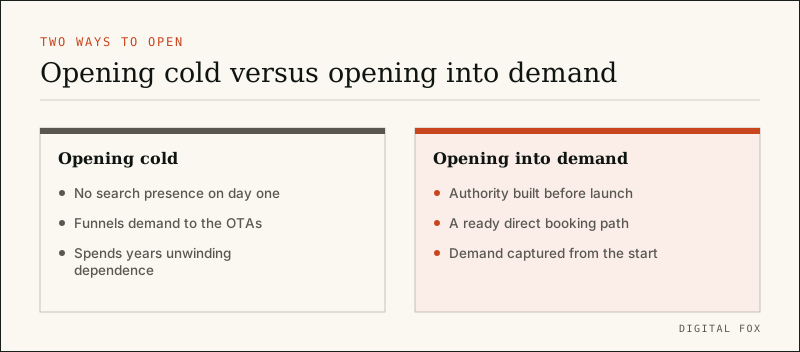
The first treats SEO as a post-opening task. Through construction and fit-out, all energy goes to the physical property, the financing, and the hiring, which is entirely understandable. The website goes live close to opening. The listings are set up in the opening weeks. Content begins after the doors open. The review process is assembled a few weeks in, after the first guests have come and gone. On opening day, the property is invisible in search: a brand-new domain with no authority, an entity the systems do not yet understand, no destination content ranking, no earned coverage, and an empty review profile. It opens into silence, and it spends its first year climbing from zero while simultaneously learning to run a hotel, its early bookings arriving overwhelmingly through the OTAs because that was the only channel ready.
The second treats the pre-opening months as the SEO window. The domain is secured and a basic site stood up as soon as the name is chosen. The real site is built early, cleanly, correctly. The entity is established months ahead, consistent and disambiguated. Destination content is published steadily through construction, maturing into a genuine authority position about the neighborhood. As the opening becomes concrete, the property captures the one-time press interest a new hotel generates, earning coverage and relationships. The booking path is built and tested to work from the first reservation. The review system is ready to ask the first guest who checks out. On opening day, the property arrives into a warm search presence: destination content already ranking and feeding the AI picture of its area, an entity the systems understand, earned authority, a direct booking path ready to convert, and a review engine that starts filling from week one.
The second property does not open into silence. It opens into existing demand, and it converts that demand at a far healthier direct share, because everything was ready. Over the first year the gap compounds: the first property is still climbing the slow clocks it started late, while the second is already building on foundations it laid before it existed. Neither hotel is better than the other. One simply used the months the other wasted.
Making the case to owners and investors.
Pre-opening SEO faces a particular obstacle that post-opening SEO does not: it competes for budget and attention during the period when a development is spending heavily on physical construction and generating no revenue, and it is easy for a decision-maker to defer something intangible in favor of the very tangible building. Winning that argument is part of the work.
The case rests on a simple asymmetry. Every slow-moving search asset started before opening is mature by launch; every one deferred to opening day begins a months-long climb during the property's most cash-sensitive early period, when empty rooms are most expensive. Framed in the owner's own terms, pre-opening SEO is not an early cost; it is the difference between opening into revenue and opening into a ramp, and the ramp is paid for in the discounted rates and OTA commissions a property accepts when it cannot yet fill itself directly.
The comparison to the physical timeline usually lands. No developer would leave the landscaping, the signage, or the booking systems until a week after opening, because those are understood as part of being ready to operate. Search visibility is exactly the same kind of thing: infrastructure that must be in place to open properly, that takes months to build, and that cannot be rushed at the end. Presented that way, it stops being a marketing nicety competing with construction and becomes part of opening readiness, which is the category where it belongs.
It also helps to be concrete about the cost of waiting. A property that opens invisible relies disproportionately on the OTAs for its early bookings, paying commission on the very reservations it can least afford to give margin away on, and it often develops a channel dependence that persists for years. The pre-opening investment, by contrast, is finite, front-loaded, and produces an asset that compounds. An owner who sees the choice as commission-heavy ramp versus front-loaded investment in a compounding asset tends to fund the work, particularly when it is framed as opening readiness rather than as speculative marketing.
Finally, the leading indicators discussed earlier give owners something real to watch for their money before a single room is sold. Destination content earning impressions, the entity becoming understood, coverage accumulating, the foundation testing clean: these are visible, measurable signs of progress that reassure a stakeholder that the pre-opening investment is doing something, which is often what the argument actually needs.
The re-opening and re-brand variant.
The same logic applies, with adjustments, to a property that is re-branding, re-positioning, or re-opening after a major renovation, and the adjustments matter because this scenario carries a risk a true new-build does not: existing search equity that can be lost.
A re-brand or re-open is not starting from zero. There is an existing domain, existing rankings, existing reviews, an existing entity, and existing authority, and the central challenge is to carry that equity forward through the change rather than destroying it. A botched name change, a careless domain migration, or a redirect plan that loses the old URLs can wipe out years of accumulated authority in a way that a new-build, having none to lose, never risks. The discipline for protecting equity through a change is the subject of hotel website migration without losing rankings and hotel rebrand SEO and content strategy, and it should be planned before anything changes, not discovered afterward.
The pre-change window is used similarly to the pre-opening one: to prepare everything so that the transition is clean and the equity survives. Map the old presence to the new, plan the redirects, prepare the entity transition so the systems understand the property is changing rather than disappearing, ready the new content and listings, and update the reviews-facing name carefully. Done in advance and deliberately, a re-brand carries its equity forward and adds to it. Done in a rush at the moment of change, it can cost the property much of what it spent years building.
What not to do.
- Do not wait until opening day to start. The slow clocks, visibility, authority, entity trust, and content maturation, all take months, and starting them at opening means opening into a year of climbing. Start them before the building is finished.
- Do not fake reviews to fill an empty profile. There is no legitimate source of reviews before guests stay, and manufactured reviews are detectable, against policy, and capable of lasting damage in the property's most fragile moment.
- Do not create a misleading pre-opening presence. An honest, accurate, clearly pre-opening profile builds your entity truthfully. One that claims to be open or carries information you cannot stand behind causes problems with both the systems and your first guests.
- Do not leave the booking path as an afterthought. A new hotel that opens into demand and funnels it to the OTAs because its direct path was not ready sets a dependence it spends years unwinding. Build and test the direct path before the first reservation.
- Do not publish thin, generic destination content just to have volume. Recent quality reassessments discount exactly that. The pre-opening content that works is genuinely specific and first-hand, and it needs the runway that only an early start provides.
- Do not, in a re-brand or re-open, change the name or domain without an equity-protection plan. Unlike a new-build, you have accumulated authority to lose, and a careless transition can destroy it.
- Do not treat pre-opening SEO as premature. It is not too early; it is the single best window a hotel ever gets, and skipping it forfeits advantages that never return.
Frequently asked questions.
When should a new hotel start its SEO?
As early as possible, ideally as soon as the name and location are decided, which is often many months before opening. The reason is that the most valuable search assets, visibility, authority, entity understanding, and content maturity, all develop over months and cannot be rushed. Starting them at opening means opening into invisibility and spending the first year climbing from zero. The pre-opening months, when the property has calm, a clean slate, and a genuine story, are the single best window a hotel ever gets for building its search presence.
How can you do SEO for a hotel that has no rooms to sell yet?
Most of the highest-value pre-opening work does not involve selling rooms at all. You build the technical foundation and site architecture correctly, establish your entity through consistent listings and references, publish genuine destination and neighborhood authority content that needs only knowledge of the place, earn coverage using the newsworthiness of a new opening, and prepare the booking and review systems to run from day one. All of this can be substantially complete before you open, so that opening day is a handover from building to running rather than the start of the build.
Can I set up a Google Business Profile before my hotel opens?
Yes. Google lets you represent a business that has not opened yet and set an opening date, so you can begin building the profile, the most direct input into your local entity understanding, before you operate. The care required is accuracy: the information and opening status must be truthful, and the verification process has its own timing you want to handle calmly in advance rather than in an opening-week scramble. Set it up early, accurately, and with a realistic opening date, and never create a misleading presence that claims to be open when it is not.
How do new hotels get reviews when nobody has stayed yet?
You cannot and must not have reviews before guests stay, and faking them is against policy, detectable, and damaging in the property's most fragile moment. What you do is have the acquisition system fully built and ready to ask the very first guest who checks out, promptly and frictionlessly, prompting for genuine specifics rather than generic praise. The biggest determinant of how fast a new property builds a healthy review profile is whether it starts asking from day one or gets around to it weeks later after the early guests have already left unasked.
What is the single most important pre-opening SEO task?
If forced to choose one, start the destination-authority content as early as possible, because it has the longest maturation runway, requires no rooms, and establishes you as a credible voice about your place before you open. But the more honest answer is that the value comes from starting all the slow clocks early, foundation, entity, content, and relationships, so that they are mature by opening. The specific tasks matter less than the timing, because the whole advantage of pre-opening SEO is giving the slow-moving assets the months they need.
Is pre-opening SEO different for a re-brand or re-opening?
Yes, in one crucial respect: a re-brand or re-open is not starting from zero, so it has existing search equity to protect. The central risk is losing accumulated authority, rankings, reviews, and entity understanding through a careless name change or domain migration, which a true new-build never faces because it has nothing to lose. The pre-change window is used to plan the transition carefully, map old to new, prepare redirects, and carry the equity forward. Done deliberately in advance, a re-brand adds to its equity; done in a rush, it can destroy years of work.
How long before opening should each task begin?
Work backward from opening and give each slow clock its runway. Secure the domain and a basic indexable site as early as possible, since domain aging cannot be rushed. Build the real site and establish the entity early, since both take months to mature and settle. Start destination content as early as you can, since it is the longest-lead item. Pursue coverage as the opening becomes concrete and newsworthy. Ready the booking path and review system in the final stretch so both work from the first reservation. The exact months depend on your runway, but the order, foundation and content first, reviews last, holds regardless.
If you have a property in development and want its search presence built during the pre-opening months rather than scrambled together after launch, so that it opens into demand instead of silence, that is exactly the kind of engagement Digital Fox is built for. You can see the approach on the services page, or reach us at inquiries@digitalfoxllc.com. The hotel opens in six months. Its search presence should have opened already.