Here is a report a hotel might receive after six months of SEO. Organic traffic up 140 percent. Keyword rankings improved across 400 terms. Impressions up 600 percent. Domain authority climbing. Page after page of green arrows pointing up. It looks like a triumph, and the hotel might reasonably conclude the work is going brilliantly. Then it looks at the only number that pays the bills, direct bookings and the revenue behind them, and finds it essentially flat. Every impressive metric in that report was real, and not one of them filled a room. This is the central trap in judging hotel SEO, and learning to see through it is the difference between rewarding activity and rewarding results.
This is the guide to judging hotel SEO by what actually matters. The industry runs on vanity metrics, traffic, rankings, impressions, authority scores, because they are easy to measure, easy to grow, and easy to report impressively, and because they usually move up even when the business does not. But a hotel does not live on traffic; it lives on bookings at good rates, and much of what gets reported as success is activity that never reaches that outcome. Learning to judge hotel SEO, and the agencies who do it, by revenue and direct bookings rather than by the flattering proxies is one of the most valuable skills a hotel owner or operator can develop, because it protects them from paying for motion that goes nowhere.
So we will work through it properly. Why vanity metrics are so seductive and so misleading for a hotel specifically. What the metrics that actually matter are, and how they differ. How to read a hotel SEO case study without being fooled by impressive-sounding numbers. Why the proof hierarchy should lead with revenue and treat traffic as a distant supporting act. How this reframes the way you should evaluate an agency and its reporting. And the honest complications, because measuring true results is genuinely hard, which is part of why the easy proxies persist.
Why vanity metrics seduce.
The trap only works because the misleading metrics are genuinely appealing, so it pays to understand the pull before trying to resist it.
To judge results well, you first have to understand why the misleading metrics are so appealing, because their appeal is exactly what makes them dangerous. Vanity metrics are not reported out of dishonesty, usually; they are reported because they are easy, flattering, and superficially plausible, which is a potent and misleading combination.
Start with why they are easy. Traffic, rankings, and impressions are simple to measure with standard tools, available in abundance, and require no connection to the messy reality of bookings and revenue. An agency can report them without ever grappling with the hard question of whether the work produced any actual business, and a hotel can receive them without having to do the difficult attribution work that real outcomes require. The ease is seductive on both sides, because it lets everyone avoid the genuinely hard measurement problem, which we will come to.
Then there is why they flatter. Vanity metrics almost always go up. Publish content and traffic rises; target enough terms and rankings improve somewhere; expand coverage and impressions grow. These numbers trend upward with activity almost regardless of whether the activity produces business, which means they can show impressive growth during an engagement that delivered no additional bookings at all. A report full of rising vanity metrics looks like success and feels like success, and it takes deliberate skepticism to ask the uncomfortable question of whether any of it reached the bottom line.
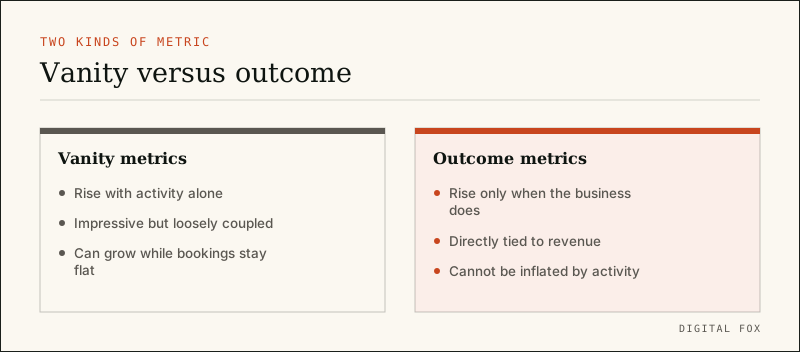
And there is why they are plausible. Traffic, rankings, and impressions are not irrelevant; they are genuinely part of the mechanism by which SEO eventually produces bookings, which is exactly what makes them convincing as proxies. The problem is that they are upstream of the outcome and loosely coupled to it: traffic that does not convert, rankings on terms that do not book, impressions on searches that fill no rooms, all move the proxy without moving the business. The metrics are real and related to success, which is precisely why they are such effective camouflage for a lack of it. The distinction between activity and outcome, and why hotels are especially prone to confusing them, runs through how SEO impacts hotel revenue.
The metrics that actually matter.
Naming the honest measures is the necessary counterpart to exposing the misleading ones, because a property needs something to judge by once it stops trusting the proxies.
If the flattering metrics mislead, the honest ones share a property that makes them trustworthy: they cannot go up unless the business does.
If traffic and rankings are the wrong measures, what are the right ones? The metrics that actually matter for a hotel are the ones tied to the business it lives on, bookings, revenue, and the channel mix, and they differ from the vanity metrics in that they resist easy inflation and cannot rise while the business stays flat.
The first and most important is direct bookings and the revenue behind them. The whole point of hotel SEO, ultimately, is to fill perishable inventory profitably by driving bookings, especially direct ones that avoid commission, so the measure that matters most is whether direct bookings and direct revenue actually grew. This is the number that pays the bills, and unlike traffic, it does not rise on activity alone; it rises only when the work genuinely produced bookings, which is exactly why it is the honest measure and the vanity metrics are not.
The second is the channel mix and commission burden. Because a hotel's strategic problem is dependence on commission-bearing OTAs, a central measure of success is whether the balance shifted toward direct and away from intermediated, reducing the commission that erodes profitability, the substance of direct booking versus OTA economics. An engagement that grew total bookings but left the property just as dependent on the OTAs has not solved the real problem; one that shifted the mix toward direct has, and the channel mix reveals which happened in a way traffic never could.
The third is revenue quality and pattern, not just volume. Because inventory is perishable and rate matters, the value of the bookings, at what rates, filling which periods, matters as much as the count. Bookings that filled the soft periods, held rate rather than discounting, and improved the property's revenue pattern are worth more than a raw booking count, and a genuine measure of hotel SEO reads revenue in this textured way rather than as a single flat number, connecting to the demand-shaping logic of seasonal demand content strategy. A booking count treats a discounted room filled on an already-busy night the same as a full-rate room that rescued an empty midweek, when their value to the property is worlds apart, which is why volume alone is a poor measure and revenue read against rate and period is the honest one.
A fourth measure worth watching is the strength of the property's owned demand over time, the branded search it commands, the direct relationships it is building, the audience it owns, since these are the durable assets that reduce dependence on both the OTAs and on paying to reacquire the same guests. Growth in owned, branded, and direct demand is a sign that the SEO is building lasting equity rather than renting temporary visibility, and it connects to the owned-audience thinking in building a first-party audience. This is a slower, more strategic measure than a booking count, but it captures whether the work is compounding into something the property keeps, which is exactly the kind of outcome a vanity metric cannot see. The common thread is that these metrics all reach through to the business, and none of them can be inflated by activity that produces no bookings, which is what makes them the honest measures and the vanity metrics the flattering ones.
Reading a case study without being fooled.
The discipline you apply to your own numbers has to be turned outward too, onto the polished proof an agency puts in front of you when it is trying to win the work.
The same instinct that judges your own reports has to be turned on the proof an agency shows you before you hire it, because a case study is where flattering numbers are most polished and most persuasive.
Case studies are how agencies prove their results, and they are also where vanity metrics do their most persuasive work, so learning to read one skeptically is essential when evaluating who to trust. The same discipline that judges your own results judges an agency's proof.
The first thing to look for is whether the case study leads with business outcomes or with proxies. A case study that leads with revenue, direct bookings, and commission avoided is claiming the thing that matters; one that leads with traffic, rankings, and impressions is claiming the proxies, and the difference reveals what the agency actually optimizes for and can actually deliver. A property should be far more impressed by a claim of substantial direct-revenue growth than by a claim of substantial traffic growth, because the first is the outcome and the second is a proxy that may or may not have reached it.
The second is to interrogate impressive-sounding numbers for what they omit. A huge traffic increase says nothing about bookings; a dramatic ranking improvement says nothing about whether those terms convert; a massive impression growth says nothing about clicks or business. The most impressive vanity number tells you nothing about the outcome, and a case study built on such numbers, however large, may be describing an engagement that produced no additional bookings. The skeptical reader asks, of every impressive metric, "and did that produce bookings and revenue," and treats the absence of that answer as telling.
The third is to value honesty and specificity over polish. A credible case study is specific about real business outcomes, honest about the context, and clear about what was actually achieved for the property's bottom line, even where the story is textured rather than a wall of green arrows. A case study that is all dramatic proxies and no business outcome, or that is vague about revenue while precise about traffic, should raise skepticism rather than admiration. A useful habit is to mentally rewrite each proxy claim as an outcome question and see whether the case study answers it. "Traffic up 300 percent" becomes "did bookings rise," "ranked number one for a major term" becomes "did that term book anyone," "impressions up tenfold" becomes "did any of those searchers stay." If the case study answers those questions with real business outcomes, it is proof; if it leaves them unanswered behind a wall of proxies, it is a description of activity wearing the costume of proof, and the honest reader treats the missing answers as the most important thing on the page.
This is exactly why the strongest proof a hotel SEO practitioner can offer is a genuine revenue outcome, and why, on our own hotel SEO agency work, the proof we lead with is a real revenue figure from a real engagement rather than a traffic chart, a choice explained in the way we present our hotel SEO case studies.
The proof hierarchy: revenue first.
Skepticism is easier to apply when you have an explicit ladder of what counts as real proof, so it is worth setting one out plainly.
Reading proof well is easier with an explicit ranking of what actually demonstrates results, from the outcome itself down to the proxies that merely hint at it.
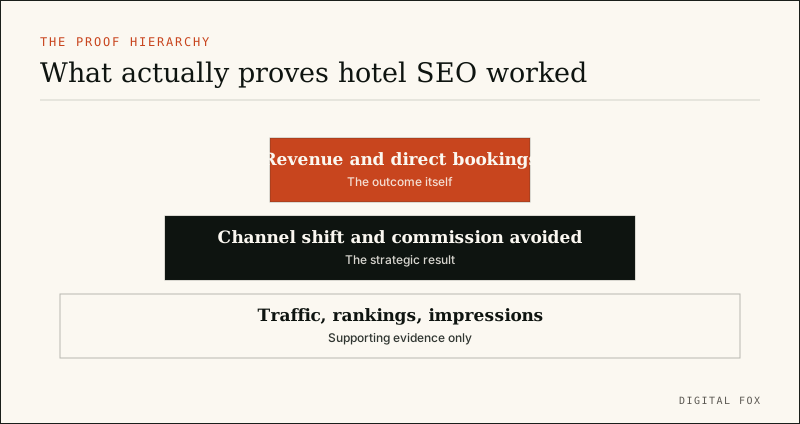
All of this implies a hierarchy of proof, an order of what actually demonstrates that hotel SEO worked, and getting the hierarchy right is what lets a property, or a practitioner, reason honestly about results. Revenue sits at the top, and the proxies descend from there.
At the top is revenue and direct bookings, the actual business outcome. A genuine increase in direct revenue and direct bookings is the strongest possible proof that hotel SEO worked, because it is the outcome itself, not a proxy for it, and it cannot be manufactured by activity that produced no business. When a property or a practitioner can point to real revenue growth from the work, that is proof at the highest level, and everything else is supporting evidence.
Below that sits the channel shift and commission avoided, which is business outcome of a slightly more specific kind: evidence that the work moved the balance toward direct and reduced the commission burden. This is strong proof because it speaks directly to the strategic problem hotel SEO exists to solve, and it is hard to fake, since a real channel shift shows up in the actual booking sources.
Only below these do the proxies belong, and only as supporting evidence for the outcomes above them. Traffic, rankings, and impressions have a place, as the mechanism through which the revenue was produced and as leading indicators of work that should eventually book, but they are supporting actors, not the headline, and they prove the outcome only insofar as the outcome itself is also demonstrated. A proof hierarchy that leads with revenue and treats the proxies as support is honest; one that leads with proxies and never reaches revenue is, wittingly or not, substituting activity for outcome. There is a useful tell in this: the party most confident in its actual results is usually the one most willing to be judged by the outcome rather than the proxy, because it has the outcome to show. A practitioner who leads with a real revenue figure is exposing itself to the hardest possible standard and inviting scrutiny on the number that matters, which is itself a signal of confidence in the work, whereas one that leads with traffic is choosing the standard that is easiest to meet. This inversion, leading with the revenue outcome rather than the traffic metric, is a deliberate principle, and it is why the strongest hotel SEO proof looks different from the traffic-led case studies the industry usually produces.
How this reframes evaluating an agency.
The hierarchy is not only a way to read results after the fact; it is a lens for sizing up an agency before you commit and for keeping it honest once you have.
Once the hierarchy is clear, it becomes a practical lens for judging not just a result but the agency behind it, before you hire and all the way through the engagement.
Understanding the proof hierarchy reframes how a hotel should evaluate an agency and its reporting, both before hiring and throughout an engagement, because it gives a clear test: does the agency orient to outcomes or to proxies? That orientation predicts almost everything about the value the agency will deliver.
Before hiring, the test is what the agency's proof and pitch lead with. An agency that talks in terms of revenue, direct bookings, and the channel shift, that leads its case studies with business outcomes, and that frames its work around the numbers a hotel actually lives on, is oriented to what matters. An agency that pitches traffic and rankings, whose case studies are walls of proxy metrics, and that talks about SEO in abstraction from bookings, is oriented to activity, however skilled it may be, and the questions that surface this orientation are covered in the questions to ask a hotel SEO agency. The orientation is visible early if you know to look for it.
During an engagement, the test is what the reporting measures. Reporting that reaches through to bookings, revenue, and the channel mix is holding itself accountable to outcomes; reporting that stops at traffic, rankings, and impressions is holding itself accountable only to activity, and a property receiving nothing but proxy reports should ask, insistently, what the work produced in bookings and revenue. A good engagement measures itself by the business, even though that is harder, because that is what it is for; an engagement that measures itself only by proxies has quietly chosen the easy metrics over the meaningful ones, whatever the reason.
This connects to the broader question of whether hotel SEO is worth the investment at all, examined in is hotel SEO worth it, because the answer depends entirely on judging it by outcomes. Hotel SEO judged by vanity metrics is impossible to evaluate as an investment, since the metrics do not connect to return; hotel SEO judged by revenue and bookings can be evaluated honestly, and either justifies its cost or does not. A property that insists on outcome-based evaluation can actually tell whether its SEO is worth it; one that accepts proxy reporting cannot, which is why the discipline of judging by revenue is not just about avoiding being fooled but about being able to make a rational investment decision at all.
Why the incentives favor vanity metrics.
If outcomes are the honest measure, it is worth asking why so much of the industry reports proxies anyway, because the answer is structural and it tells a property exactly where it has to push.
It is worth understanding why the industry defaults to vanity metrics even when everyone involved genuinely wants results, because the reasons are structural, not merely lazy, and seeing them helps a property push against the current rather than drift with it.
The first incentive is that vanity metrics are safer to promise and easier to deliver. An agency that commits to traffic and ranking growth is committing to something it can almost always achieve through activity, whereas an agency that commits to revenue and booking growth is committing to a harder, riskier outcome influenced by factors beyond SEO. The safer promise is the proxy, so agencies gravitate to promising and reporting proxies, not necessarily out of bad faith but because the proxies are the deliverable they can most reliably control. A property that wants outcome accountability has to ask for it explicitly, against this grain.
The second incentive is that vanity metrics let both sides avoid the hard measurement work. Attributing real bookings to SEO is genuinely difficult for hotels, so reporting proxies is the path of least resistance for the agency and the path of least confrontation for the client, who is not forced to confront whether the spend produced return. The difficulty of real measurement, which we will come to, is a large part of why the easy proxies persist: they are the comfortable option for everyone, and comfort is a powerful default. Choosing the harder, meaningful measurement takes deliberate insistence from a property that refuses the comfortable proxies.
The third incentive is that impressive proxy reports justify continued spend. A wall of rising vanity metrics makes an engagement feel successful and worth renewing, regardless of business outcome, which serves an agency that wants to retain a client and a manager who wants to justify a budget. This is the most quietly corrosive incentive, because it aligns the agency and the internal champion around a flattering story that may not be true, and only a property insisting on outcome-based evaluation breaks the comfortable loop. Understanding these incentives is not cause for cynicism about agencies, many of whom would happily be judged on outcomes, but a reason for a property to insist on the measurement that matters, since the default current runs toward proxies and someone has to swim against it. The right questions to ask, which force the conversation toward outcomes, are in the questions to ask a hotel SEO agency.
Using the proxies correctly.
None of this means the proxies are worthless. Kept in their proper place beneath the outcomes, they do real work, and discarding them entirely would be its own mistake.
Judging by revenue does not mean throwing the proxies away, and it is worth being precise about how to use traffic, rankings, and impressions correctly, because they have a genuine role as diagnostic and leading indicators when kept in their proper place beneath the outcomes.
Their legitimate use is as leading indicators of work that should eventually book. Because revenue outcomes lag the SEO work that produces them, the proxies can serve as early signals that the work is on track: rising rankings on genuinely booking-relevant terms, growing traffic on content with real booking intent, and improving visibility on the searches that matter are reasonable early evidence that bookings should follow. Used this way, as leading indicators of the outcome rather than substitutes for it, the proxies are genuinely useful, especially early in an engagement before the revenue signal is clear.
Their legitimate use is also diagnostic, helping understand how results are or are not being produced. When bookings grow, the proxies help explain which work drove it; when bookings do not grow despite activity, the proxies help diagnose where the chain broke, traffic that did not convert, rankings on terms that did not book, impressions that produced no clicks. Read diagnostically, alongside the business outcome, the proxies illuminate the mechanism, which is valuable for improving the work. The key is that they are read in service of understanding the outcome, not in place of it.
The discipline, then, is hierarchy, not exclusion. Lead with revenue and bookings as the measure of success; use the channel shift as the strategic outcome; and use traffic, rankings, and impressions as leading indicators and diagnostics beneath them, valuable in their place and misleading only when promoted above their station. A property that reads the proxies this way, as supporting evidence and early signal for an outcome measured in revenue, gets the genuine value the proxies offer without being fooled by them, which is exactly the balanced literacy that lets a hotel judge its SEO well rather than either worshipping the proxies or dismissing them entirely.
A concrete way to hold the balance is to pair every proxy with its outcome counterpart in your own reading. Rankings pair with whether the ranked terms book; traffic pairs with whether the traffic converts; impressions pair with clicks and then with bookings; AI citations pair with whether cited visibility reaches guests. Read in pairs like this, the proxy always points forward to the outcome it is supposed to produce, and it becomes impossible to mistake the proxy for the result, because the outcome question is always attached. Properties that build this pairing into how they read their reports rarely get fooled, because they have made the outcome inescapable at every step of the chain.
Judging results in AI search.
The proxy problem is not a relic of traditional search; it is already reappearing, in new clothes, on the AI surfaces that are reshaping hotel discovery.
As discovery moves to assistants, a fresh crop of impressive-sounding metrics arrives with it, and the same discipline that saw through the old proxies has to be applied to the new ones.
As hotel discovery shifts toward AI systems and assistants, a new category of proxy metric is emerging around AI visibility, and the same discipline applies: judge by whether it reaches bookings and revenue, not by impressive-sounding AI-era proxies detached from the business.
The AI shift introduces its own tempting proxies, being cited by assistants, appearing in AI answers, AI-surface visibility scores, and these are genuinely meaningful signals, part of the mechanism by which AI-mediated discovery produces bookings, the substance of generative engine optimization for hotels. But they are proxies, upstream of the outcome, and the same trap applies: a property can be increasingly cited and visible in AI answers while its bookings stay flat, if the citations do not reach guests who book. Judging AI-search success requires the same reach-through to bookings and revenue that judging traditional SEO does, treating AI visibility as a leading indicator rather than the outcome.
There is a specific measurement wrinkle, because AI-mediated discovery can be even harder to attribute than traditional search, with guests influenced by an assistant's recommendation arriving through channels that obscure the AI's role, a dark-traffic problem examined in hotel SEO attribution and dark traffic. This difficulty makes it even more tempting to fall back on AI-visibility proxies, and even more important not to, since the whole point is bookings, however hard the attribution. The property that insisted on outcome-based judgment in traditional search should hold the same line in AI search, resisting the new proxies as it resisted the old ones.
The through-line is that the medium changes but the discipline does not. Whether the visibility is a traditional ranking, an AI citation, or whatever comes next, the question is always whether it reached the bookings and revenue the hotel lives on, and the proxies are always supporting evidence for that outcome rather than a replacement for it. A property that has internalized this judges every new surface and every new metric by the same honest standard, which is the only standard that protects it from paying for impressive-looking visibility, in any medium, that never fills a room.
The hard part: measuring real outcomes.
All of this rests on an inconvenient truth that deserves to be faced squarely rather than glossed over: measuring the outcomes that matter is genuinely difficult, which is a large part of why the easy proxies win by default.
Honesty requires acknowledging that judging by revenue is harder than judging by proxies, and that this difficulty is genuine rather than an excuse, because understanding why real measurement is hard is what lets a property do it anyway rather than retreating to the easy metrics.
The difficulty is real and specific to hotels. Bookings happen across a website-to-booking-engine handoff that frequently breaks tracking, so the connection between the SEO-driven visit and the eventual booking is often severed. Demand flows through OTA and metasearch layers that obscure which channel truly drove a booking. A large share of influence is dark and untrackable, guests who discovered the property through SEO or an AI answer but booked through a path that hides the origin. And the perishable, seasonal, multi-touch nature of hotel demand makes clean attribution genuinely elusive. These are not excuses; they are real obstacles, examined in hotel SEO attribution and dark traffic, and they are precisely why the easy proxies are so tempting.
But difficulty is a reason to measure harder, not to give up on outcomes. A property can use the booking and revenue data it does have, its actual direct bookings, its channel mix, its revenue by period, read alongside the SEO work and the proxy trends, to form an honest, if imperfect, picture of whether the work produced business. It can watch the direct-booking and commission trends over the engagement, look for the business moving in the periods and channels the work targeted, and triangulate the real outcome from the data available, accepting some imprecision rather than retreating to proxies that are precise about the wrong thing. Imperfect measurement of the right thing beats precise measurement of the wrong thing.
The honest standard, then, is to judge by outcomes as well as the genuine difficulty allows, with transparency about what can and cannot be attributed, rather than either pretending attribution is clean or using its difficulty to justify proxy-only reporting. A good practitioner acknowledges the measurement challenge openly, does the harder outcome measurement as well as it can be done, and is honest about the uncertainty, which is very different from an agency that uses the difficulty as cover for reporting only the flattering proxies. The willingness to grapple honestly with hard outcome measurement, rather than hiding in easy proxies, is itself one of the clearest signals of a practitioner worth trusting.
A worked example: two reports, one truth.
The whole discipline becomes vivid when you set two real-seeming reports side by side and watch which one the business actually rewarded.
Consider two hotels that received very different-looking reports from very similar amounts of SEO work, and what happened when each looked past the report to the business. The contrast is the whole lesson.
The first hotel received a spectacular report. Traffic had more than doubled, rankings had improved across hundreds of terms, impressions had grown enormously, and the domain authority had climbed. The report was a wall of green arrows, and the hotel was delighted, until it looked at its actual business and found direct bookings essentially flat, occupancy in the soft periods unchanged, and the commission burden exactly where it had started. The impressive metrics were all real, and all upstream of an outcome they had never reached. The traffic had grown on informational content that did not convert; the rankings had improved on terms that did not book; the impressions had soared on searches that filled no rooms. The report described genuine activity that had produced no genuine business.
The second hotel received a more modest-looking report. Traffic was up moderately, rankings had improved on a focused set of terms, and there was less dramatic proxy growth to show. But the report led with the business: direct bookings up meaningfully, direct revenue grown, commission burden eased, the soft periods filling better. The proxy metrics were less spectacular precisely because the work had been aimed at the terms and content that produced bookings rather than at maximizing traffic, and the result was a real improvement in the numbers the hotel lived on, even though the report photographed less impressively.
The lesson the two reports teach together is that the impressive-looking one described failure and the modest-looking one described success, and only a property judging by outcomes could tell them apart. A property dazzled by proxy metrics would have rated the first engagement a triumph and might have undervalued the second; a property judging by revenue saw immediately that the first had produced motion without business and the second had produced business without spectacle. The discipline of leading with revenue is precisely what lets a property see through the report to the truth, reward the work that actually filled rooms, and stop paying for the work that only filled charts. The whole skill of judging hotel SEO comes down to preferring the second report to the first, and knowing why.
It is worth sitting with how counterintuitive that is, because the instinct runs the other way. Every human bias favors the spectacular report: the big numbers feel like more work, more value, more success, and the modest report can feel like underperformance even when it describes the better outcome. Overcoming that instinct, and training yourself and your team to be more impressed by a real revenue gain than by a doubled traffic figure, is the actual discipline, and it is harder than it sounds precisely because the proxies are engineered, consciously or not, to impress. A property that can look at a dazzling proxy report and calmly ask what it did for bookings has acquired the single most protective skill in buying hotel SEO, and one that keeps this skill will never again pay for motion mistaken for progress.
What good reporting looks like.
It is one thing to say judge by revenue and another to know what a report built on that principle should contain, so it is worth spelling out the shape a property can actually ask for.
It helps to describe, concretely, what outcome-oriented hotel SEO reporting actually looks like, because a property that knows what to ask for can request it, and the shape of good reporting is itself a standard to hold an agency to.
Good reporting leads with the business. It opens with direct bookings and direct revenue over the period, the channel mix and how it shifted, the commission burden and how it moved, and the revenue pattern across the property's seasons, and only then turns to the proxies as supporting evidence and leading indicators. The very order of a report signals its orientation: a report that opens with revenue and reaches proxies later is accountable to outcomes, while one that opens with traffic and never quite arrives at revenue is accountable to activity. A property can judge a great deal from the first page of a report alone.
Good reporting is honest about attribution. It is transparent about what can and cannot be cleanly attributed, presents the business trends alongside the SEO work without overclaiming a precise causal link the data cannot support, and acknowledges the genuine measurement difficulty rather than papering over it with false precision. This honesty is more useful than a confident but unfounded attribution, because it gives the property a truthful picture to act on, and it signals a practitioner grappling seriously with outcomes rather than hiding in convenient proxies.
Good reporting connects the work to the outcome as a story, not just a dashboard. It explains what was done, what it was meant to produce, and what actually happened in the business as a result, so the property understands not just the numbers but the causal chain from work to bookings, which is what lets it judge whether the work is worth continuing. A dashboard of metrics without that narrative leaves the property to guess at causation; a report that tells the honest story of work, intent, and business outcome lets the property evaluate the engagement as the investment it is. Requesting reporting of this shape, and being wary of proxy-only dashboards, is one of the most practical ways a property can hold its SEO accountable to what matters, and it pairs naturally with the outcome-oriented posture that runs through judging whether hotel SEO is worth it.
What not to do.
- Do not judge hotel SEO by traffic, rankings, or impressions. They rise with activity whether or not it books rooms, so they can show impressive growth during an engagement that produced no additional business. Judge by bookings and revenue.
- Do not be dazzled by the size of a vanity metric. A huge traffic or impression number says nothing about whether it produced bookings. The most impressive proxy can accompany zero business outcome.
- Do not accept a case study that never reaches revenue. If the proof leads with proxies and is vague about business outcomes, it may be describing activity, not results. Value revenue outcomes, honesty, and specificity over walls of green arrows.
- Do not ignore the channel mix. Growing total bookings while leaving the property just as OTA-dependent has not solved the real problem. Measure the shift toward direct and the commission avoided.
- Do not accept proxy-only reporting during an engagement. Reporting that stops at traffic and rankings holds itself accountable only to activity. Insist on reporting that reaches through to bookings, revenue, and channel mix.
- Do not confuse a modest-looking report with a poor result. Work aimed at booking-producing terms may show less dramatic proxy growth while producing real revenue. Read the business outcome, not the drama of the charts.
- Do not evaluate an agency without testing its orientation. Whether it leads with revenue or with proxies predicts the value it will deliver. An outcome-oriented agency measures what matters; an activity-oriented one measures what is easy.
Frequently asked questions.
These are the questions hoteliers ask once they start suspecting their impressive reports and the flat bookings underneath them are telling two different stories.
What are vanity metrics in hotel SEO?
Vanity metrics are the measures that are easy to grow and impressive to report but loosely connected to the business, chiefly traffic, keyword rankings, impressions, and authority scores. They are seductive because they are easy to measure, they almost always rise with activity, and they are genuinely part of the mechanism by which SEO eventually produces bookings, which makes them plausible as proxies. The problem is that they sit upstream of the outcome and are loosely coupled to it: traffic that does not convert, rankings on terms that do not book, and impressions on searches that fill no rooms all move the proxy without moving the business. So a report full of rising vanity metrics can describe an engagement that produced no additional bookings at all.
What metrics should I actually use to judge hotel SEO?
The ones tied to the business a hotel lives on. First, direct bookings and the direct revenue behind them, since the point of hotel SEO is to fill perishable inventory profitably by driving bookings, and unlike traffic this rises only when the work genuinely produced business. Second, the channel mix and commission burden, since a hotel's strategic problem is OTA dependence, so whether the balance shifted toward direct matters enormously. Third, revenue quality and pattern, the rates achieved and the periods filled, not just booking volume, because for a perishable, seasonal product the value and timing of bookings matter as much as the count. These reach through to the business and cannot be inflated by activity that books nothing.
How do I read a hotel SEO case study without being fooled?
Check three things. First, whether it leads with business outcomes, revenue, direct bookings, commission avoided, or with proxies like traffic and rankings, since that reveals what the agency actually optimizes for. Second, interrogate every impressive number for what it omits: a huge traffic increase says nothing about bookings, a dramatic ranking gain nothing about whether those terms convert. Ask of each metric, "and did that produce bookings and revenue," and treat the absence of that answer as telling. Third, value honesty and specificity over polish: a credible case study is specific about real business outcomes even when the story is textured, while a wall of dramatic proxies with no revenue outcome should raise skepticism rather than admiration.
Why should revenue lead the proof rather than traffic?
Because revenue is the outcome itself and traffic is only a proxy for it. A genuine increase in direct revenue and direct bookings is the strongest possible proof that hotel SEO worked, since it is the business result, not a stand-in, and it cannot be manufactured by activity that produced no bookings. Traffic, rankings, and impressions have a place as the mechanism through which revenue is produced and as leading indicators, but they are supporting evidence, not the headline, and they prove the outcome only insofar as the outcome is also demonstrated. A proof hierarchy that leads with revenue is honest; one that leads with proxies and never reaches revenue is substituting activity for outcome, wittingly or not.
Does this mean traffic and rankings are useless?
No, they are genuinely part of the mechanism, which is exactly why they are convincing and why they matter as supporting evidence and leading indicators. Rising traffic on booking-relevant terms and improving rankings on terms that convert are real signs of work that should eventually produce bookings, and they help diagnose how the results are being achieved. The point is not that they are worthless but that they are upstream and loosely coupled, so they cannot stand in for the outcome. Use them to understand the mechanism and as early signals, but judge success by the bookings and revenue they were supposed to produce, and be skeptical whenever the proxies are impressive but the business outcome is absent or vague.
What if an agency says booking attribution is too hard to measure?
Measuring true booking outcomes is genuinely hard for hotels, because bookings happen across a website-to-booking-engine handoff that breaks tracking, through OTA and metasearch layers that obscure attribution, in a world of dark and untrackable traffic, all covered in hotel SEO attribution work. So an agency acknowledging the difficulty is being honest. But difficulty is not an excuse to retreat to vanity metrics; it is a reason to do the harder measurement as well as possible, using the booking and revenue data the hotel does have, reading the business trends alongside the proxies, and being transparent about what can and cannot be attributed. An agency that uses the difficulty to justify reporting only easy proxies has chosen the convenient measures over the meaningful ones, which is exactly the pattern to be wary of.
How does judging by revenue help me choose an agency?
It gives you a clear, early test of orientation. Before hiring, notice what the agency's proof and pitch lead with: revenue, direct bookings, and the channel shift signal an outcome orientation, while traffic and rankings signal an activity orientation, however skilled. During an engagement, notice what the reporting measures: outcome-based reporting holds itself accountable to the business, proxy-only reporting holds itself accountable only to activity. This orientation predicts the value the agency will deliver, and it lets you evaluate hotel SEO as an actual investment, since work judged by revenue can be assessed for return while work judged by vanity metrics cannot. Insisting on outcome-based evaluation is how you tell a partner who fills rooms from one who fills charts.
If your hotel SEO reports are full of rising traffic and improving rankings while your direct bookings sit flat, the reports are measuring activity rather than results, and the fix is to judge the work by the revenue it produces. Leading with the real revenue outcome, rather than the flattering proxy, is how a genuine hotel SEO agency should prove its worth, and it is how you should judge one. You can see the approach on the services page, or reach us at inquiries@digitalfoxllc.com. Traffic is not revenue. Judge by the number that pays.