Service · AI Search (GEO / AEO)

Get your hotel cited by AI, not skipped.

GEO (generative engine optimization) and AEO (answer engine optimization) are how a hotel earns a place in AI answers. For a property, it means structuring your content, your facts, and your authority so ChatGPT, Gemini, Perplexity, and Google's AI Overviews can read your hotel, trust it, and name it when a traveler asks where to stay. Often a faster win than a ranking.

Travelers now plan trips with ChatGPT, Gemini, and Google's AI Overviews. We position your property to be the answer they cite, often a faster win than traditional rankings, and increasingly where the qualified clicks come from.

A specialist hotel SEO agency · Miami, FL · Working with hotels nationwide & internationally

What it is

The fastest-moving front in hotel search.

Roughly 68% of Google searches now end without a click, and AI Overviews appear on a growing share of results. That sounds like bad news until you realize being the property an AI engine cites now drives more qualified clicks than a traditional blue link in many markets.

Generative and answer engine optimization (GEO / AEO) is the work of structuring your content, data, and authority so AI systems can find, trust, and quote your hotel. It's covered in depth in GEO for hotels and what GEO/AEO changes.

The shift is already underway. Traditional SEO competes for a position in a list of links; AI search competes to be the source an answer is built from and cited to. The signals overlap heavily with good SEO: clear question-answering content, accurate structured data, consistent entity signals, and real authority, which means the work compounds across both. The difference is that an AI answer often has room for only a handful of cited sources, so being one of them matters more, and earlier.

How it works

How a hotel gets cited by AI answers.

Being cited is not luck, and it is not a trick. AI engines cite the properties they can read, resolve to a known entity, and trust enough to put their name on. Four things decide whether yours is one of them, and they build on each other.

1. Destination and amenity coverage

AI answers are built from facts, so the first requirement is simple: your site has to contain the facts a traveler is asking about. When someone asks an assistant where to stay near a landmark, what a property offers families, or which hotel has a rooftop pool in a neighborhood, the engine can only name properties whose content spells those things out. That means thorough coverage of the destination and of your own amenities: the area and its attractions, the neighborhoods and how to move between them, the room types and who they suit, the dining, spa, and meeting space, and the details that make your property distinct. Thin sites that stop at a booking widget give the engines nothing to work with, so they reach for whoever did the work instead. Comprehensive, specific, genuinely useful content is what puts your property in the set an AI engine can choose from, and it is the same content that earns traditional rankings, so none of the effort is wasted.

2. Consistent facts across your site, Google Business Profile, and the OTAs

AI systems do not read your website in isolation. They cross-reference what your own site says against your Google Business Profile, the OTA and metasearch listings, directories, and reviews, and they trust a property more when those sources agree. When your name, location, room count, amenities, and descriptions are consistent everywhere, the engines can resolve your hotel to a single, confident answer. When they conflict, an outdated number here, a different amenity list there, an inconsistent property name across listings, the systems hedge, and hedging usually means they cite someone clearer instead. A large part of getting cited is therefore unglamorous reconciliation: making the facts about your property accurate and identical across the surfaces you control and the ones you influence. That means an optimized, current Google Business Profile, clean and consistent OTA listings, and structured data on your own site stating the same facts in a form machines can read. Consistency is what lets an AI engine treat your property as a known entity rather than a question mark.

3. Third-party corroboration from travel publications

Engines are more willing to cite a property that independent sources already vouch for. Your own site can say you are the best boutique hotel in your market, but an AI system weighs that differently from a travel publication, a respected best-of list, or a body of genuine guest reviews saying something similar. Third-party corroboration is what turns a claim into something the engine treats as established, and it is one of the signals that separates the properties that get named from the ones that get skipped. Building it is the patient, legitimate work of being worth mentioning: earning coverage in travel and local publications, getting included in the roundups that cover your destination, and accumulating the real reviews that reflect the actual stay. There are no shortcuts here that survive contact with the systems, because manufactured signals are exactly what they are built to discount. The properties AI engines cite with confidence are the ones a human researcher would also find corroborated across independent sources, which is the standard the work aims at.

4. Crawler access

None of the above matters if the engines cannot read your site. AI answers are built from content their crawlers can reach, parse, and retrieve, so technical access is the quiet prerequisite behind every citation. That means your important content lives in crawlable HTML rather than behind scripts the engines skip, your site is fast and cleanly structured, and you are not inadvertently blocking the AI crawlers that gather the information these systems rely on. It also means giving the engines explicit help: clean structured data, a sensible architecture, and an llms.txt file that points AI systems to the content you most want them to use. Much of this overlaps with ordinary technical SEO, which is why GEO works best layered on a solid technical foundation rather than bolted on afterward. If the crawlers can reach and understand your content, everything else you have built becomes available for the engines to cite. If they cannot, the property stays invisible no matter how good the content is.

Do all four together and the property becomes something an AI engine can confidently cite: readable, consistent, corroborated, and genuinely useful. Miss one and the rest are undermined. A site full of strong content the crawlers cannot reach, or consistent facts with nothing independent to back them, still falls short. The work is making sure every link in that chain holds, which is also why it overlaps so closely with the content, technical, and local SEO we run alongside it.
What we deliver

Six concrete deliverables.

01

GEO / AEO content structuring

Reformatting and creating content in the clear question-and-answer patterns AI engines lift from, so the answer to a traveler's question sits in a block an engine can quote cleanly.

02

Structured data for AI

The schema and entity markup that helps AI systems understand and trust what your property is, covering rooms, amenities, location, and reviews in a form machines can read.

03

Authority & entity signals

Building the off-site and on-site signals that make an AI engine confident enough to cite you, from a consistent entity footprint to genuine third-party corroboration.

04

Answer content

The specific, citable answers to the questions travelers ask AI assistants about your market and property, written to be extracted rather than buried in marketing copy.

05

AI citation monitoring

Tracking where and whether your hotel appears in AI answers across the major engines, for the queries that matter. Start with our free AI Citation Check.

06

Alignment with classic SEO

GEO works best layered on solid technical and content foundations, not instead of them, so the same work compounds across Google and the AI engines at once.

Measurement

AI visibility for hotels: what we measure.

AI visibility is one pillar of a hotel's broader digital visibility, the single program that covers search, answers, and AI together. It is only worth pursuing if you can see it move, so rather than report soft impressions, we track four concrete measures of your hotel's AI search visibility, benchmarked at the start of the engagement and again as the work compounds.

  • Unbranded mention rate. How often AI assistants name your property in answers to unbranded prompts, the ones where a traveler has not asked for you by name but is deciding where to stay.
  • Official-domain citation rate. How often those answers cite your own website as a source, rather than sending the traveler to an OTA or a third-party list.
  • Third-party citation coverage. Whether the independent sources AI engines lean on, the directories, reviews, and publications, describe your property accurately and consistently, since that corroboration is what makes an engine confident enough to cite you.
  • AI referral sessions in GA4. The visits arriving from AI assistants and AI-powered search, tracked in Google Analytics so AI visibility connects to real traffic and, in the end, to direct bookings.
Who it's for

Built for hotels watching clicks erode.

This service is built for properties that can already feel the ground moving. As AI Overviews expand and more travelers plan with assistants, the click that used to come from a strong ranking increasingly goes to the property an AI engine names instead. Getting in early, while most competitors still treat AI search as a novelty, is the advantage.

  • Properties seeing organic click-through fall as AI Overviews expand in their market.
  • Hotels that want first-mover visibility in AI answers before competitors catch on.
  • Owners who keep hearing about ChatGPT and Gemini trip planning and want their property in those answers.
Selected results

What the work has delivered.

+198%

Boutique island resort

Organic visibility growth that translated into roughly $756K in attributable revenue from search.

Organic growth · Direct revenue
+678%

Downtown luxury hotel

Search clicks up 678% and impressions up roughly 16x, with 245 long-form guides live.

16x impressions · 245 guides · position 21 to 7
Evidence

Cited by Google's own AI Overview.

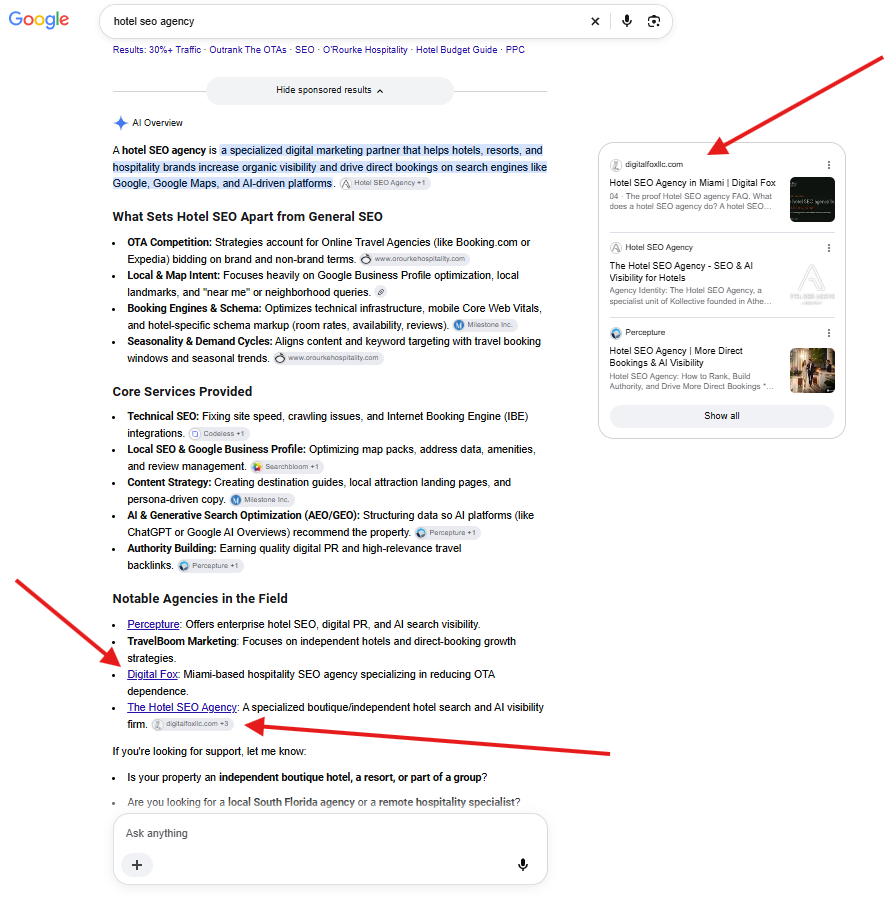
This is not theoretical. In October 2026, Google's AI Overview for the query "hotel seo agency" named Digital Fox among its notable agencies and cited this site as its top source. The same playbook we run for hotels is the one that earned this page its citation. We would rather show a working example than make claims about AI visibility we cannot back, which is the same standard we hold the reporting to once an engagement begins.

Google AI Overview for the query hotel seo agency, naming Digital Fox as a notable hotel SEO agency and citing digitalfoxllc.com as the top source in the generated answer.
Google's AI Overview for "hotel seo agency," October 2026. Digital Fox is named as a notable agency in the answer, and digitalfoxllc.com is the top-cited source.
Read more

How AI engines choose hotels.

The mechanics behind AI citation, in depth, from our insights library. Each piece goes a level deeper than this page into how a specific engine sources and names the hotels it recommends.

Questions

AI search (GEO / AEO) FAQ.

What is GEO / AEO for hotels?

Generative Engine Optimization (GEO) and Answer Engine Optimization (AEO) are the practices of structuring a hotel's content and data so AI systems like ChatGPT, Gemini, and Google's AI Overviews can find, trust, and cite the property in their answers.

How is AI search different from Google rankings?

Traditional SEO competes for a position in a list of links. AI search competes to be the source an answer is built from and cited to. The signals overlap, but AI citation rewards clear, structured, trustworthy answers, and is often a faster win.

Can a hotel actually appear in AI Overviews?

Yes. AI Overviews and assistants pull from content they can read and trust. Properties with structured, authoritative, genuinely useful content are the ones that get cited, and that citation increasingly drives more qualified clicks than a classic ranking.

How do you measure AI visibility?

By tracking whether and where a property is cited across AI engines for the queries that matter. You can get a first read with our free AI Citation Check tool.

Let's win back the bookings you already earned.

Request a complimentary hotel SEO audit. We'll show you where the opportunity is before you commit to anything.