It usually shows up on a Monday. You open your analytics out of habit, and the line that has climbed patiently for a year has fallen off a shelf. Organic sessions down by a third, or a half, or worse, and it happened over a few days while you were doing nothing differently at all. No page was deleted. No developer touched the site. Nothing broke. And yet the traffic is simply gone, and the first thing almost every hotelier does next is exactly the wrong thing: panic, and start changing things at random.
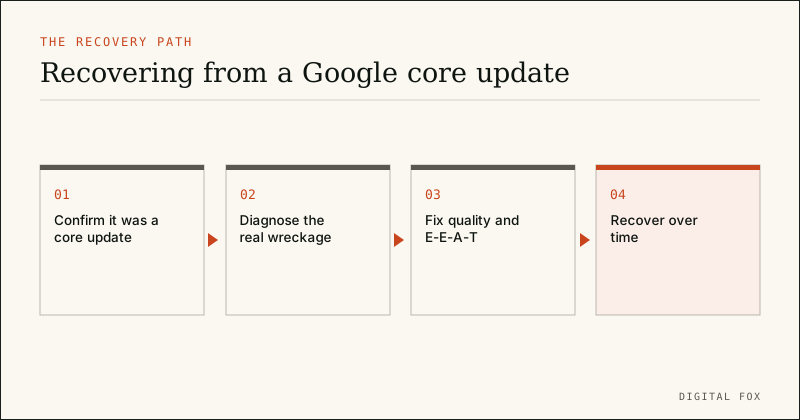
This is the guide to not doing that. A sudden, sitewide organic decline that coincides with no change of your own is the signature of a Google core update, and core updates are the single most misunderstood event in hotel SEO. They are misread as penalties, responded to with frantic rewriting, blamed on the wrong causes, and "fixed" with tactics that at best waste months and at worst deepen the hole. The properties that recover are almost never the ones that moved fastest. They are the ones that correctly diagnosed what happened before touching anything, and then did the slow, unglamorous work that a core update actually rewards.
So we will go in order. How to confirm it was genuinely an update rather than something more mundane and more fixable. What a core update actually is, mechanically, so the response makes sense. The specific ways these updates bite hotels in particular. How to read your own wreckage to find the real problem. The panic moves that feel productive and accomplish nothing. The work that genuinely recovers rankings. And an honest account of the timeline, because the thing nobody wants to hear is that recovery is measured in months and tied to Google's schedule rather than yours.
First, confirm it was actually a core update.
Before you accept the core-update explanation, rule out the things that look identical on a graph and are far more fixable. A surprising share of "the algorithm hit us" emergencies turn out to be something else entirely, and the something else is often something you can fix this afternoon rather than over two quarters.
Start with the most common impostor: a technical fault. A botched deployment, a robots file that started disallowing crawlers, a plugin that broke your canonical tags, an accidental noindex pushed live, a certificate that expired, a booking widget that started throwing errors, a site migration that lost redirects. Every one of these produces a sharp traffic drop that mimics an update, and every one is genuinely repairable rather than a matter of slow rehabilitation. Check your indexing status, crawl the site, look at your server logs, and confirm that Google can still fetch and render your pages. If a technical fault is the cause, the update theory is a costly distraction from a five-minute fix.
Then rule out seasonality, which for hotels is enormous and constantly mistaken for algorithmic disaster. Demand for your property swings violently across the year, and a decline that lines up with the end of your season is your season ending, not Google turning against you. Compare the period against the same period last year rather than against last month, because month-over-month comparison for a seasonal business is close to meaningless, a trap examined in why your analytics are lying to you. If last July also dipped here, you are looking at the calendar, not the algorithm.
Rule out a manual action, which is a different animal from a core update and comes with an actual notice. If Google has taken manual action against your site, there will be a message in Search Console telling you so, along with the reason. A core update leaves no such message, because it is not a punishment aimed at you. If your console is clean of manual actions, that particular fear can be set aside.
Finally, rule out a change in the results page itself rather than in your ranking. Sometimes your position has not moved at all, but the page around it changed: an AI Overview appeared above you, a booking module expanded, more ads loaded, a local pack pushed the organic results down. Your rank is intact and your visibility collapsed, which is a real problem but a different one, and it is examined in how AI Overviews pick hotels. The fix for a SERP-layout change is not the fix for a core update.
Only once those are excluded should you accept the core-update diagnosis. The confirming signature is specific: a decline that is sitewide rather than confined to a few pages, that began over a window of days rather than a single moment, that coincides with a widely reported Google update, and that comes with no technical fault, no manual action, and no seasonal explanation. That pattern is a core update, and it calls for a completely different response than any of the impostors.
What a core update actually is.
Getting this next part right is the difference between a recovery and a year of wasted motion, so it is worth slowing down on it even though the instinct in a crisis is to skip the theory and start fixing.
The single most important thing to understand, because it governs every sensible response, is that a core update is not a penalty. Nobody at Google looked at your hotel, decided it was bad, and demoted it. That framing, which is how almost everyone instinctively reads it, leads directly to the wrong actions.
A broad core update is a wholesale reassessment of how well pages across the entire web satisfy the people searching for them. Google periodically rolls out significant changes to its core ranking systems, and when it does, it re-evaluates enormous swaths of content against its current understanding of quality and relevance. Your rankings did not fall because you did something wrong on a Tuesday. They fell because the system re-weighed everything, and in the new weighing, other pages were judged to serve the searcher better than yours. It is comparative and relative, not punitive and absolute.
This has a liberating and slightly maddening implication. Google's own long-standing guidance on recovering from core updates does not hand you a checklist of violations to fix. It points you back to fundamental questions about whether your content is genuinely helpful, original, and produced with real expertise, and whether it serves the person rather than the search engine. There is no lever labeled "undo." There is only the slow work of being, in the system's revised judgment, a better answer than you were.
The other implication is that a drop is information, not just damage. The update is telling you how the system now assesses your content relative to the alternatives. Sometimes that assessment is unfair or noisy and will partially reverse. Frequently, though uncomfortably, it is pointing at something real: content that was thin, or produced at volume without genuine expertise, or that reads as written for the algorithm rather than the guest. The properties that recover are the ones willing to hear that, rather than the ones who treat every drop as an injustice to be appealed.
Reading the timing and the shape.
Once you have accepted that a reassessment happened, the graph stops being just bad news and becomes evidence. Read it carefully before you touch anything, because it will tell you a great deal about where the damage is and, by extension, where the work needs to go.
The graph itself carries diagnostic information, and reading it properly narrows the problem considerably before you touch a single page.
First, pin the date. Identify precisely when the decline began, to the day, using Search Console rather than analytics because it isolates organic search cleanly. Then compare that date against the record of confirmed Google updates. If your drop begins within the window of a widely reported broad core update, the case is strong. If it begins on a date with no known update, look harder at the technical and seasonal explanations, because unattributed sitewide drops are more often faults than algorithm shifts.
Second, read the shape. A core update decline typically unfolds over the multi-day or multi-week rollout period rather than in a single instant, because updates roll out gradually. A drop that happened in one clean step from one day to the next is more consistent with a technical event, a tracking break, or a page falling out of the index. The rollout shape is part of the fingerprint.
Third, read the breadth. Log into Search Console and look at which queries and pages lost, and which held or gained. This is the richest diagnostic you have, and it usually reveals that the damage is not uniform. Perhaps your informational content, the blog and area guides, collapsed while your core booking pages held. Perhaps a specific cluster of pages fell while the rest stood. Perhaps everything slid by a similar proportion. Each pattern points somewhere different, and the pattern is visible for free in your own console.
Fourth, separate branded from non-branded. If your branded queries, people searching your hotel's name, are unaffected while your non-branded queries collapsed, that is a clean core-update signature: your inherent demand is intact, but your ability to win competitive discovery searches was re-weighed. If even branded queries fell, look again at technical causes, because a genuine core update rarely touches the searches where you are the unambiguous answer.
The ways core updates bite hotels specifically.
The mechanics above are universal, but the wounds are patterned, and hospitality sites tend to bleed in the same few places. If you are trying to find your own problem quickly, start by checking yourself against this list, because your issue is very likely on it.
Core updates apply to the whole web, but hospitality sites tend to get hit through a recurring set of weaknesses, and knowing the common failure modes helps you find yours faster.
The most common by far is thin content produced at volume. Over the past few years a great deal of hotel SEO advice pushed properties to publish constantly: dozens or hundreds of short posts, near-identical area pages, template-driven location content, thin listicles. Recent core updates have been pointed squarely at exactly this, and volume metrics that once looked like progress now read as a red flag. A property that published two hundred thin posts to "cover" its market is precisely the kind of site the reassessment demotes, and the fix is not more posts. The dynamics of this are covered in why hospitality blogs underperform and how many posts a hotel actually needs.
The second is absent expertise and authorship signals. Google's quality systems increasingly reward content that demonstrates genuine first-hand experience and expertise, and penalize content that reads as generic, interchangeable, and authorless. A hotel site full of competent but anonymous content that any property in any city could have published is vulnerable, because nothing about it signals that a real expert with real knowledge of this specific place produced it. This is the practical face of what gets abbreviated as experience, expertise, authoritativeness, and trust.
The third is content written for the algorithm rather than the guest. Pages stuffed with keyword variations, structured to hit a word count, optimized to a content-scoring tool, and shaped to resemble whatever currently ranks. Core updates are unusually good at detecting the difference between content that genuinely helps a person and content assembled to rank, and the tools that encouraged the latter are examined in why your SEO tools give the wrong answers.
The fourth, increasingly, is informational content being absorbed by AI surfaces. Some of what reads as a core-update loss is really the migration of informational queries into AI Overviews and assistants, where the answer is delivered without a click. Your "things to do near the hotel" guide did not necessarily get demoted; the question may simply be getting answered above the results now. Distinguishing genuine ranking loss from click loss to AI is essential, and the reframing is in generative engine optimization for hotels.
The fifth is weak trust and reputation signals. Trust is a component of how quality is assessed, and a property with thin, stale, or poor reviews, an incomplete presence, and little independent corroboration presents the system with less evidence to trust. This overlaps heavily with the review and reputation work in hotel reviews and reputation management.
Not every update is a core update.
One more piece of vocabulary prevents a common misdiagnosis. Google runs several distinct kinds of updates, and they call for different responses, so lumping them all under "the algorithm hit us" obscures what to actually do.
A broad core update is the whole-web reassessment of quality and relevance described above. It has no single target and no list of violations, and the response is the slow quality work that most of this guide concerns. This is the most common cause of the sudden, sitewide, unattributable hotel traffic drop.
A spam update is narrower and more punitive: it targets content and tactics that violate Google's spam policies specifically, things like automatically generated content produced purely to manipulate rankings, deceptive practices, and manipulative link schemes. If you were hit by a spam update, the diagnosis is different, the response is to identify and remove the policy-violating behavior, and the recovery can be faster because it is tied to fixing a specific violation rather than to a broad reassessment. Most legitimate hotels are not the target of spam updates, but a property that leaned on aggressively automated content or bought manipulative links may be.
Updates aimed at rewarding genuinely helpful, people-first content have, in recent years, been folded into the core systems rather than run as separate events, but the principle they embodied remains central to how quality is assessed: content made to help people tends to be rewarded, and content made primarily to rank tends not to be. For hotels this is the most important through-line, because so much hospitality content of the past few years was produced explicitly to rank.
The practical point is to check what kind of update coincided with your drop, because the response to a spam-policy violation is not the response to a broad quality reassessment. Treating a spam-update hit as a core update means you never fix the actual violation; treating a core-update reassessment as a spam hit sends you hunting for violations that do not exist. The reported details of the update that aligns with your drop will usually tell you which conversation you are in.
Diagnosing your own wreckage.
Diagnosing your own wreckage.
With the impostors excluded and the general failure modes in mind, the actual diagnosis is a methodical read of your own data. Resist every urge to act until this is done, because acting before diagnosing is how properties spend months fixing the wrong thing.
Export the before and after.
In Search Console, compare the period after the drop against an equivalent period before it, query by query and page by page. You want a clear list of what lost, what held, and what, if anything, gained. This single export is the foundation of the entire diagnosis.
Find the pattern in the losers.
Look at the pages that lost the most and ask what they have in common. Are they your thin blog posts? Your programmatic area pages? A particular content type or template? Content of a certain age? The commonality is the diagnosis. If the losers are your thinnest, most generic pages, the update is telling you something true.
Find the pattern in the survivors.
Equally revealing: what held or grew. If your genuinely expert, specific, first-hand pages survived while your generic ones fell, that contrast is the clearest possible instruction about what to build more of and what to cut.
Separate ranking loss from click loss.
For the queries that lost clicks, check whether you also lost ranking position or merely lost clicks at a stable position. Stable position with fewer clicks points to a SERP change or AI absorption, not a quality demotion, and the response is entirely different.
Judge your own content honestly.
Take a sample of the pages that lost and read them as a demanding guest would. Are they genuinely useful, specific, and expert, or are they competent filler that any property could have published? This is the hardest step because it requires honesty about your own work, and it is the most important.
By the end of this you should be able to state the problem in a sentence. "Our thin, high-volume blog content was demoted while our expert pages held." "Our informational guides lost clicks to AI Overviews without losing rank." "Our whole site slid modestly, consistent with a general quality reassessment against stronger competitors." Each of those sentences implies a different plan, and none of them is "rewrite everything immediately."
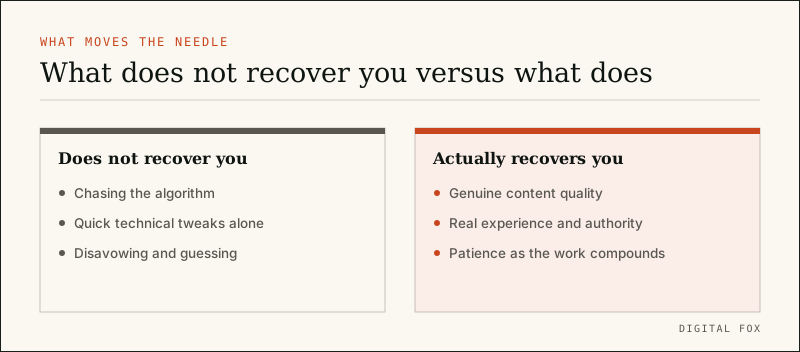
What does not recover you.
With the diagnosis in hand, you will feel a powerful urge to move fast and visibly. Almost everything that urge suggests is a mistake, so it is worth naming the mistakes explicitly before naming the cures.
The panic response to a core update is remarkably consistent across properties, and remarkably ineffective. These are the moves that feel like action and deliver nothing, and doing them can actively delay real recovery by consuming the months you should be spending on the work that matters.
Rewriting everything at once. The instinct to immediately rewrite every page is both exhausting and misdirected. If the problem is a specific content type, rewriting your good pages wastes effort and risks harming what survived. Diagnose first, then act surgically.
Changing published dates to look fresh. Bulk-updating the dates on old posts to appear recently published, without genuinely improving them, is a transparent signal that fools nobody and can itself read as manipulation. Freshness without substance is not freshness.
Disavowing links in a panic. Reaching for the disavow tool after a core update is a classic misfire. Core updates are about content quality, not links, and Google generally ignores low-quality links rather than penalizing you for them. Aggressive disavowal can remove links that were helping you, turning a content problem into a link problem you created yourself.
Chasing the algorithm's supposed preferences. Adding more keywords, hitting a higher word count, mirroring whatever currently ranks, bolting on schema everywhere, and generally trying to reverse-engineer the update. Core updates specifically reward content that serves people rather than content engineered for the system, so optimizing harder for the system is running the wrong way.
Publishing more volume. If thin volume was the problem, more volume is not the cure. Yet the reflexive response to falling traffic is often to publish more, faster, which pours fuel on exactly the fire that started the blaze.
Switching everything overnight and expecting a rebound tomorrow. Even the correct changes do not produce immediate recovery, because the system re-evaluates on its own schedule. Making good changes and then concluding after two weeks that they failed, and reversing them, is how properties thrash their way out of a recovery that was actually working.
What actually recovers you.
Recovery from a core update is, at its core, becoming a genuinely better answer than you were, and then waiting for the system to re-evaluate you. That is less satisfying than a quick fix and it is the truth. The work divides into a few honest categories.
Fix the specific problem the diagnosis found. If thin, high-volume content was demoted, the answer is usually consolidation and pruning rather than expansion: combining overlapping thin posts into fewer genuinely comprehensive ones, and removing or improving content that adds nothing. The discipline is set out in content refresh and pruning for hotels, and after a core update it moves from good hygiene to central strategy. A smaller site of genuinely strong pages routinely outperforms a large site of weak ones in the current environment.
Inject genuine expertise and first-hand experience. The content that survives and recovers is content that could only have been produced by someone who genuinely knows this property and this place. Real detail about the neighborhood, honest specifics about the rooms, first-hand knowledge no competitor could copy, clear authorship by a named person with actual expertise. This is the practical work of building the experience and expertise signals that quality systems reward, and it is the opposite of generic filler.
Strengthen trust. Complete and consistent information across your presence, current and substantial reviews, independent corroboration of your claims, transparent authorship and contact information, and a genuinely good site experience. Trust is assessed from many signals, and a property that is thinly evidenced everywhere gives the system little to trust.
Serve the guest, visibly. Rework the demoted content to genuinely answer the question a real traveler has, in a way that a real traveler would find useful, rather than to satisfy a keyword tool. The test is not whether it contains the right terms but whether a guest reading it would be genuinely helped.
Get the technical fundamentals right. Not because technical work reverses a core update, but because a fast, crawlable, well-structured, accessible site removes friction and supports everything else. The essentials are in what technical SEO for hotels actually means.
Notice that none of this is a trick, and all of it makes your site genuinely better for the human being on the other end. That is not a coincidence. Core updates are explicitly designed so that the way to recover is to deserve to.
The AI Overview complication nobody accounts for.
There is a specific confusion worth isolating, because in 2026 it distorts almost every core-update diagnosis for hotels: a meaningful share of what looks like a core-update loss is not a ranking loss at all. It is the answer moving above the results.
When an AI Overview or a similar generated answer appears at the top of a results page, it can satisfy the searcher without a click, and your organic listing below it can hold its exact position while its clicks quietly evaporate. On a traffic graph this is indistinguishable from a demotion. In your Search Console data it is not: your average position stays roughly the same while your clicks fall and your click-through rate drops. That divergence is the tell, and checking for it is the single most clarifying thing you can do when informational content appears to have been hit.
The reason this matters so much for diagnosis is that the two problems have opposite solutions. If your content was demoted on quality, the answer is to make it genuinely better and wait for reassessment. If your content held rank but lost clicks to an AI surface, rewriting it for quality will not bring the clicks back, because the clicks did not leave over quality. They left because the question is now being answered before the click. The response there is a different discipline entirely: structuring content to be the source the AI cites and to earn the click that a generated answer still passes through, which is the whole subject of generative engine optimization for hotels and where AI actually gets its hotel information.
So before you file a lost informational query under "core-update casualty," check whether you actually lost position or merely lost the click. The mislabeling is common, and it sends properties into months of quality rewrites aimed at a problem that quality cannot solve.
What to tell ownership.
If you answer to an owner or asset manager, the core-update conversation is where SEO programs most often get derailed, because the pressure to show a fast reversal is intense and every honest answer sounds like an excuse. Getting this conversation right is part of the recovery.
Lead with the mechanism rather than reassurance. Explain plainly that a core update is a reassessment of the whole web rather than a penalty against your property, that there is consequently no switch to flip, and that Google's own guidance ties meaningful recovery to a future reassessment that runs only a few times a year. This is not you making excuses; it is the actual operating reality, and an owner who understands it stops demanding next month's bounce.
Then redirect attention to the indicators that genuinely lead recovery, so there is something real to watch in the interim. Whether the diagnosis has been completed and the specific problem identified. Whether the fix, usually consolidation and genuine quality improvement, is underway and how much is complete. Whether the survivor pages, your genuinely strong content, are holding, which they should be. And whether branded demand is intact, which it usually is. Those are the honest leading signals, and they move well before the headline traffic number does.
Be equally direct about what would make things worse, because owners under pressure propose exactly these: publishing a burst of new content to "recover" the lost traffic, chasing the old peak at any cost, or firing the people mid-recovery and starting over with someone promising a faster fix. Each resets the clock on a recovery that depends above all on consistency and patience. Naming them in advance is often what prevents them.
Finally, reframe the target honestly. The goal is not the old number, which may have been partly built on content the system now correctly discounts. The goal is a healthier, more durable position that the next update is more likely to reward than to punish. An owner who accepts that frame will back the right work. An owner still anchored to the fragile peak will keep pushing for the tactics that guarantee no recovery at all.
The technical audit you should run anyway.
Even when you are confident it was a core update, run a full technical pass, for two reasons. First, to be certain no technical fault is compounding the update, because it is entirely possible to be hit by a reassessment and to have a broken canonical or a crawl problem at the same time, and fixing the fault removes friction from everything else. Second, because a fast, clean, well-structured site supports quality signals rather than undermining them, and a core update is a reasonable moment to clear technical debt that has accumulated.
Confirm that Google can crawl and render every important page, that no accidental noindex or robots block crept in, and that your canonical tags point where they should. Check that your booking engine and its content are reachable rather than hidden behind scripts a crawler cannot execute, a common and expensive blind spot examined in booking engine SEO and crawlability. Verify your site speed and core web vitals, since a genuinely slow site is a genuine quality problem. And make sure your structured data is accurate rather than merely present, because broken or misleading schema is worse than none.
None of this reverses a core update on its own. But a recovery built on genuinely better content is undermined by a site that is slow, partly uncrawlable, or technically broken, and clearing those issues ensures the quality work you do can actually be seen and rewarded. Think of it as removing the obstacles between your improved content and the reassessment that will judge it.
The honest timeline.
The honest timeline.
Here is the part nobody wants and everybody needs. Recovery from a core update is slow, and its pace is set by Google, not by you.
The reason is mechanical. Google's own guidance has long held that recovery from a core update often does not come until a subsequent core update, when the system re-evaluates the web again and, ideally, judges your improved content more favorably. Since broad core updates arrive only a handful of times a year, this means the honest expectation for meaningful recovery is measured in months, and the improvements you make now may not visibly reward you until the next reassessment runs.
This has three practical consequences. First, make your improvements as early and as thoroughly as you can, so that they are fully in place and indexed well before the next update, rather than half-finished when the reassessment arrives. Second, do not judge the changes by the following two weeks, because the mechanism that would reward them has not run yet. Third, set expectations with owners honestly and in advance, because an owner who expects a bounce next month and does not get one will pressure you into exactly the thrashing, reversing, panic behavior that guarantees no recovery at all.
There is also no guarantee of full recovery to the previous level, and pretending otherwise is dishonest. If the previous level was inflated by thin content that the system now correctly discounts, some of that traffic is not coming back, and chasing it is chasing a number that reflected a weakness. The realistic goal is a healthier, more durable position built on genuinely strong content, which is worth more than the fragile peak that a core update knocked down.
The order of operations, on one page.
Because the temptation to act immediately is so strong, it helps to have the sequence in front of you, so that panic has somewhere to go that is not a keyboard.
Stop, and change nothing yet.
The most valuable action in the first hours is not acting. Nothing you do in a panic will help, and several things will hurt. Give yourself permission to diagnose before you touch anything.
Rule out the impostors.
Technical fault, seasonality, manual action, SERP-layout change. Three of the four are fixable today, and misdiagnosing them as a core update wastes the fix. Do not proceed until these are excluded.
Confirm the fingerprint.
Sitewide, gradual over the rollout, aligned with a reported update, branded queries intact, no manual action. That specific pattern is a core update. A single-step drop or an unaligned date points elsewhere.
Diagnose from your own data.
Export before and after. Find the pattern in what lost and what held. Separate ranking loss from click loss. State the problem in one honest sentence before you write the plan.
Fix the specific thing, surgically.
Usually consolidation, pruning, and genuine quality improvement aimed at the content type the diagnosis identified. Not a mass rewrite, not more volume, not the panic moves.
Get it done early and wait properly.
Complete and index the improvements well before the next reassessment, then hold your nerve through the interval where nothing visible happens. The mechanism that rewards you runs on Google's schedule, not yours.
Six steps, and the first is to do nothing. That is not a joke about inaction. It is the recognition that the reflex to act is the single most reliable way to make a recoverable situation worse, and that the discipline to diagnose before treating is what separates the properties that come back from the ones that thrash for a year and give up.
A worked example.
A worked example.
Consider an independent property that had built its organic traffic aggressively over two years, largely through volume. It had published well over a hundred blog posts, plus a set of programmatic area pages generated from a template, plus a scattering of thin listicles. Traffic had grown steadily, and the property was pleased with it.
Then a broad core update rolled out, and over about ten days organic sessions fell by close to half. The owner's first reaction was to assume a penalty and demand an immediate fix. The temptation was to rewrite everything and publish a wave of new posts to "make up" the lost traffic.
Instead, the property did the diagnosis first. The Search Console export showed a clear pattern: the thin blog posts and the templated area pages had collapsed, while a smaller set of genuinely detailed, expert pages, the honest neighborhood guide written by the general manager, the specific and useful room pages, the substantive local guides, had held their positions almost entirely. Branded queries were untouched. The informational losses were partly ranking loss and partly clicks migrating to AI Overviews.
The diagnosis wrote its own plan. The property consolidated its overlapping thin posts into a much smaller number of genuinely comprehensive guides, pruned the templated pages that added nothing, and rewrote the survivors to be even more specifically expert. It stopped publishing volume entirely and committed to a slow cadence of genuinely first-hand content authored by named people. It strengthened its reviews and its listings. And then, hardest of all, it waited.
Nothing visible happened for weeks, which tested everyone's nerve. The meaningful recovery came with the next core update, when the reassessment ran against a site that was now smaller, denser, more expert, and more trustworthy. The property did not recover to its former peak, because the former peak had been partly built on content the system now correctly discounted. It recovered to a lower but far more durable level, and from there it grew again, this time on foundations that the next update was more likely to reward than to punish.
The lesson the owner took away was not about any specific tactic. It was that the frantic version of the response, executed in the first week, would have wasted the exact months that the patient version spent building something better.
When it is not the algorithm's fault.
There is an uncomfortable version of this story that deserves its own space, because it is common and because the industry conspires to avoid saying it. Sometimes the core update is right about you.
If your traffic was built on thin, scaled, generic content, and a core update discounted it, the update did not malfunction. It did exactly what it is designed to do, which is to stop rewarding content that does not genuinely serve people. In that case the drop is not an injustice to be appealed but a correction to be learned from, and the only recovery is to build the genuinely good content you did not build the first time.
This is hard to hear, especially for a property that followed popular advice in good faith and did what the SEO content of a few years ago told it to do. But the advice changed because the algorithm changed, and clinging to a strategy the system now penalizes is not resilience, it is denial. The properties that come out of a core update stronger are frequently the ones that used it as the push to finally do the harder, better work they had been avoiding, and were quietly rewarded for it over the following year.
Building resilience before the next one.
There will always be a next core update, and the properties least disrupted by them share a posture worth adopting whether or not you have just been hit.
They build on quality rather than volume, so there is little thin content for a reassessment to discount. They invest in genuine, specific, first-hand expertise that competitors cannot replicate, so their content is durable across reassessments by design. They maintain strong trust signals continuously, so the evidence the system needs is always present. They watch the balance of their content, pruning and consolidating routinely rather than only in a crisis. And they read every update as feedback about the direction of the system rather than as an attack, adjusting steadily rather than lurching.
None of that makes you immune, because rankings are relative and competitors improve too. But it converts core updates from existential threats into periodic weather, survivable and occasionally even beneficial when they knock down weaker competitors who did not do the work. The strategic case for building this way from the start, rather than chasing the cheap traffic that a later update reclaims, is the through-line of where hospitality SEO is heading.
What not to do.
- Do not assume it was an update before ruling out technical faults, seasonality, manual actions, and SERP-layout changes. Three of those you can fix immediately, and misdiagnosing them as a core update wastes the fix.
- Do not treat a core update as a penalty. It is a reassessment, not a punishment, and the penalty framing leads directly to the wrong actions.
- Do not act before you diagnose. Read your own Search Console data and identify the pattern in what lost and what held before you touch a single page.
- Do not rewrite everything, fake freshness, disavow links, or publish more volume in a panic. These feel productive and accomplish nothing, and some of them cause new harm.
- Do not judge your changes by the next two weeks. The mechanism that would reward them, the next reassessment, has not run yet.
- Do not promise owners a fast bounce. Recovery is measured in months and tied to Google's schedule, and an owner expecting otherwise will pressure you into thrashing.
- Do not assume full recovery to the old peak. If the peak was inflated by content the system now discounts, some of it is not coming back, and chasing it is chasing a weakness.
Frequently asked questions.
How do I know if a Google core update caused my hotel's traffic drop?
Confirm the signature and rule out the impostors. A core update produces a sitewide decline that unfolds over the update's multi-day rollout, coincides with a widely reported Google update, and comes with no technical fault, no manual action notice in Search Console, and no seasonal explanation. Before accepting it, check for a broken deployment or accidental noindex, compare against the same period last year to exclude seasonality, and check whether your position actually fell or the results page simply changed around you. If those are all clean and the timing lines up with a known update, it is a core update.
Is a core update a penalty against my site?
No, and this distinction governs everything. A core update is a broad reassessment of how well pages across the whole web serve searchers, not a punishment aimed at you. Nobody flagged your hotel as bad. Your rankings changed because the system re-weighed everything and, in the new weighing, judged other pages to serve the searcher better. That is why there is no violation to fix and no "undo" button, only the work of becoming a genuinely better answer than you were.
How long does it take to recover from a core update?
Honestly, months, and the pace is set by Google rather than by you. Google's long-standing guidance is that recovery often does not arrive until a subsequent core update re-evaluates the web, and those come only a handful of times a year. So make your improvements early and thoroughly, get them fully indexed before the next update, and do not judge them by the following two weeks. There is also no guarantee of returning to the exact previous level, particularly if that level was inflated by content the system now correctly discounts.
Should I delete all my old blog posts after a core update?
Not indiscriminately, but if the diagnosis shows thin, high-volume content was demoted, then consolidation and pruning are usually central to recovery. Combine overlapping thin posts into fewer genuinely comprehensive ones, remove content that adds nothing, and improve what remains. A smaller site of strong pages routinely outperforms a large site of weak ones in the current environment. What you should not do is delete good content, or rewrite pages that survived, which risks harming exactly what held up.
Will adding more content help me recover faster?
Usually the opposite. If thin volume was the problem, more volume pours fuel on the fire. Recent core updates have been pointed squarely at high-volume, low-substance content, so the reflex to publish more and faster after a drop is often the single most counterproductive response. The path back is fewer, genuinely better, genuinely expert pages, not a larger pile of the kind of content that got demoted.
My branded searches are fine but everything else fell. What does that mean?
That is a clean core-update signature. Your inherent demand, the people searching your name, is intact, which means your fundamental standing is fine and the reassessment affected your ability to win competitive, non-branded discovery searches. It also rules out most technical causes, because a genuine fault would usually touch branded queries too. Focus your recovery on the quality and expertise of the content that competes for non-branded terms, since that is precisely what got re-weighed.
Should I disavow links or change my published dates to recover?
Neither. Core updates are about content quality, not links, so disavowing is aimed at the wrong target, and aggressive disavowal can remove links that were helping you. Bulk-changing published dates to fake freshness without genuinely improving the content is a transparent signal that fools nobody and can itself read as manipulation. Both are classic panic moves that feel productive and accomplish nothing. Spend the effort on genuinely improving the content the diagnosis identified instead.
If your hotel's traffic has fallen and you want an honest diagnosis of whether it was a core update, a technical fault, or a real content problem, along with a realistic recovery plan rather than a panic, that assessment is where every Digital Fox engagement starts. You can see the approach on the services page, or reach us at inquiries@digitalfoxllc.com. The traffic fell and nothing on your site changed, which feels like an injustice. Handled well, it is something more useful: the clearest instruction you will ever get about what your site should have been all along.