A generalist SEO agency lands a hotel client and does what it always does. It runs a technical audit, fixes the crawl errors, researches keywords, publishes a content calendar, builds some links, and reports on rankings and traffic climbing. Six months in, the graphs look healthy and the hotel is no better off. Traffic is up, but direct bookings are not; the OTAs still outrank the property for its own name; the rate on Google looks wrong; the busy season came and the content was about the wrong things. The agency did competent, ordinary SEO, and it underperformed, because a hotel is not an ordinary SEO client. It sells a perishable, intermediated, rate-controlled product that almost nothing else on the web has to sell, and that changes the discipline from the ground up.
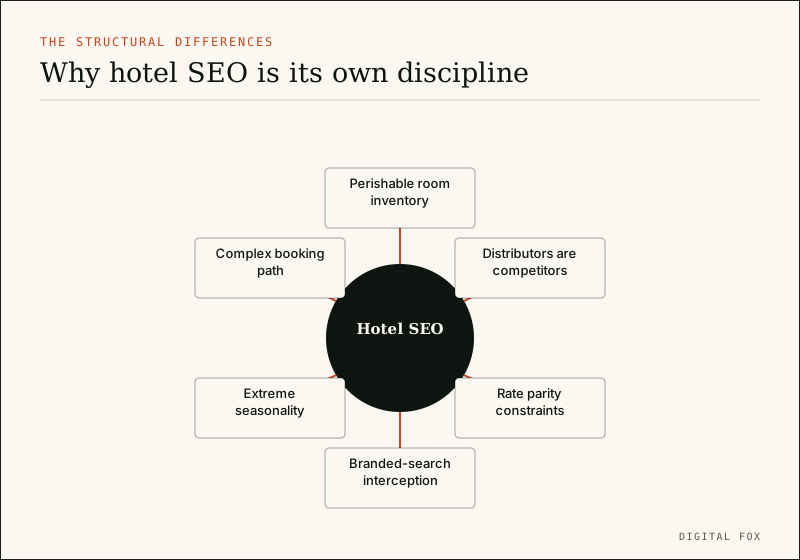
This is the guide to why hotel SEO is genuinely different, and why the difference matters for who you trust to do it. Hotels face a set of structural realities, inventory that expires worthless every night, powerful intermediaries who both distribute and compete against them, rate agreements that constrain what they can even say, seasonality that swings demand violently, and a booking path more complex than almost any other transaction online, that together make hotel SEO a distinct discipline rather than a vertical flavor of the generic craft. A practitioner who does not understand these realities can do textbook-correct SEO and still fail the property, because the textbook was not written for a business like this.
So we will work through the specific ways hotels differ, one structural reality at a time, because each changes what good SEO actually means. Perishable inventory and why it reframes the entire goal. The OTA intermediation that makes your distributors your competitors. Rate parity and the strange constraints it puts on your own marketing. The branded-search problem where you lose guests who were looking specifically for you. The seasonality that makes timing everything. The booking-path complexity that decides whether any of it converts. And, finally, why all of this adds up to a case for genuine hotel specialism over generic competence.
Perishable inventory changes the goal.
Everything else in hotel SEO follows from one fact about the product, so it is the right place to begin.
Start with the most fundamental difference, the one that reframes everything else: a hotel sells a perishable product, and an unsold room-night is gone forever. This single fact changes what SEO is even for, in a way a generalist rarely internalizes.
Most SEO clients sell things that persist. An unsold product sits in inventory and sells later; a service not booked today is booked tomorrow; the goal is a steady flow of demand over time. A hotel room-night is nothing like this. The night of the fourteenth, unsold, is worth zero on the fifteenth, permanently, and no future demand recovers it. Every night, a hotel runs a countdown to a deadline after which unsold inventory is destroyed, and the entire commercial imperative is to fill the right rooms at the right rate before that deadline, over and over, forever.
This reframes what SEO is for. It is not, ultimately, about traffic or rankings or even leads in the abstract; it is about filling perishable inventory profitably, night after night, which means driving bookings, at good rates, in the right patterns, at the right times. A generalist optimizing for traffic and rankings is optimizing for the wrong thing, because traffic that does not convert to bookings before the inventory perishes is worthless to a hotel in a way it is not to a business selling durable goods. The perishability makes conversion and revenue the only metrics that matter, and makes vanity metrics actively misleading, a distinction developed in how SEO impacts hotel revenue.
It also makes timing and pattern central in a way most SEO ignores. Because inventory perishes nightly and demand swings, a hotel does not just need bookings; it needs them in the right shape, filling the nights that would otherwise go empty, at rates that protect profitability, in patterns that match the property's needs. SEO for a hotel has to serve this real, perishable, time-shaped commercial reality, not an abstract goal of more traffic, and a practitioner who does not grasp that the product is destroyed nightly optimizes for a version of success that does not pay the hotel's bills.
One more consequence of perishability is worth drawing out, because it explains a mistake generalists make constantly. Since the inventory is destroyed nightly, a hotel cannot afford to wait for SEO to deliver a slow, steady build of generic traffic that may convert someday; it needs visibility that produces bookings within the windows its inventory actually sells in. This does not mean hotel SEO is a quick fix, it is not, and the realistic time horizon is covered in how long hotel SEO takes. It means the work has to be aimed, from the start, at the bookings the perishable inventory needs, in the right periods, rather than at an abstract traffic curve that trends upward while the rooms that mattered went unsold. A generalist comfortable with a slow, general traffic build is optimizing on a timescale and a target that the perishability does not forgive.
Your distributors are your competitors.
If perishability changes the goal, the next difference changes the whole competitive field, and it is one so peculiar to hospitality that a generalist has almost certainly never had to think about it.
The second great difference has no real parallel in most of SEO: a hotel's main distribution channel is also its main search competitor. The OTAs both sell the hotel's rooms and outrank the hotel for its own product, a dual role that shapes the entire strategic landscape.
Consider the strangeness of it. A hotel distributes through the OTAs, paying them commission to bring bookings, and simultaneously competes against those same OTAs in search, where their enormous domain authority lets them outrank the hotel, often using the hotel's own content, even for searches for the hotel's own name. The distributor is the competitor. No ordinary SEO client faces this: an e-commerce brand's distributors do not typically outrank it for its own products on its own name, but a hotel's do, routinely, which means hotel SEO is played on a field where your most powerful search rivals are the same companies you depend on for distribution.
This changes the strategic goal in a way generic SEO does not contemplate. Much of hotel SEO is about the direct-versus-intermediated balance: shifting bookings from commission-bearing OTA channels to direct ones, winning back the guests the OTAs intercept, and reducing the dependency that erodes profitability, the whole substance of work like direct booking SEO and the OTA duplicate content problem. A generalist who treats a hotel like any other site, chasing rankings without understanding the OTA dynamic, misses the actual game, which is not simply to rank but to reclaim demand from intermediaries who both distribute for you and compete against you.
It also demands an understanding of the economics that no generic SEO brings. The value of a direct booking versus an OTA booking, the commission math, the lifetime value of an owned guest relationship, the strategic tradeoffs of the channel mix, all covered in direct booking versus OTA economics, are the context in which hotel SEO decisions actually make sense. A practitioner who does not understand why a direct booking is worth so much more than an intermediated one, and how SEO shifts that balance, cannot do hotel SEO well, because the entire point of much of it is invisible to them.
Rate parity constrains your own marketing.
The OTA relationship does not stop at distribution and competition; it reaches into the hotel's own pricing freedom, through a constraint most marketers have never encountered in any other business.
The third difference is one almost no generalist has ever encountered: a hotel is often constrained, by its agreements with the OTAs, in the rates it can publicly offer, which limits what its own marketing can even say. Rate parity is a genuine and unusual constraint that shapes hotel SEO in ways generic SEO never has to consider.
Rate parity, broadly, is the set of arrangements under which a hotel's publicly available rates are kept in line across channels, so the hotel cannot freely undercut the OTAs on its own website with a lower public rate. The full dynamics are complex and are examined in rate parity, OTA contracts, and rankings, but the essential point for SEO is that a hotel's ability to compete on public price, the most basic marketing lever most businesses have, is constrained by its distribution agreements. A generalist accustomed to advising clients to compete on price, or to shout a lower price in their marketing, runs straight into a constraint they have never seen, because a hotel frequently cannot do that.
This shapes hotel SEO in specific ways. It pushes the competition away from public price and toward the things a hotel can differentiate on: the value and the extras of booking direct rather than the headline rate, the member and loyalty structures that offer better terms outside the public-parity constraint, the genuine reasons to book direct beyond price, the whole strategy of member-only rates and direct-booking architecture. Hotel SEO has to win the direct booking without simply undercutting on public price, which is a subtler competitive problem than most SEO ever addresses, and one a generalist is unequipped to navigate because they do not know the constraint exists.
It also affects how a hotel presents itself in the very surfaces where rates appear, from metasearch to Google's hotel panels to the booking comparison a guest sees, discussed in Google Hotels and free booking links. Getting the direct option in front of the guest, and making it genuinely worth choosing within the parity constraints, is a delicate, hotel-specific discipline. A practitioner who does not understand rate parity may give advice that is not just unhelpful but impossible for the hotel to follow, or that risks its distribution agreements, which is a category of mistake generic SEO cannot even make because it never encounters the constraint.
The branded-search problem.
The intermediaries do not only contest the generic searches; they contest the one search that ought to be a certain win, and this is where the OTA dynamic does its most expensive damage.
The fourth difference is a peculiar vulnerability that hotels suffer acutely and most businesses barely experience: hotels lose guests who were searching specifically for them, intercepted at the moment of highest intent by intermediaries. The branded-search problem is central to hotel SEO and largely alien to generic SEO.
When someone searches for a hotel by name, they have already chosen it; they are looking specifically for that property, at the peak of intent, ready to book. For most businesses, a branded search is a near-guaranteed win, since few competitors seriously contest your own name. For a hotel, it is a battleground, because the OTAs appear prominently for the hotel's own branded searches, built from the hotel's own content, and intercept the guests who were explicitly looking for the property, routing them to commission-bearing bookings the hotel could have had direct. The hotel loses guests it had already won, at the moment they were most ready to book, to intermediaries competing for its own name.
This makes owning branded search a central hotel SEO discipline with no real generic equivalent. The work of dominating your own branded results, pushing the OTA interception down, and capturing the high-intent guests searching specifically for you, detailed in owning your branded search results, is one of the highest-value battles in hotel SEO precisely because it reclaims the guests who already chose you. A generalist who assumes branded search is a solved, easy win, as it is for most clients, misses one of the most important and most winnable problems a hotel actually has.
It connects to the entity and knowledge-panel work that establishes a hotel as the definitive answer for its own name, covered in entity SEO for hotels. A hotel has to build a strong enough entity and branded presence to own its own results against intermediaries contesting them, which is specialized, hotel-specific work. A practitioner who does not understand that a hotel's own name is contested, and why, and how to win it back, is unequipped for a problem that sits at the heart of hotel SEO and almost nowhere else.
Seasonality makes timing everything.
Beyond the competitive and pricing peculiarities, hotels face a demand pattern so extreme that it reshapes the rhythm of the SEO itself.
The fifth difference is one of degree so extreme it becomes a difference in kind: hotels experience demand swings so violent that timing, seasonality, and demand-shaping become central to SEO in a way they are not for most businesses. Hotel demand is not a steady stream to be optimized but a wildly variable one to be anticipated and shaped.
Most businesses have some seasonality, but a hotel's is often extreme and specific: high seasons and dead seasons, sold-out weekends and empty midweeks, demand tied to local events, weather, holidays, and patterns that can swing occupancy from full to sparse and back within a week. This is not a minor modifier on a steady baseline; it is the defining shape of the business, and it means hotel SEO has to be built around anticipating and serving demand that varies enormously over time, filling the troughs and capturing the peaks, rather than optimizing for a constant flow.
This makes timing and demand-shaping central hotel SEO disciplines. Content and visibility have to be ready ahead of the demand they serve, since search for a season or an event happens before it arrives, the logic of seasonal demand content strategy. A hotel needs to be visible for the high-season searches before the high season, to build content for the events and periods that drive its demand in advance, and to work deliberately at filling the low periods, none of which a generalist optimizing for steady traffic naturally does. The whole rhythm of hotel SEO is dictated by a demand pattern most SEO never has to accommodate.
It also connects to the perishability from the start: because inventory perishes and demand swings, the strategic priority shifts across the year, defending rate and capturing overflow in peak periods, driving volume and filling troughs in low ones, and SEO has to serve whichever the property needs when. This time-shaped, demand-aware strategy is specific to hospitality's extreme seasonality, and a practitioner treating a hotel like a steady-demand business, publishing evergreen content on a generic cadence with no regard for the property's demand calendar, serves the property poorly at exactly the moments that matter most.
The booking path is unusually complex.
Visibility, positioning, and timing all decide whether a guest arrives; the booking path decides whether that arrival becomes revenue, and for a hotel that final stretch is unusually treacherous.
Suppose the visibility, the direct-booking positioning, and the timing all work and the guest arrives ready to book. A hotel still faces a conversion step more fraught than almost anything else online.
The sixth difference is in the conversion itself: a hotel booking is a more complex transaction than almost anything else online, and the booking path introduces technical and experiential challenges generic SEO rarely faces. Getting a guest to the site is only half the job; the booking path decides whether any of it converts, and that path is unusually fraught.
Consider what a hotel booking involves. Date selection, availability that changes constantly, rates that vary by date and length and conditions, room types and options, a booking engine that is often a separate system from the website, and a multi-step flow more involved than a typical purchase. This complexity introduces problems most SEO never encounters: booking engines that search engines cannot crawl, availability and rate content that lives outside the indexable site, a handoff between website and booking system that can break the experience and the tracking, and a conversion path with many points of failure, the terrain of booking engine SEO and crawlability.
This makes the booking path a central technical concern in hotel SEO with few parallels. A generalist may optimize the website beautifully and never realize that the booking engine, where the actual conversion happens, is a crawlability black hole, a tracking nightmare, or an experience that loses guests at the final step. The specific challenges of hotel booking systems, their crawlability, their integration, their conversion experience, and the measurement across the website-to-booking-engine handoff, are hotel-specific technical problems a generalist is unlikely to even look for, because ordinary sites do not have them.
It also complicates measurement profoundly, which compounds everything else. Attributing bookings across the website-to-booking-engine handoff, through the OTA and metasearch layers, in a world of dark and untrackable traffic, is genuinely hard and hotel-specific, the subject of hotel SEO attribution and dark traffic. A practitioner who does not understand the hotel booking path cannot properly optimize the conversion that is the entire point, nor measure it correctly, which means they cannot even tell whether their SEO is working in the terms that matter. The complexity of the hotel transaction is a discipline unto itself.
The guest is choosing an experience, not a product.
The structural differences are the most concrete, but there is a softer one, easy for a generalist to overlook, that governs whether any of the content actually connects with the person booking.
There is a further difference that sits underneath the structural ones and shapes all the content work: a hotel guest is not buying a commodity to a specification but choosing an experience, a place, a stay, on emotional and situational grounds that generic product SEO does not contemplate. What the guest is really deciding is unlike what most SEO clients ask their customers to decide.
Most SEO serves a fairly rational purchase: the buyer wants a product with certain features at a certain price and compares options against a specification. A hotel stay is not like that. The guest is choosing where to spend a portion of their life, a honeymoon, a family holiday, a difficult work trip, a visit to a sick relative, and the decision is bound up with how the place feels, whether it suits the occasion, whether it can be trusted with something that matters. The purchase is emotional, situational, and high-consideration in a way a commodity purchase is not, and the content that serves it has to speak to the real human decision rather than reciting features and price.
This makes the content discipline genuinely different. Hotel content that works is experiential and honest, conveying what a stay is actually like and for whom, answering the real questions a guest weighs when choosing where to spend something meaningful, rather than the specification-and-price content that serves a commodity purchase. It connects to the reasons so many hospitality blogs underperform, which is that they produce generic content disconnected from the real guest decision, and to the experience and expertise the quality systems now reward, developed in E-E-A-T for hotels. A generalist producing efficient, generic, feature-led content misses what a hotel guest is actually choosing, and the content underperforms because it answers a question the guest was not really asking.
It also raises the stakes on trust and honesty specifically, because the guest is committing something that matters to a place they cannot fully verify in advance. Content that honestly conveys what a stay is like, and sets expectations the stay can meet, does the real work of helping an emotional, high-consideration decision, and protects the reputation that the whole business depends on. This human, experiential, trust-laden dimension of the hotel purchase is central to hotel content and largely absent from generic product SEO, and understanding it is part of what separates a practitioner who serves hotels well from one applying commodity-SEO instincts to a decision that is nothing like a commodity.
Local, but not like a local business.
Hotels get filed under local SEO, and the label is half right, which is exactly what makes it dangerous in a generalist's hands.
Hotels are local businesses, and yet hotel local SEO differs from ordinary local SEO in ways that trip up generalists who assume their local playbook transfers cleanly. A hotel is local in some respects and emphatically not in others, and conflating the two produces subtly wrong strategy.
In one sense a hotel is intensely local: it has a fixed physical location, it competes in a local map and local results, it needs a strong local presence and business profile, and much of its demand is location-anchored, the terrain of local SEO for hotels and the hotel map pack. The ordinary local-SEO fundamentals genuinely apply, and a hotel that neglects them undermines itself. So far, a generalist's local playbook seems to fit.
But in another sense a hotel is not a local business at all, and this is where the generic local playbook breaks. A local plumber serves customers who live nearby; a hotel serves guests who come from everywhere, searching from their own distant locations for a place in the hotel's location. The searcher is usually not local to the hotel; they are remote, planning to travel there, which inverts the usual local-SEO assumption that the searcher and the business share a location. Hotel local SEO has to serve a remote searcher looking into a destination, blending local presence with destination and travel-planning content, which is a different discipline from serving a genuinely local customer base.
This blend of the local and the destination is specific to hospitality and travel, and it requires understanding both the local-presence mechanics and the remote-searcher, destination-planning reality at once. A generalist applying a standard local-SEO playbook, built for businesses serving nearby customers, gets the local-presence part right and the remote-searcher part wrong, missing that a hotel's demand comes from people who are not local and are researching a destination they intend to visit. The result is local SEO that is technically competent and strategically incomplete, because a hotel is local and destination at the same time, in a way an ordinary local business is not.
Hotel SEO in the age of AI search.
It would be reasonable to wonder whether the arrival of AI search flattens these differences and makes hotel SEO more like everything else. It does the opposite.
Every difference described so far is amplified, not erased, as search shifts toward AI systems and assistants, because the hotel-specific realities carry straight into how AI mediates hotel discovery and booking, and a generalist unversed in them is even less equipped for the AI surface than for the traditional one.
Consider how the differences reappear in AI search. The perishability and the direct-versus-intermediated struggle sharpen when AI systems can research and even book hotels, raising the stakes on whether an assistant routes a guest to the hotel direct or to an intermediary, a dynamic explored in agentic search and hotel booking. The branded-search and entity problems reappear as the question of whether an AI system understands and recommends your specific property or defers to the OTAs' representation of it. The experiential, trust-laden nature of the hotel decision matters more when an assistant is synthesizing a recommendation a guest will act on. And the same hospitality understanding that makes traditional hotel SEO work is what makes a property legible and citable to AI systems, the substance of generative engine optimization for hotels.
The AI shift also introduces hotel-specific considerations of its own, layered on top of the existing ones. How AI systems source their hotel information, which properties they can understand and recommend, how they weigh the reviews and entity signals a hotel controls to varying degrees, and how a hotel makes itself a source an assistant can rely on, are all developed in where AI gets its hotel information. These are not generic AI-search questions; they are hotel-specific ones, shaped by the same intermediation, trust, and entity realities that define hotel SEO generally, and they require the same hospitality understanding to answer well.
The through-line is that AI search does not make hotel SEO more like generic SEO; it makes the hotel-specific understanding more valuable, because the differences that defined hotel SEO in traditional search define it in AI search too, in heightened form. A practitioner who understood hotels well in the traditional context is positioned to understand them in the AI one, because the underlying realities are the same. A generalist who missed the hotel-specific differences in traditional search will miss them again in AI search, now with higher stakes, because the same perishability, intermediation, trust, and entity dynamics govern both, and understanding them is what the whole discipline of hotel SEO, traditional and AI alike, actually rests on.
Why specialism beats generic competence.
Set every one of these differences side by side and a single, practical conclusion falls out, one that bears directly on how a hotel should choose who does its SEO.
Put these differences together and the conclusion is unavoidable: hotel SEO is a distinct discipline, and doing it well requires understanding a business unlike almost any other, which is the real case for hotel specialism over generic competence. This is not a marketing slogan; it follows directly from the structural realities.
A generalist can be genuinely skilled at SEO and still fail a hotel, because the skills that transfer, technical fundamentals, content, links, are necessary but not sufficient. What a hotel additionally needs is a practitioner who understands perishable inventory and optimizes for bookings over vanity metrics, who grasps the OTA dynamic and works the direct-versus-intermediated balance, who knows the rate-parity constraints and competes within them, who understands the branded-search problem and wins back the intercepted guests, who builds around the property's extreme seasonality, and who can navigate the complex booking path and measure across it. None of that comes from generic SEO expertise; it comes from understanding the hospitality business, which is exactly what a specialist brings and a generalist does not. The distinction between specialist and generalist, and why it matters for a hotel, is developed further in the hospitality SEO specialist versus generalist question.
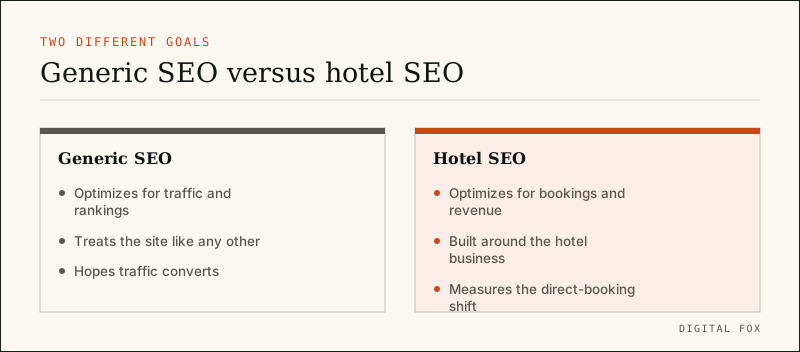
This is also the honest answer to why who does your hotel SEO matters more than what it costs. The differences above mean the gap between hotel-literate SEO and generic SEO is not a matter of polish but of whether the work addresses the actual business at all. Hotel-literate SEO aims at filling perishable inventory profitably by shifting demand direct, within the real constraints of parity, seasonality, and the booking path. Generic SEO aims at traffic and rankings and hopes they convert. The first is doing the job; the second is doing a job, competently, that happens not to be the one the hotel needs, which is why a hotel evaluating help should weigh genuine hospitality understanding far above price, a point that runs through the whole question of choosing a specialist hotel SEO agency.
The deeper point is that specialism here is not about knowing hotel-specific tricks; it is about understanding the business well enough to do SEO that serves it. The best hotel SEO comes from people who understand hospitality, the perishability, the distribution, the economics, the guest, from the inside, and who apply SEO in service of that understanding, rather than applying generic SEO to a business they do not really grasp. That understanding is the difference between SEO that moves the numbers a hotel actually lives and dies by and SEO that moves numbers that look good in a report and change nothing, which is the distinction the rest of this series keeps returning to.
For a hotel weighing who to trust with this, the practical implication is to probe for genuine hospitality understanding rather than general SEO credentials. Does the practitioner talk in terms of bookings, rate, occupancy, and the direct-versus-intermediated balance, or only in terms of traffic and rankings? Do they understand the OTA dynamic, rate parity, the branded-search problem, the demand calendar, and the booking path, or do they treat the hotel as a generic site? The right questions to ask, and the signals that distinguish genuine hotel literacy from generic competence dressed in hospitality language, are the whole subject of the questions to ask a hotel SEO agency. The single most useful test is whether they measure and talk about the business the way a hotelier does, because that is the surest sign they understand it.
Measuring what a hotel actually lives on.
If understanding the hotel is what separates the two kinds of SEO, nowhere does the separation show more plainly than in what each one counts as success.
The differences converge on a final one that a generalist rarely gets right: what you measure. Because a hotel's success is bookings and revenue against perishable, seasonal, intermediated demand, measuring hotel SEO well is itself a hotel-specific discipline, and measuring it like an ordinary site produces numbers that mislead.
An ordinary SEO engagement reports traffic, rankings, and impressions, and for many businesses those are reasonable proxies for progress. For a hotel they are not, because the thing that matters is bookings at good rates in the right patterns, and traffic can rise while bookings do not, rankings can improve on terms that never convert, and impressions can soar on searches that fill no rooms. Measuring a hotel by these proxies produces exactly the healthy-looking-graphs-and-no-improvement pattern this guide opened with, which is why hotel measurement has to reach through to the outcomes that matter, the discipline of how SEO impacts hotel revenue.
Doing that is genuinely hard for hotels specifically, which is part of why it takes hospitality understanding. The bookings happen across a website-to-booking-engine handoff that breaks tracking, through OTA and metasearch layers that obscure attribution, in a world of dark and untrackable traffic, so connecting SEO to the bookings it produced is a hotel-specific measurement problem, the subject of hotel SEO attribution and dark traffic. A generalist who reports the easy proxies has not measured what a hotel lives on; they have measured what is easy to measure, which for a hotel is often exactly the wrong thing.
The reason this matters here, in a piece about why hotel SEO is different, is that measurement is where all the other differences come home. If you understand perishability, you measure bookings not traffic. If you understand the OTA dynamic, you measure the direct-versus-intermediated shift. If you understand seasonality, you read the numbers against the demand calendar. If you understand the booking path, you measure across the handoff. Measuring a hotel correctly requires understanding everything that makes it a hotel, which is why a practitioner who measures it well is almost certainly a practitioner who understands the business, and one who measures it with generic proxies almost certainly does not.
A worked example: the healthy graphs that meant nothing.
The whole argument lands most clearly on a property that got textbook-correct SEO and no business improvement, because the gap between the two is exactly the gap this guide is about.
Consider a hotel that hired a capable generalist agency and, six months later, had a folder of encouraging reports and a business that had not moved. Organic traffic was up substantially. Rankings had improved across a spread of keywords. Impressions had grown. Every metric the agency reported pointed up and to the right, and the hotel could not understand why its direct bookings, its occupancy in the soft periods, and its commission burden were all essentially unchanged.
The diagnosis was that the agency had done competent ordinary SEO for a business that needed hotel SEO. It had optimized for traffic and rankings, and delivered them, on terms that did not convert to bookings, while the hotel-specific realities went unaddressed. The OTAs still intercepted the property's own branded searches, so the highest-intent guests still booked through intermediaries. The content, published on a generic evergreen cadence, was not aligned with the property's demand calendar and was not ready ahead of the seasons that mattered. The booking path, where conversion actually happened, was a crawlability and tracking problem the agency had never examined. And nothing addressed the direct-versus-intermediated balance, so the commission dependency was exactly where it started. The graphs were real; they simply measured the wrong things.
The correction was to redo the work around the realities that made the property a hotel. Branded search was reclaimed, so the guests searching specifically for the property found it and booked direct rather than through the OTAs. Content was rebuilt around the demand calendar and readied ahead of the seasons and events that drove the property's business. The booking path was fixed so it converted and could be measured, and the free direct-booking channels were captured. Measurement was rebuilt around bookings, revenue, and the direct-versus-intermediated shift rather than traffic and rankings. None of this was more advanced SEO than the generalist had done; it was SEO aimed at the actual business rather than at proxies.
Within a couple of quarters the numbers that mattered began to move, the ones that had been flat under the healthy graphs: direct bookings up, commission burden easing, the soft periods filling, occupancy improving in the patterns the property needed. The traffic graphs did not necessarily look more dramatic than before; some vanity metrics even mattered less in the new reporting. But the business improved, because the SEO was finally built around what a hotel is, rather than around what is easy to optimize and easy to report. The difference between the two engagements was not skill or effort. It was understanding the hotel.
What not to do.
The mistakes below are really a single mistake in different guises: doing SEO to a hotel as though it were an ordinary website. Named individually, they are easier to catch.
- Do not optimize a hotel for traffic and rankings. Perishable inventory makes bookings and revenue the only metrics that matter, and traffic that does not convert before the inventory perishes is worthless. Optimize for what actually fills rooms profitably.
- Do not ignore the OTA dynamic. Your distributors are your search competitors, and much of hotel SEO is about the direct-versus-intermediated balance. A practitioner who treats a hotel like any other site misses the actual game.
- Do not advise competing on public price. Rate parity constrains what a hotel can publicly offer, and generic price-competition advice can be impossible to follow or risk distribution agreements. Compete on the value of booking direct instead.
- Do not assume branded search is an easy win. Hotels are intercepted by intermediaries on their own names at peak intent. Owning branded search is a central, winnable hotel SEO battle, not a solved problem.
- Do not treat a hotel as a steady-demand business. Extreme seasonality makes timing and demand-shaping central. Content and visibility must anticipate the property's demand calendar, not run on a generic evergreen cadence.
- Do not ignore the booking path. The hotel booking transaction is unusually complex, and the booking engine where conversion happens is often a crawlability, experience, and tracking problem a generalist never looks for.
- Do not mistake generic competence for hotel expertise. Skilled generic SEO is necessary but not sufficient. A hotel needs a practitioner who understands the hospitality business, because that understanding is what makes the SEO serve the property.
Frequently asked questions.
The questions below come up whenever a hotelier starts to suspect that generic SEO has been missing the point of their business.
Is hotel SEO really that different from regular SEO?
Yes, structurally, not just cosmetically. Hotels sell a perishable product that is destroyed nightly, distribute through intermediaries who also outrank them in search, operate under rate agreements that constrain public pricing, get intercepted on their own branded searches at peak intent, face extreme seasonality that makes timing central, and convert through an unusually complex booking path. None of these is a minor variation on ordinary SEO; each changes what good SEO means. The technical fundamentals transfer, but they are necessary rather than sufficient, because a hotel additionally needs a practitioner who understands these realities and optimizes for filling perishable inventory profitably by shifting demand direct, which generic SEO expertise does not provide.
Why do the differences matter for who I hire?
Because a genuinely skilled generalist can do textbook-correct SEO and still fail a hotel, since the skills that transfer are only half the job. The other half is understanding the hospitality business well enough to aim the SEO at what the property actually needs: bookings over vanity metrics, direct over intermediated, visibility within parity constraints, ownership of branded search, alignment with the demand calendar, and a working booking path. That understanding comes from hospitality specialism, not generic SEO competence. So the gap between hotel-literate and generic SEO is not about polish; it is about whether the work addresses the real business at all, which is why who does your hotel SEO matters more than what it costs.
Can a generalist SEO agency do a good job for a hotel?
They can do competent work on the parts that transfer, the technical fundamentals, the content, the links, and that is not nothing. But they are likely to optimize for the wrong goal, traffic and rankings rather than bookings and revenue, and to miss the hotel-specific problems entirely: the OTA dynamic, the rate-parity constraints, the branded-search interception, the seasonality, the booking-path complexity. The result is often the pattern this guide opened with: healthy-looking graphs and no improvement in the numbers the hotel actually lives on. A generalist may deliver activity and reports; whether they deliver the outcome a hotel needs depends on whether they understand the business, which is exactly what a specialist brings.
What does perishable inventory have to do with SEO?
Everything, because it reframes the goal. An unsold room-night is worth zero the next day, permanently, so the entire commercial imperative is to fill the right rooms at the right rate before that nightly deadline. This makes bookings, revenue, conversion, and timing the metrics that matter and makes traffic and rankings misleading proxies, since traffic that does not convert before the inventory perishes is worthless. It also makes demand-shaping central, filling the nights that would otherwise go empty, at protective rates, in the right patterns. A practitioner who does not grasp that the product is destroyed nightly optimizes for a version of success that does not fill rooms, which is the version generic SEO defaults to.
Why are the OTAs described as both distributors and competitors?
Because they are literally both, which is unusual and strategically decisive. A hotel pays the OTAs commission to distribute its rooms, and simultaneously competes against those same OTAs in search, where their vast domain authority lets them outrank the hotel, often using the hotel's own content, even for the hotel's own name. Your distributor is your competitor. This means much of hotel SEO is about the direct-versus-intermediated balance, shifting bookings from commission-bearing channels to direct ones and reclaiming the guests the OTAs intercept, which requires understanding the OTA economics and dynamics. A generalist who does not grasp this dual role misses the actual strategic game a hotel is playing.
How does seasonality change hotel SEO specifically?
It makes timing and demand-shaping central rather than incidental. Hotel demand often swings violently, high seasons and dead seasons, sold-out weekends and empty midweeks, demand tied to events and weather, and this is the defining shape of the business, not a minor modifier. So hotel SEO has to anticipate and serve demand that varies enormously: being visible for high-season searches before the high season, building content for demand-driving events and periods in advance, and working deliberately to fill the low periods. The strategic priority shifts across the year, defending rate in peaks, driving volume in troughs, and SEO has to serve whichever the property needs when. A generalist optimizing for steady traffic does not do this.
Does this mean hotel SEO needs special technical skills too?
It needs the technical fundamentals applied to hotel-specific problems, especially the booking path. A hotel booking is a complex transaction, date selection, changing availability, variable rates, room options, and a booking engine that is often a separate system from the website, and this introduces problems generic SEO rarely faces: booking engines search engines cannot crawl, rate and availability content outside the indexable site, a website-to-booking-engine handoff that breaks experience and tracking, and attribution across that handoff and through the OTA and metasearch layers. So the skills are the familiar technical ones, but pointed at hotel-specific challenges a generalist is unlikely to even look for, because ordinary sites do not have them.
If a generalist has been doing your hotel's SEO and the graphs look healthy while the bookings do not, the gap is almost always that the work is not built around the realities that make a hotel a hotel. Diagnosing that, and doing SEO that actually serves a perishable, intermediated, seasonal, direct-booking business, is the whole of what a specialist hotel SEO agency does. You can see the approach on the services page, or reach us at inquiries@digitalfoxllc.com. Hotel SEO is not ordinary SEO. It should not be done as though it were.